
5 Proven Rapid MVP Development Services for Startups
In the modern software industry, the graveyard of failed startups is filled with brilliant founders who made one fatal mistake: they fell in love with their code instead of their customers.
When a startup team or an enterprise division identifies a lucrative gap in the market, the natural instinct is to retreat into “stealth mode.” They spend six to twelve months, and hundreds of thousands of dollars, quietly building the “perfect” application. They obsess over secondary features, intricate animations, and theoretical scaling problems.
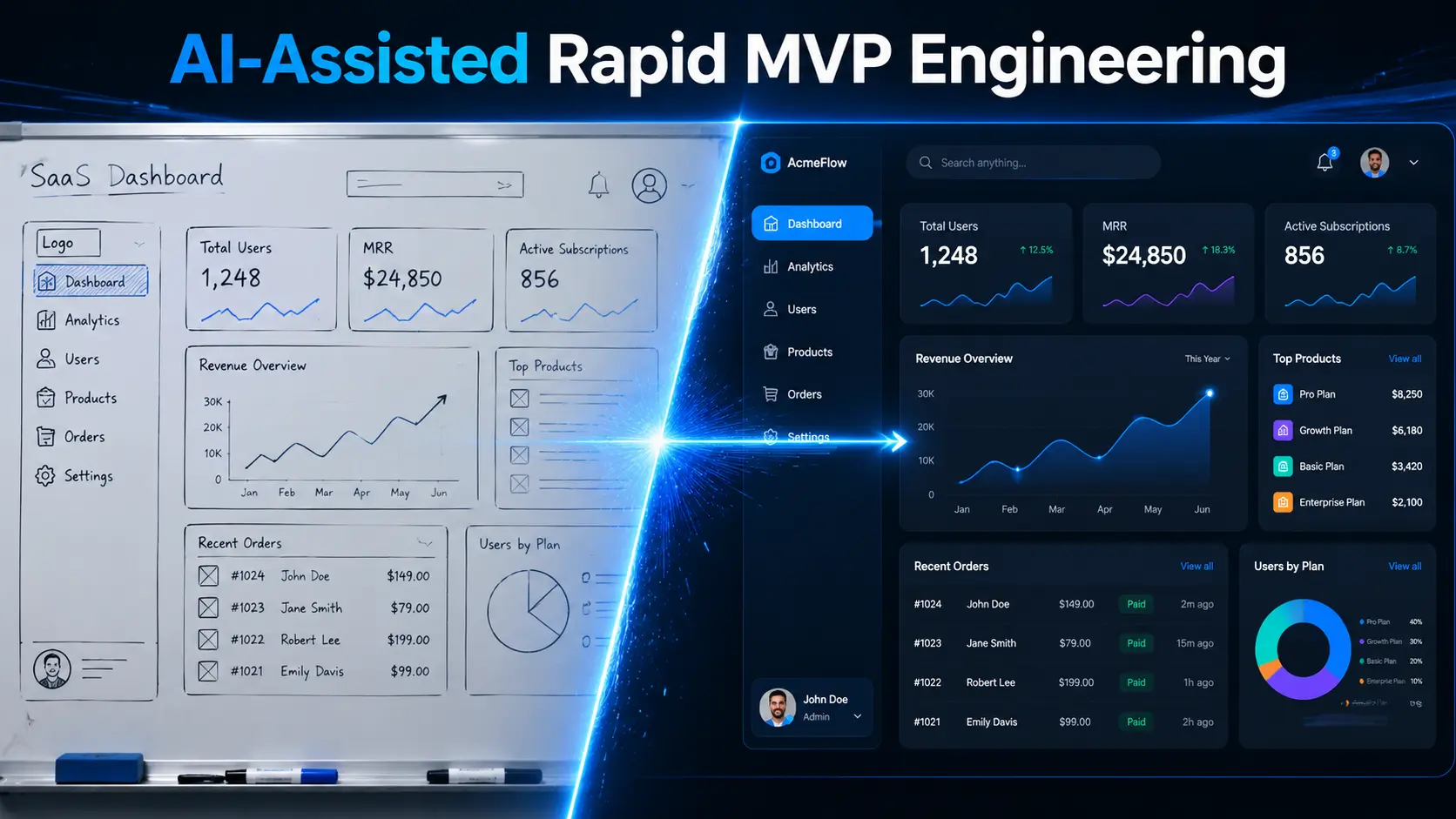
Rapid MVP Development Services: Launch in Weeks, Not Months
The most expensive mistake a software founder can make is spending a year building something nobody asked for.
It happens more often than most people admit. A founder identifies a real problem, gets excited about the solution, retreats into development mode, and emerges eight to twelve months later with a fully featured product — only to discover that the market has shifted, a competitor has already launched, or the core assumption the product was built on does not hold up when real users interact with it.
The problem is not the idea. The problem is the timeline. Twelve months of development without user feedback is twelve months of building on untested assumptions. Every feature added before a single paying customer has validated the core concept is a feature that might need to be thrown away.
Rapid MVP development services exist to compress that timeline. Instead of building the complete product before showing it to anyone, you build the smallest version that lets real users validate the core idea — and you do it fast enough that the feedback can actually shape what you build next.
At MarkupMarvel, we use AI-assisted engineering workflows to deliver functional, market-ready web applications in 4 to 8 weeks. Not prototypes. Not clickable mockups. Working software with real authentication, real data persistence, and a real user interface — built on the same frameworks that scale to millions of users when the time comes.
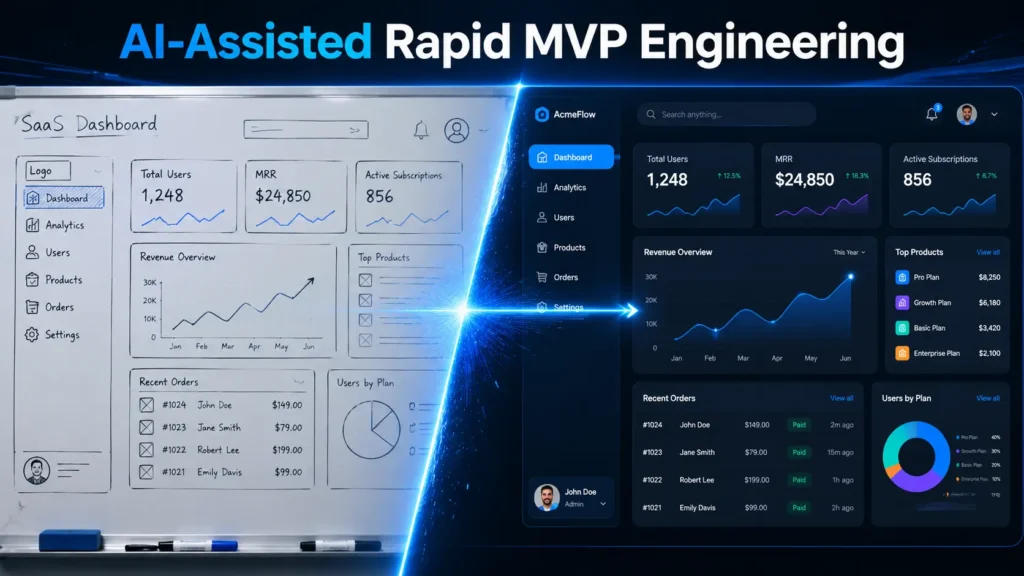
1. Why Traditional Development Timelines Kill Startups
Traditional software agencies are not built for startup speed. They are built for enterprise projects with defined requirements, extended scoping phases, and billing models that reward thoroughness over velocity.
When a startup engages a legacy development agency, the first several weeks disappear into discovery workshops, architecture debates, and infrastructure setup before a single line of product code is written. By the time a working prototype exists, three months and a significant portion of the runway are gone.
This creates three specific problems that our rapid MVP development services are designed to solve.
Momentum loss
Startups run on energy. The window between a validated idea and a working product is where that energy either compounds into something real or dissipates into meetings and status updates. When a development cycle stretches to eight or twelve months, early supporters lose interest, market conditions shift, and the founding team’s conviction — which is the actual engine of an early-stage company — starts to erode.
Speed is not just an efficiency concern. It is a morale and momentum concern. Getting working software in front of users quickly creates a feedback loop that sustains the energy needed to build something great.
Feature creep without validation
Without the discipline of an MVP model, development teams build in a vacuum. They add a notification system because it seemed useful. They build a social sharing feature because a competitor has one. They implement a reporting dashboard before anyone has asked for reports.
Every feature built before validation is a bet placed without evidence. Some of those bets pay off. Most do not. And each one extends the timeline and consumes budget that could have gone toward finding out whether the core product works.
Market irrelevance
Technology moves fast. A concept that is genuinely differentiated today may be table stakes in twelve months. Rapid MVP development services reduce the risk of building something that was relevant when the project started and ordinary by the time it launches.
2. What AI-Assisted MVP Engineering Actually Looks Like
The phrase “AI-assisted development” gets used loosely, so it is worth being specific about what it means in practice and what it does not mean.
It does not mean using an AI tool to generate the entire application. Automated code generation without senior engineering oversight produces messy, insecure, unmaintainable output. That is not what we do.
What it does mean is using AI-powered development environments — Cursor and GitHub Copilot are the primary tools — to automate the parts of software development that are repetitive and well-defined, so that our senior engineers can spend their time on the parts that require actual judgment.
What AI handles in our rapid MVP development services:
Setting up authentication flows, database schemas, API route scaffolding, standard CRUD operations, form validation logic, and other boilerplate infrastructure that follows predictable patterns. These are tasks that would take a developer days to write carefully from scratch. With AI assistance, they take hours — and they are reviewed and validated by a senior engineer before anything moves to staging.
What our engineers handle:
Your specific business logic. The features that make your product different from every other tool in the category. The data models that reflect how your customers actually think about the problem. The user flows that need to feel effortless. The edge cases that only become visible when you understand the domain deeply.
The AI handles the scaffolding. Our engineers build the product.
According to GitHub’s research on Copilot productivity, developers using AI-assisted coding tools complete tasks up to 55% faster than those working without them — a productivity gain that translates directly into shorter timelines for our clients.
3. Ruthless Feature Prioritization Before Any Code Is Written
The most important part of our rapid MVP development services happens before development starts.
Every founder arrives with a feature list. Some arrive with a detailed product requirements document. Almost all of them have built more into the initial concept than the MVP actually needs.
We run a technical discovery sprint — typically one to two days — where we work through the product concept with your founding team and apply a single filter to every proposed feature: does this directly validate the core business hypothesis?
If a feature does not help you answer the question “will people pay for this, and does our solution actually solve the problem?” — it goes into the Phase 2 backlog. It is documented, prioritized, and ready to build when the MVP has validated the core concept. But it does not block the launch.
This process is uncomfortable for founders who have spent months thinking about their product. It requires letting go of features that feel important. But it is the single most effective thing we do to compress timelines and reduce the risk of building the wrong product.
A typical rapid MVP development services engagement starts with 40 to 60 proposed features and launches with 8 to 12. The other 30 to 50 get built — but only after real users have confirmed they want them.
4. Why No-Code Platforms Are the Wrong Foundation for a Real Product
When founders want to move fast, no-code platforms like Bubble, Glide, or Webflow look attractive. They promise working software without engineering costs. For a personal project or an internal tool with low stakes, they can work fine.
For a startup that intends to raise funding, acquire customers at scale, or build a defensible technical product, they create problems that are expensive to fix later.
You do not own the code
No-code platforms generate proprietary output. If the platform changes its pricing, gets acquired, or shuts down, your product is at risk. When investors conduct technical due diligence, they will ask about the codebase. “It runs on Bubble” is not the answer that builds confidence.
You cannot customize the backend
Every no-code platform has a ceiling. When your product needs a data structure, a workflow, or an integration that the platform was not designed for, you hit that ceiling. At that point, you are either working around the platform’s limitations — which creates technical debt — or rebuilding from scratch in real code.
They do not scale under real load
No-code platforms are shared infrastructure. When your product gets traction and user volume increases, performance degrades in ways you cannot control. You are dependent on the platform’s infrastructure decisions, not your own.
Our rapid MVP development services build on React, Next.js, Node.js, and Laravel — the same frameworks that power products at any scale. When your MVP validates the market and you are ready to grow, the foundation you built on grows with you. There is no rebuild, no platform migration, no throwing away the work that got you to product-market fit.
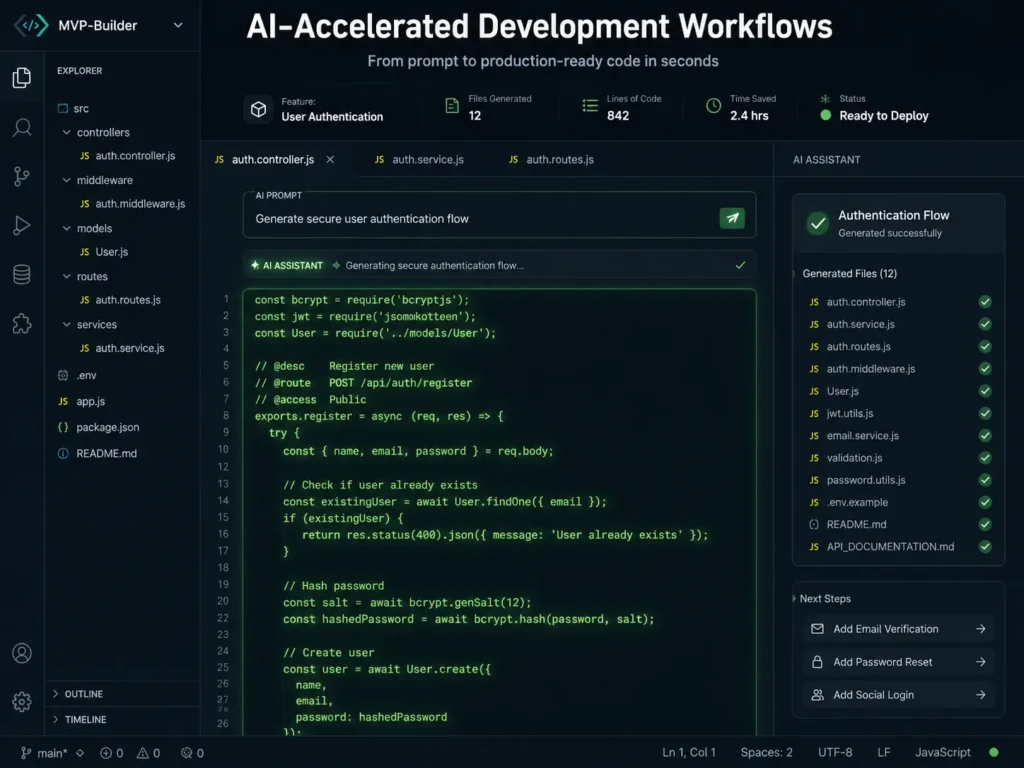
5. What a Market-Ready MVP Actually Looks Like
There is a common misconception that rapid MVP development services produce rough, unfinished software that users are expected to tolerate in exchange for early access pricing. That is not what a well-built MVP is.
A well-built MVP is a complete product for the use case it targets. It does not have every feature. But the features it does have work correctly, look professional, and instill enough trust that users are willing to pay for them.
This matters for a specific reason: if your MVP looks broken or untrustworthy, user feedback is contaminated. When a user abandons your product, you cannot tell whether they left because the core concept did not resonate or because the interface was too confusing to use. The design and the user experience need to be good enough that they are not the reason people leave.
Every rapid MVP we build includes:
A conversion-optimized user interface designed from Figma files or built from design principles our team applies. Fully responsive layout that works on desktop and mobile without degradation. Secure authentication with proper session management, password handling, and role-based access where the product requires it. A clean, intuitive onboarding flow that gets users to the core value of the product as quickly as possible. Performance that does not embarrass you when a potential investor or customer opens the product for the first time.
The goal is software that looks like it was built by a well-funded team, launched at a fraction of the time and cost.
6. From MVP to Scale: The Phase 2 Transition
One of the most important questions a founder should ask any development partner before signing is: what happens after the MVP?
If the answer is a new contract, a new scoping process, and effectively starting over — that is a problem. The transition from MVP to a scaled product should be an extension of the same codebase, the same architecture, and the same development relationship. Not a rebuild.
Because our rapid MVP development services use production-grade frameworks and modular code architecture from the start, the transition to Phase 2 is straightforward. The backlog features that were deferred during the MVP phase get built on top of the existing foundation. The database schema gets extended. The infrastructure gets scaled.
We also bring validated user feedback into the Phase 2 planning process. What users actually used, what they ignored, what they asked for that was not there — this data shapes the Phase 2 roadmap in ways that a pre-launch product plan never can.
Founders who have gone through a successful MVP validation process consistently make better product decisions in Phase 2 than founders who tried to build the complete product from the beginning. The validation process changes what you build, and it changes it for the better.
7. Investor-Ready Output from Day One
For founders raising a pre-seed or seed round, the MVP serves a dual purpose. It validates the market, and it demonstrates technical credibility to investors.
Investors evaluating early-stage software companies look at a few things: does the product work, is the code quality defensible, is the architecture scalable, and does the team understand what they built? Our rapid MVP development services are designed to produce a positive answer to all four questions.
The codebase is documented and organized in a way that technical due diligence can move quickly. The architecture decisions are explainable and reflect standard industry practice. The security implementation covers the basics that sophisticated investors check: authentication, data encryption, input validation, and access control.
We also deliver a technical architecture document alongside the MVP that explains the stack choices, the data model, the API structure, and the scaling path. This is useful for investor conversations and for onboarding any internal engineering hires the founder makes post-funding.
Frequently Asked Questions
Q: How fast can you actually deliver a working product through your rapid MVP development services?
For a focused MVP with a well-defined core feature set, 4 to 8 weeks is a realistic timeline. Complex business logic, multi-system integrations, or scope that was not tightly defined during discovery can extend this. We provide a specific timeline estimate during the discovery sprint before any development begins.
Q: Do we own the source code?
Yes — fully. Upon project completion and final payment, your company holds 100% intellectual property rights to the codebase. You receive full access to the GitHub repository and can take the code to any development team for future work.
Q: What happens after the MVP launches?
We continue as your technical partner. We help you analyze early user behavior, prioritize the Phase 2 feature backlog based on what the data shows, and scale the infrastructure as user volume grows. The relationship does not end at launch.
Q: Can you build a mobile MVP as well as a web application?
We prioritize Progressive Web Apps and responsive web applications for MVP launches — they reach both iOS and Android users without the App Store approval delay and get you to user feedback faster. If your core use case genuinely requires native mobile hardware access, we can build on React Native. We make this recommendation based on your specific product requirements.
Q: Is AI-assisted code secure and production-ready?
Yes. Every line of code generated with AI assistance is reviewed by a senior engineer before it moves to staging. We implement authentication, input sanitization, data encryption, and access control to enterprise standards. The AI accelerates the scaffolding work — the security review is still done by humans.
Q: What if our idea changes significantly after talking to early users?
That is the point of an MVP. Early user feedback frequently changes the product direction, sometimes significantly. Because we build on modular, clean code, pivoting specific features or flows is a controlled process rather than a full rebuild. The validation process is designed to surface these changes early, when they are still affordable to act on.
The Market Does Not Wait for Perfect Software
The founders who win are not the ones who built the most complete product. They are the ones who got to market first, learned the fastest, and adapted most effectively to what users actually needed.
Rapid MVP development services are how you compress the time between idea and evidence. Eight weeks to a working product that real users can pay for is not a shortcut — it is a strategy.
MarkupMarvel builds rapid MVP development services for founders who understand that speed is a competitive advantage.



