
Multi-Vendor Marketplace Development: 7 Proven Strategies
The traditional, single-seller e-commerce model is rapidly evolving. If you look at the most lucrative, resilient, and scalable digital businesses of the last decade, they all share one specific trait: they are platforms that connect buyers directly with independent sellers.
Industry titans like Amazon, Etsy, Airbnb, Uber, and Fiverr don’t actually own the inventory they sell, nor do they manufacture the products. Instead, they own the digital infrastructure. They collect a toll on every single transaction that passes through their gates. It is the ultimate digital business model.
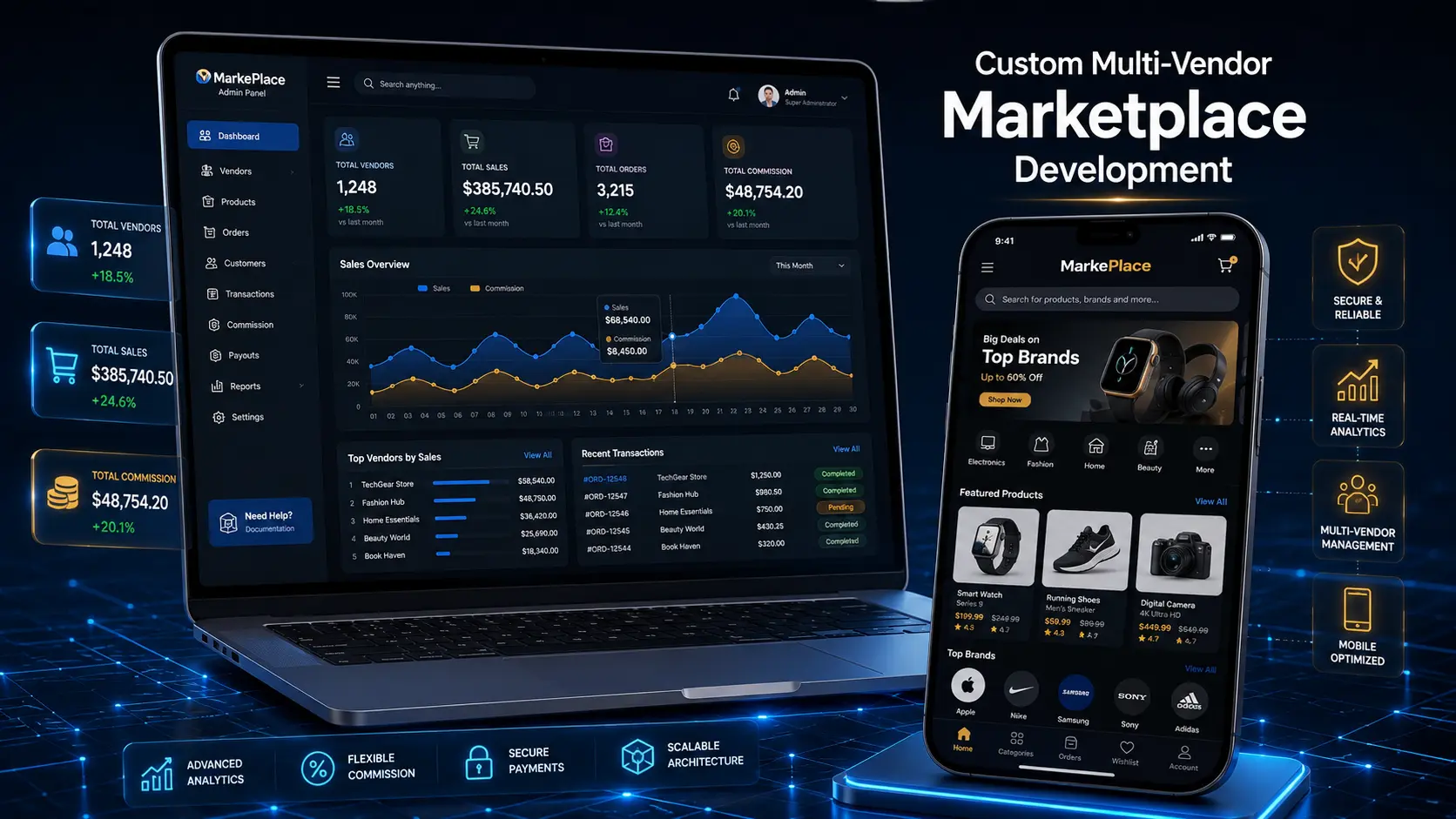
Multi-Vendor Marketplace Development: 7 Smart Features
The most valuable digital businesses of the past decade share a structural characteristic that most people notice but rarely think about carefully.
Amazon does not manufacture most of the products it sells. Etsy does not make the handmade goods on its platform. Airbnb does not own the properties listed on its site. Uber does not employ most of its drivers. What these companies own is the infrastructure that connects buyers and sellers — and they collect a fee on every transaction that passes through it.
This is the marketplace model. And while the business logic is straightforward, the engineering required to execute it properly is not.
Multi-vendor marketplace development is significantly more complex than building a standard e-commerce store. A single-seller store has one inventory, one shipping configuration, one payout destination. A marketplace has hundreds or thousands of each — all operating simultaneously under one platform, managed through separate vendor accounts, and presenting a unified experience to buyers who should never have to think about the complexity behind what they are purchasing.
When this engineering is done on a foundation of WordPress plugins and off-the-shelf templates, the cracks appear quickly. Split payments do not route correctly. Vendor dashboards are too limited for real sellers to use. Search performance degrades as the product catalog grows. The architecture that was fast enough for 50 vendors starts showing strain at 500.
At MarkupMarvel, our multi-vendor marketplace development work starts with custom architecture — not plugins patched together to approximate marketplace behavior, but systems engineered specifically for how a multi-vendor platform actually needs to work.
1. Why Marketplace Logic Is Fundamentally Different from E-Commerce
Understanding why multi-vendor marketplace development requires a different architectural approach than standard e-commerce is the starting point for understanding why plugin-based solutions consistently fall short.
A standard e-commerce store has one seller. One inventory to manage. One set of shipping rules. One bank account to receive payments. The complexity is in the products and the customer experience — the underlying architecture is relatively linear.
A marketplace has all of that complexity multiplied by however many vendors are on the platform — and then layered with the additional complexity of making all of it work seamlessly for a buyer who sees one unified storefront.
The cart and checkout problem
When a buyer adds products from three different vendors to a single cart, what happens at checkout? The system needs to calculate separate shipping costs for each vendor’s products based on their individual shipping configurations. It needs to apply the correct tax rates for each vendor’s location. It needs to process one unified payment from the buyer and route the funds correctly to each vendor minus the platform’s commission — all in a single transaction that completes in seconds.
Standard e-commerce logic is not built for this. It assumes one seller, one shipping calculation, one payout destination. Multi-vendor marketplace development requires building this split-cart logic from the ground up.
The database performance problem
A marketplace with 500 vendors and 100 products each has 50,000 product listings. With 1,000 vendors, it has 100,000. As concurrent users apply filters, search queries, and browse category pages, the database load is orders of magnitude higher than a single-seller store.
Without proper indexing, caching, and query optimization built into the architecture, performance degrades as the platform grows — exactly the wrong direction for a marketplace that needs to attract and retain both vendors and buyers.
According to Stripe’s marketplace documentation, building a compliant multi-party payment system requires careful architecture around fund routing, vendor identity verification, and regulatory compliance — all of which need to be designed into the platform from the beginning, not added later.
2. Vendor Dashboard and Self-Service Architecture
The operational sustainability of a marketplace depends on vendor autonomy. If every inventory update, price change, or payout request requires your support team’s involvement, you cannot scale beyond a small number of vendors without drowning in administrative overhead.
We build vendor portals that give sellers everything they need to run their part of the marketplace independently, without accessing or affecting any other part of the platform.
What vendors can do in their portal:
Upload and manage products — individual listings, variants, images, descriptions, pricing, and inventory levels — through a clean, intuitive interface that does not require technical knowledge. Configure their own shipping rules, including carrier integrations, flat-rate options, and free shipping thresholds. View and fulfill incoming orders, print shipping labels, and communicate with buyers through an integrated messaging system. Access real-time revenue analytics — daily sales, conversion rates, top-performing products, and payout history. Request payouts or configure automatic payout schedules based on their connected bank account or digital wallet.
This self-service architecture means a marketplace with 1,000 vendors does not require 1,000 support interactions per day. Vendors manage themselves. Your team focuses on platform growth, not operational maintenance.
3. Master Admin Dashboard and Platform Controls
Alongside the vendor portal, every multi-vendor marketplace development project we build includes a master admin dashboard that gives the platform operator complete visibility and control over the entire ecosystem.
The admin view is not a vendor dashboard with extra permissions. It is a purpose-built operational interface for managing a platform with many moving parts.
What the admin dashboard provides:
Real-time GMV (Gross Merchandise Value) tracking — total transaction volume, platform commission revenue, vendor activity, and buyer behavior — all in one view. Vendor management — approval workflows for new vendor applications, performance monitoring, suspension controls, and commission tier assignment. Product moderation — the ability to review, approve, reject, or remove any product listing on the platform for quality control and policy compliance. Dispute resolution tools — access to the full communication and transaction history for any buyer-seller dispute, with the ability to issue refunds, release held funds, or escalate cases. Platform configuration — global tax settings, shipping zone management, commission structure adjustments, and feature flag controls for rolling out new functionality.
4. Automated Commission and Split Payment Architecture
The payment layer is the operational backbone of multi-vendor marketplace development, and it is where the most significant technical complexity lives.
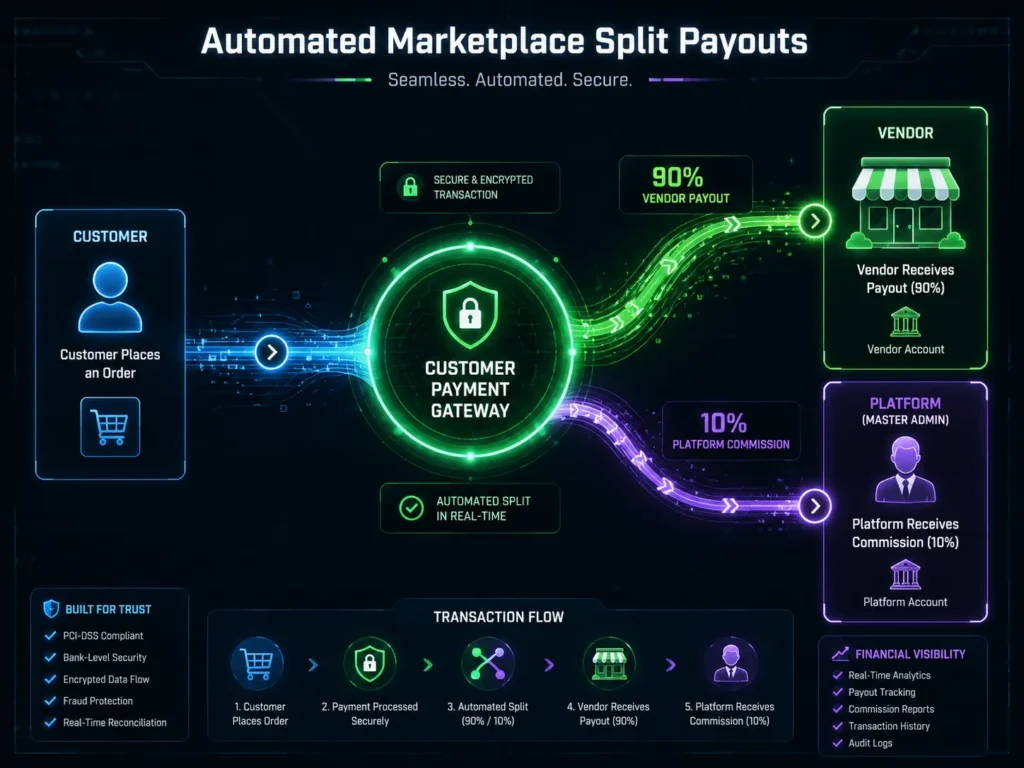
When a buyer completes a purchase, the platform needs to do several things simultaneously: capture the full payment, calculate the platform commission, route the net amount to the correct vendor, handle tax collection where applicable, and maintain a complete audit trail for every fund movement. This needs to happen reliably, at scale, in compliance with financial regulations, and without any manual intervention.
We build this payment infrastructure using Stripe Connect — the industry-standard API for multi-party marketplace payments.
How Stripe Connect works in our multi-vendor marketplace development:
Each vendor completes a Stripe Connect onboarding flow that collects the KYC (Know Your Customer) information required for financial compliance — identity verification, bank account details, tax information. This happens within your platform but is handled by Stripe, which means the regulatory burden of vendor identity verification sits with the payment processor rather than with you.
When a transaction is processed, the split happens automatically at the payment level. The platform commission routes to your Stripe account. The vendor’s net amount routes to their connected Stripe account. The buyer sees one charge. The accounting is clean and auditable. End-of-year tax documentation for vendors is handled by Stripe’s built-in reporting.
We also build the commission configuration layer — allowing you to set flat-rate transaction fees, percentage commissions, tiered rates based on vendor subscription level, or any combination of these — and expose it through the admin dashboard so rates can be adjusted without code changes.
5. Search, Performance, and Infrastructure at Scale
A marketplace that is slow loses vendors before it loses buyers. Vendors evaluate platforms partly on performance — a slow search experience means fewer sales, which means they will list on a platform that converts better.
Search is the most performance-critical feature in most marketplace architectures. Buyers searching across a catalog of 50,000 or 500,000 products need results in under a second, with accurate filtering by category, price range, location, vendor, and product attributes. Standard database queries do not handle this at scale. We integrate Elasticsearch for search functionality in larger marketplace builds — a purpose-built search engine that handles complex, faceted queries across large datasets with consistently fast response times regardless of catalog size.
For page rendering performance, we use server-side caching with Redis to serve frequently accessed pages — category listings, popular product pages, search results for common queries — from memory rather than regenerating them on every request. This dramatically reduces database load during traffic spikes and keeps page load times consistent under pressure.
Infrastructure is deployed on AWS or Google Cloud with horizontal scaling configured — additional server capacity spins up automatically when traffic increases, and scales back down when it drops. The platform handles seasonal spikes and viral traffic events without manual intervention and without performance degradation.
6. Multi-Vendor Marketplace Development Security and Fraud Prevention
A marketplace is a more attractive target for fraud than a single-seller store because it has more attack surfaces: vendor accounts that could be compromised, payment flows that could be manipulated, product listings that could be used to deceive buyers, and buyer accounts that could be used for fraudulent transactions.
We build fraud prevention into the architecture at multiple layers.
Vendor verification and onboarding controls
New vendor applications go through an approval workflow before they can list products or receive payments. Identity verification is handled through Stripe Connect’s KYC process. Admins can configure automated screening rules and manual review requirements based on product category or account risk signals.
Payment security
All payment processing is PCI-DSS compliant through Stripe. Card data never touches your servers — it is tokenized at the point of entry by Stripe’s hosted payment fields. Disputes and chargebacks are managed through the Stripe dashboard with full transaction history available for evidence submission.
Platform security
Standard application security practices are implemented throughout: input validation and sanitization to prevent injection attacks, CSRF protection on all state-changing requests, rate limiting on authentication endpoints to prevent brute force attacks, and proper access control to ensure vendors can only access their own data and admins can access everything.
For marketplaces handling high transaction volumes or operating in regulated industries, we also integrate third-party fraud detection tools that analyze transaction patterns and flag anomalies for review before funds are released.
7. Monetization Models and Custom Business Logic
One of the advantages of custom multi-vendor marketplace development over template solutions is the ability to implement exactly the monetization model your business requires — not the one the plugin was designed for.
Transaction commission
The most common marketplace monetization model: the platform takes a percentage of every sale. Commission rates can be flat across the platform, tiered by product category, or configured per vendor based on their subscription tier or negotiated rates.
Vendor subscription fees
Vendors pay a monthly or annual fee to list on the platform, independent of transaction volume. This model provides predictable platform revenue and is common in B2B marketplaces and niche vertical platforms where vendor access has clear value.
Hybrid models
A subscription fee for platform access combined with a reduced transaction commission. Premium vendor tiers with higher visibility, lower commission rates, and additional dashboard features. Listing fees for featured placement. Advertising revenue from promoted listings. We build the business logic to support any combination of these — all configurable through the admin dashboard without code changes.
Custom buyer features
Buyer-side monetization options include premium membership tiers with benefits like reduced fees, early access to new listings, or enhanced buyer protection. Escrow services for high-value transactions. Subscription boxes or recurring purchase programs for specific marketplace verticals.
The business model is a configuration question, not an architecture question — as long as the architecture was built to support it.
Frequently Asked Questions
Q: Can you build a marketplace similar to Etsy, Airbnb, or a food delivery platform?
Yes. The underlying architecture of a marketplace — connecting buyers to sellers, routing payments, managing accounts — applies across product types and business models. Whether you are building a physical goods marketplace, a service booking platform, a rental marketplace, or a digital download hub, the core engineering approach is the same. The specific features are tailored to your model.
Q: How do vendor payouts work — do we process them manually?
No. We integrate Stripe Connect to automate the entire payout process. When a transaction is completed, the commission splits and routes automatically. Vendors receive their earnings according to the payout schedule configured in their account — no manual processing required on your end.
Q: How does the platform handle a cart with products from multiple vendors?
We build split-cart fulfillment logic that handles multi-vendor orders as separate sub-orders internally while presenting a unified checkout to the buyer. Each vendor receives their own order notification and fulfillment workflow. Shipping is calculated per vendor based on their individual configuration.
Q: Will the platform handle high traffic and large product catalogs without performance issues?
Yes. We use Elasticsearch for search, Redis for caching, and cloud infrastructure with auto-scaling for traffic spikes. The architecture is designed for growth — it performs well at launch and continues to perform well as vendor count and product catalog size increase.
Q: Can vendors have different commission rates?
Yes. Commission structures are fully configurable — flat rates, percentage-based rates, tiered rates by vendor subscription level, or category-specific rates. All of this is manageable through the admin dashboard.
Q: How long does multi-vendor marketplace development take?
A marketplace with core functionality — vendor onboarding, product listings, split payments, admin dashboard — typically takes 14 to 20 weeks. Larger platforms with advanced search, custom mobile applications, and complex business logic run 24 to 32 weeks. We provide a detailed timeline during the scoping phase.
Build the Platform, Not Just the Store
Single-seller e-commerce is a competitive market. Marketplace ownership is a different position entirely — you collect revenue on every transaction without managing the inventory, fulfillment, or customer relationships yourself.
Getting there requires multi-vendor marketplace development done properly. The architecture needs to handle split payments, vendor autonomy, and scale from the start — not as features bolted on after launch.
MarkupMarvel builds multi-vendor marketplace development platforms for founders ready to own the infrastructure.



