
Custom Blockchain Development Services: Secure Web3 Now
For the better part of a decade, the business conversation surrounding blockchain technology has been completely hijacked. It has been overshadowed by the wild volatility of cryptocurrency markets, speculative trading, and digital art fads. Because of this noise, a massive percentage of serious business owners and corporate executives simply tuned the technology out.
However, forward-thinking enterprises, supply chain giants, and global B2B organizations are looking strictly past the consumer hype. They are recognizing blockchain for what it fundamentally is beneath the surface: the most secure, transparent, and mathematically immutable database architecture ever engineered by human beings.
Custom Blockchain Development Services: Secure Web3 Now
Most business owners hear “blockchain” and immediately think cryptocurrency. That association has been so thoroughly reinforced over the past decade that the actual enterprise utility of the technology gets lost in the noise of market speculation and digital collectibles.
That is a problem worth correcting, because the businesses quietly investing in custom blockchain development services right now are not doing it to speculate on token prices. They are doing it to solve problems that centralized database architecture genuinely cannot solve well.
How do you create a shared, tamper-proof record between multiple organizations that do not fully trust each other? How do you automate a complex multi-party agreement without paying lawyers and intermediaries to enforce it? How do you prove to a regulator, an auditor, or a customer that a piece of data has never been altered since it was first recorded?
These are infrastructure problems. Blockchain solves them at the architecture level.
At MarkupMarvel, our custom blockchain development services are built for B2B enterprises, supply chain operators, FinTech platforms, and organizations that need the security and transparency of distributed ledger technology applied to real operational problems. Not consumer crypto products. Not speculative token launches. Serious engineering for serious business use cases.
1. What Centralized Databases Cannot Do — and Why It Matters
To understand why organizations invest in custom blockchain development services, you have to start with what traditional database architecture gets wrong in multi-party environments.
Every company in a B2B ecosystem maintains its own isolated database. When a manufacturer ships a product, they record it in their system. When the logistics provider picks it up, they record it in theirs. When the retailer receives it, they record it in theirs. Three separate records, maintained by three separate organizations, with no guaranteed consistency between them.
When those records disagree — and they frequently do — someone has to figure out who is right. That process involves email threads, phone calls, cross-referencing spreadsheets, and in serious disputes, legal involvement. It is expensive, slow, and entirely avoidable.
The single point of failure problem
A centralized database is, by definition, a single target. One successful attack on the administrator credentials, one insider threat with database access, one ransomware deployment — and the entire historical record of an organization is compromised, held hostage, or destroyed. Backups help, but they do not provide an audit trail that proves the data was never altered between backups.
The intermediary cost problem
Moving value, enforcing agreements, and settling transactions across organizational or national boundaries currently requires intermediaries — banks, clearinghouses, brokers, escrow services. Each one adds cost and delay. A cross-border payment that could logically settle in seconds takes three to five business days because of the correspondent banking infrastructure it has to pass through.
Custom blockchain development services address all of these problems at the architectural level, not with another layer of software on top of the same centralized foundation.
According to Gartner’s blockchain research, enterprise blockchain adoption is concentrated in supply chain, financial services, and healthcare — industries where data integrity across organizational boundaries has direct operational and regulatory consequences.
2. How Enterprise Blockchain Actually Works
A blockchain is a distributed ledger. Instead of one organization maintaining the authoritative copy of a dataset, identical copies are held by multiple authorized participants — called nodes — across a network.
Every time new data is added, it is packaged into a block, cryptographically hashed, timestamped, and linked to the previous block. This chain structure means that altering any historical record requires recalculating every subsequent block — and getting the majority of the network’s nodes to accept that recalculation. In practice, this makes past records immutable. The data that was recorded stays recorded.
For B2B applications, this creates a shared, verifiable source of truth that no single party controls and no single party can manipulate unilaterally. When the manufacturer, the logistics provider, and the retailer are all reading from the same distributed ledger, disputes about what happened and when become resolvable in seconds rather than weeks.
This is the operational value proposition of custom blockchain development services — not a technology bet on the future, but a structural solution to a coordination problem that costs real money today.
3. Smart Contract Engineering: Automating Agreement Execution
Smart contracts are the feature of blockchain architecture that delivers the most direct operational value for enterprise use cases, and they are a core part of every custom blockchain development services engagement we take on.
A smart contract is a self-executing program deployed permanently on the blockchain. It encodes the terms of an agreement in code, and when the defined conditions are met, it executes automatically — without requiring a human intermediary to verify, approve, or process anything.
A practical example: a supply chain payment agreement encoded as a smart contract might say — when the IoT sensor at the receiving warehouse confirms that Shipment A has arrived and the verified weight matches the purchase order within the specified tolerance, release the escrowed payment to the supplier. No invoice. No accounts payable process. No bank transfer delay. The condition is met, the code executes, the payment settles.
How we build smart contracts in our custom blockchain development services:
We write smart contracts primarily in Solidity for Ethereum-compatible chains, and in Go or Rust for Hyperledger and Solana deployments depending on the network requirements. Before any contract is deployed to a live network, it goes through extensive testing on a testnet environment — automated test suites, manual logic review, and security auditing specifically targeting common vulnerability patterns including reentrancy attacks, integer overflow, and access control failures.
Smart contracts are immutable once deployed. A logic error on the mainnet cannot be patched the way a bug in a traditional application can be. This makes the pre-deployment audit process the most critical phase of smart contract engineering, and we treat it accordingly.
4. Decentralized Application (dApp) Development
Blockchain infrastructure without a usable interface is not a product — it is a backend. The people who need to interact with your blockchain system — warehouse staff, procurement teams, financial controllers, end customers — are not going to work with command-line interfaces or raw transaction hashes.
dApp development is how we make custom blockchain development services accessible to the humans who need to use them.
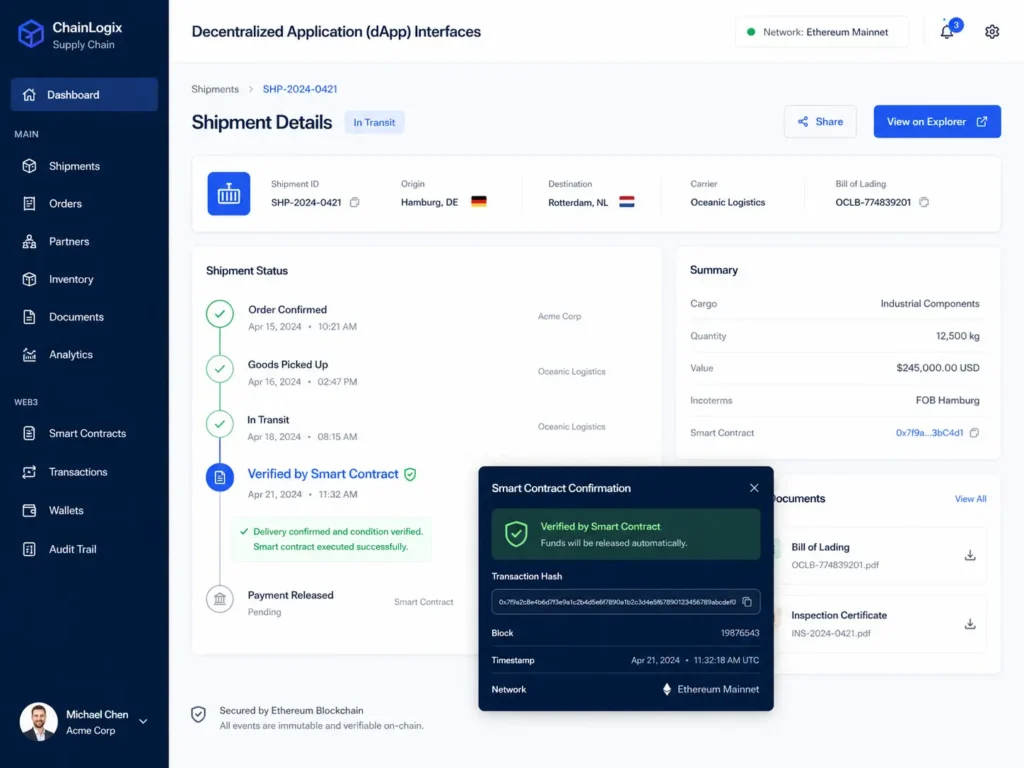
A dApp is a frontend web application built with standard modern frameworks — React, Next.js, or Vue — that connects to the blockchain backend through Web3 libraries like Ethers.js or Web3.js. From the user’s perspective, it looks and behaves like any other well-designed SaaS application. The complexity of the underlying blockchain infrastructure is entirely abstracted behind a clean, intuitive interface.
A supply chain manager using a dApp we built sees a shipment dashboard with verified status updates, document hashes, and payment release confirmations. They do not see cryptographic primitives or transaction IDs unless they specifically need to. The blockchain enforces the integrity of the data — the dApp makes that data usable.
Wallet integration and authentication
Instead of email and password authentication — which is vulnerable to phishing, credential stuffing, and data breaches — dApps use cryptographic wallet authentication. We integrate MetaMask, WalletConnect, and enterprise custody solutions depending on the user base and security requirements. Authentication is handled by the user signing a cryptographic message with their private key. No password database to breach.
5. Real-World Industry Applications of Custom Blockchain Development Services
The most credible evidence for where custom blockchain development services deliver real value is in the industries that have already committed to the technology at scale.
Supply chain and provenance verification
Counterfeit goods cost the global economy hundreds of billions of dollars annually. For luxury brands, pharmaceutical manufacturers, and food safety operations, the inability to verify the authentic origin and handling history of a product is both a financial and a safety problem.
We build immutable tracking systems where every handoff in a supply chain — from raw material origin to final delivery — is recorded on the blockchain with a verified timestamp and cryptographic proof. A consumer scanning a QR code on a product can see the complete, unalterable chain of custody. A regulator auditing a pharmaceutical shipment can verify the cold chain was maintained at every point. The record cannot be falsified after the fact.
Real estate and asset tokenization
Commercial real estate is one of the most illiquid asset classes available to investors. Buying or selling a position requires lawyers, brokers, title companies, and weeks of transaction processing. Custom blockchain development services make fractional ownership of real-world assets possible through tokenization.
A commercial property is represented on the blockchain as a defined number of tokens, each representing a fractional ownership stake. Investors can buy, sell, and transfer these tokens through a smart contract platform, with ownership records maintained on the distributed ledger. The friction of traditional property transactions — the intermediaries, the paperwork, the delays — is reduced dramatically.
FinTech and cross-border settlement
The correspondent banking system that handles international payments was built for a pre-digital world. It is slow, expensive, and opaque. For enterprises settling large cross-border transactions regularly, the cost in fees and the delay in settlement are material business expenses.
Private blockchain networks built for financial settlement can process transactions in seconds with a complete audit trail, at a fraction of the cost of traditional wire transfer infrastructure. For regulated industries, the immutable transaction record also simplifies compliance reporting significantly.
6. Private Blockchains vs. Public Ledgers: Choosing the Right Architecture
One of the most important decisions in any custom blockchain development services engagement is whether the use case calls for a public ledger, a private blockchain, or a consortium network. The answer depends on who needs access to the data and how much transparency is appropriate.
Public blockchains — Ethereum, Polygon, Solana — are open networks where anyone can participate, read the ledger, and submit transactions. They are appropriate for applications where broad transparency and open participation are features: public asset tokenization, open marketplaces, consumer-facing applications where the public verifiability of the ledger creates trust.
Private blockchains are permissioned networks where participation is controlled by a single organization. They offer the immutability and security of blockchain architecture with strict data privacy. Only authorized nodes can join the network, read the data, or validate transactions. This is the appropriate architecture for organizations that want the security benefits of distributed ledger technology without exposing internal operational data.
Consortium blockchains sit between the two. A defined group of organizations — a set of supply chain partners, a group of financial institutions, an industry consortium — shares a permissioned network. Each member maintains a node and participates in consensus, but the network is not open to the public. Data visibility can be configured at a granular level — some data visible to all members, some visible only to the parties directly involved in a transaction.
We specialize in Hyperledger Fabric and Enterprise Ethereum for permissioned deployments, and in Ethereum and Polygon for public deployments. The architecture recommendation comes after understanding your specific use case, your data privacy requirements, and the regulatory environment your business operates in.
7. Security Auditing and Enterprise Compliance
Security in custom blockchain development services has two distinct dimensions that both require careful attention: the security of the smart contract code itself, and the security of the surrounding application infrastructure.
Smart contract security auditing
Smart contract vulnerabilities have resulted in hundreds of millions of dollars in losses across the broader blockchain ecosystem. The most common vulnerability classes — reentrancy, integer overflow, access control failures, front-running — are well-documented, but they require deliberate engineering and testing discipline to avoid.
Every smart contract we deploy goes through our internal security review process: automated analysis with tools like Slither and MythX, manual code review by a senior engineer specifically looking for the known vulnerability patterns, and testing on a testnet with adversarial test cases designed to surface exploits before mainnet deployment.
For high-value deployments, we recommend and coordinate third-party security audits with specialist blockchain security firms. A contract managing significant value should be reviewed by multiple independent parties before going live.
Regulatory compliance
Depending on the industry and jurisdiction, blockchain applications may need to address specific compliance requirements: GDPR data handling for European operations, HIPAA considerations for healthcare data, AML/KYC requirements for financial applications. We build compliance requirements into the architecture design phase — not as an afterthought during deployment.
Frequently Asked Questions
Q: What is the core difference between a traditional database and a blockchain?
A traditional database is controlled by a single administrator who can edit, delete, or alter records. A blockchain distributes identical copies across multiple nodes, and the cryptographic chaining of records makes past data practically impossible to alter without network consensus. It provides a permanent, verifiable audit trail that no single party controls.
Q: Are smart contracts legally enforceable?
Smart contracts execute code automatically when conditions are met. They are not legal documents on their own, but they are frequently used to automate the mechanical execution of a traditional legal agreement that exists off-chain. The legal agreement defines the terms; the smart contract enforces them without requiring human intermediaries to process the fulfillment.
Q: Do we need cryptocurrency to use blockchain for our business?
No. Private and consortium blockchains built on frameworks like Hyperledger Fabric do not require or involve public cryptocurrency tokens. They use the distributed ledger architecture for data integrity and process automation without any connection to speculative token markets.
Q: How do users authenticate with a dApp?
We implement Web3 wallet authentication — MetaMask, WalletConnect, or enterprise custody solutions — depending on the user base. Authentication is cryptographic rather than credential-based, which eliminates the phishing and credential breach risks associated with traditional password systems.
Q: Can a blockchain handle the transaction volume our business requires?
Yes. Modern blockchain architectures — Layer-2 solutions, sidechains, and private consortium networks — handle thousands of transactions per second at latency comparable to traditional databases. Early public blockchain limitations on throughput are not a constraint for properly architected enterprise deployments.
Q: How long does a custom blockchain development services project take?
A smart contract system with a basic dApp frontend typically takes 10 to 16 weeks. A full enterprise consortium network with complex business logic, multiple integrations, and a complete frontend application is usually 20 to 28 weeks. We provide a detailed timeline during the technical scoping phase.
Your Data Integrity Problem Has an Architectural Solution
If your business depends on shared data across multiple organizations, automated multi-party agreements, or provable data integrity for regulatory compliance, the architecture you are using to manage that data matters.
Custom blockchain development services are not a future technology play. They are an available solution to infrastructure problems that cost real money in manual reconciliation, intermediary fees, and audit overhead right now.
MarkupMarvel builds custom blockchain development services for enterprises that are ready to solve their trust and data integrity problems at the architecture level.



