

Website Redesign for ROI: 5 Proven Strategies for Growth

Website Redesign for ROI: How to Balance Brand, UX, SEO, and Conversion
Introduction: Why Most Website Redesigns Fail to Deliver ROI
Most business owners approach a website redesign thinking about how it looks. They want something modern, clean, and on-brand. And while those things matter, a redesign that focuses only on visuals almost always fails to deliver real business results.
A truly strategic website redesign for ROI treats your website as a core business asset — not just a digital brochure. It asks a different set of questions: Where are visitors dropping off? Which pages are failing to convert? What is slowing the site down? Where is the messaging unclear?
When a redesign fails to deliver measurable returns, it is almost always because design, technical performance, and user intent were never properly aligned. For agencies, SaaS companies, and eCommerce brands, the goal must be to streamline the user journey, improve load speed, and protect search visibility — all at the same time.
If your new site looks great but does not turn visitors into leads or customers, you have not invested in growth. You have paid for an expense. To achieve a real website redesign for ROI, every decision must connect back to a measurable business outcome.
Short Answer: How do you achieve ROI from a website redesign?
Achieving ROI from a website redesign requires a clear framework that puts data-backed UX, Core Web Vitals performance, and conversion-focused architecture at the center. Instead of starting with aesthetics, start by identifying where your highest-value conversion paths are breaking down. By combining strong technical SEO, mobile-first design, and clean back-end architecture, you reduce bounce rates, lower your cost per customer, and increase the percentage of visitors who take action. True ROI comes when every design decision is driven by user behavior data and clear business goals — not personal preference.
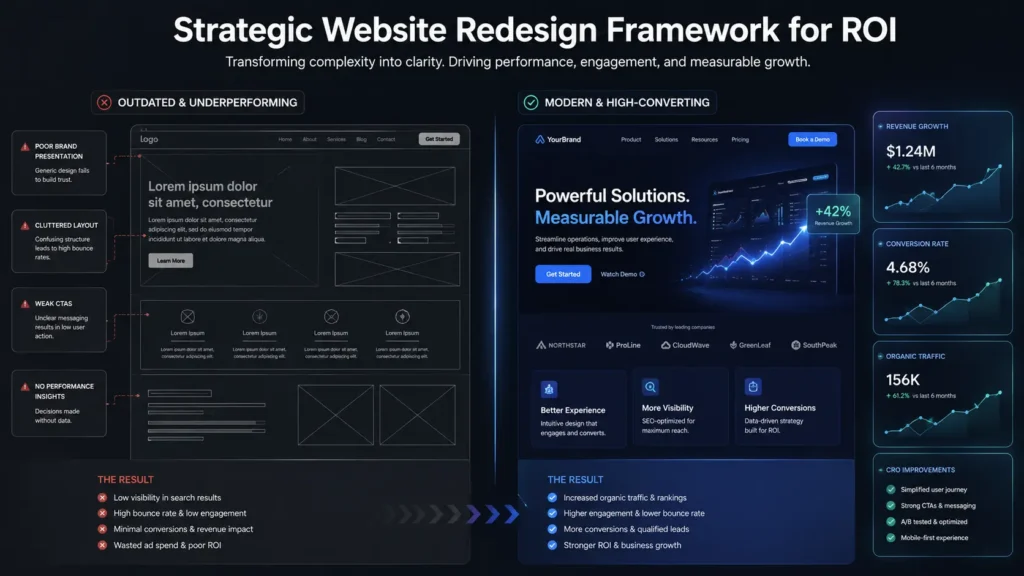
1. Why a Website Redesign for ROI Is a Business Decision, Not a Creative One
For agencies, SaaS platforms, and eCommerce brands, your website is your most important sales asset. It works around the clock, and every visitor it fails to convert is revenue you are leaving on the table. Approaching a website redesign for ROI as a purely creative project introduces real business risk.
The Hidden Cost of Getting It Wrong
When a redesign is not planned properly, the problems show up quickly after launch. Pages break. Load times get worse. Search rankings drop. Forms stop working. Each of these issues costs money — in lost leads, in developer time to fix the problems, and in the drop in paid campaign performance that follows.
Why Scalability Must Be Built In From the Start
Building a new site on a rigid or outdated framework limits what you can do as your business grows. Every time you need to add a feature, connect a new tool, or expand into a new market, a poorly planned architecture creates friction and extra cost. Planning for scalability from day one protects your investment over time.
How Search Rankings Are Affected
According to Google’s Search Central documentation, URL structure changes without proper redirect mapping can cause significant and lasting ranking drops. (Google Search Central)
Small Conversion Gains Deliver Large Revenue Returns
Even a 1% improvement in your conversion rate can produce a meaningful increase in annual revenue. That is why a website redesign for ROI that prioritizes conversion architecture consistently delivers a higher return than one focused primarily on visual updates.
2. Performance-First Architecture: The Foundation of Every Successful Redesign
The most effective website redesign for ROI does not start with colors or fonts. It starts with technical architecture — the decisions about how your site is built, how fast it loads, and how well it handles traffic.
Three Pillars Every Redesign Must Cover
Every high-performing redesign is built on three interconnected foundations:
Technical Integrity: Clean code, secure hosting, and fast database connections that hold up under heavy traffic without slowing down.
User-Centered Design: Navigation and layout that make it easy for visitors to find what they need and take the next step — without having to think too hard about it.
Search and Discoverability: Proper metadata, structured schema markup, and content architecture that helps both search engines and AI-powered discovery tools understand what your site is about and who it serves.
Why Core Web Vitals Cannot Be an Afterthought
Google’s Core Web Vitals — Largest Contentful Paint (LCP), Interaction to Next Paint (INP), and Cumulative Layout Shift (CLS) — measure how your site actually feels to a real user. Poor scores mean visitors experience a slow, frustrating interface, and Google factors these scores into search rankings.
According to web.dev, sites that meet Core Web Vitals thresholds see measurably better user engagement and lower bounce rates compared to sites that do not.
Building Core Web Vitals compliance into your redesign from the start — rather than trying to fix it after launch — is far more efficient and less expensive.
3. Five Elements of a Website Redesign That Actually Delivers ROI
Element 1 — Data-Driven UX Mapping
Before changing a single page layout, run a data audit on your existing site. Use heatmaps, session recordings, and funnel analytics to find out exactly where visitors are dropping off and why. This data tells you which elements to remove, which to move, and where to place your most important calls to action. Designing based on real user behavior produces far better results than designing based on assumptions.
According to Nielsen Norman Group, usability testing and behavioral data analysis are the two most reliable methods for identifying UX friction that reduces conversion rates.
Element 2 — Technical SEO and Core Web Vitals Optimization
Every template, every page layout, and every content block in your redesign must be evaluated for its impact on Core Web Vitals and technical SEO. Image sizes, font loading methods, script loading order, and server response times all affect how fast your pages load and how well they rank.
Our <a href=”/services/technical-seo-analytics/”>Technical SEO and Analytics Setup service</a> ensures your redesigned site launches with clean metadata, proper schema markup, optimized page speed, and a fully configured analytics tracking system — so you can measure performance from day one.
Element 3 — Conversion-Centered Page Architecture
Every page on your site should have a clear purpose and a clear next step. If a page does not move a visitor closer to becoming a lead or a customer, it is adding weight without adding value. Effective conversion architecture means placing your value proposition, trust signals, and call to action buttons in the locations where users naturally look for them — based on eye-tracking research and behavioral data, not guesswork.
Element 4 — Headless Architecture for High-Growth Platforms
For SaaS platforms, large eCommerce stores, and content-heavy sites, a headless web architecture separates the front-end display layer from the back-end data layer. This means your pages load almost instantly from global servers, regardless of how complex your back-end systems are. It also gives your development team the flexibility to update the front end without touching back-end logic.
If your current site is slow despite standard optimization efforts, explore our <a href=”/services/headless-web-architecture/”>Headless Web Architecture and API Integration service</a> to see if this approach fits your growth roadmap.
Element 5 — AI-Powered Lead Capture and Automation
Modern websites can do more than display information. Integrating smart lead capture tools — such as behavior-triggered chat flows, automated email sequences, and personalized content delivery — turns your site into an active lead generation system. These automations qualify visitors and route them toward the right next step without requiring manual intervention from your team.
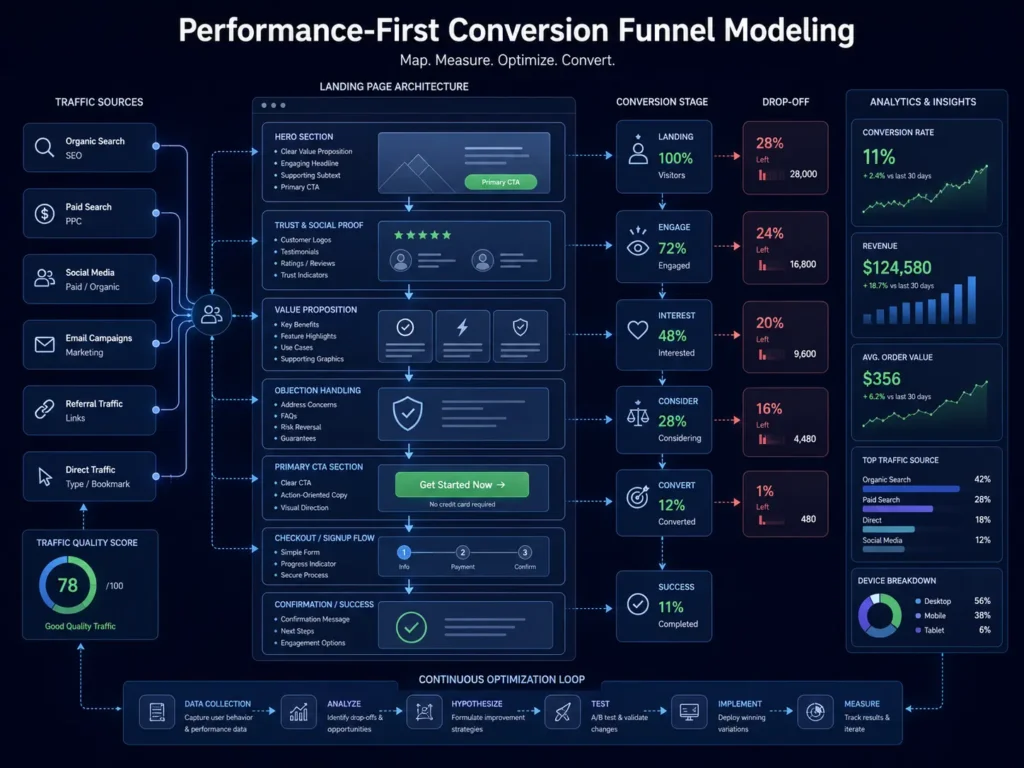
4. Decision Matrix: Matching Business Problems to Redesign Solutions
Common Website Problems and the Right Fix for Each
Business Problem | Focus Area | Recommended Action
Falling lead conversion rate | UX and CTA optimization | Run a conversion rate audit; test headline and CTA placement variations
Declining organic search rankings | Technical SEO and metadata | Conduct a full technical SEO audit; fix metadata and schema errors
Slow page load times | Back-end performance and hosting | Optimize images and scripts; consider headless architecture for complex sites
High mobile bounce rate | Mobile-first layout | Rebuild layouts using mobile-first CSS; simplify mobile navigation
Poor post-launch analytics visibility | Event tracking setup | Configure GA4 and Google Tag Manager before launch; verify all conversion events
5. Critical Mistakes That Kill Website Redesign ROI
Even experienced development teams make mistakes during a redesign that quietly destroy the return on investment. Here are the most common ones to avoid:
Skipping URL Redirect Mapping
Changing your URL structure without setting up 301 redirects for every old URL is one of the fastest ways to destroy years of accumulated search authority. Every broken link is a lost ranking signal and a poor experience for any visitor who lands on a dead page. Build a complete redirect map before you launch.
Designing for Desktop First
According to Statista, mobile devices account for over 60% of global web traffic.
Overloading the Site with Plugins
Every plugin you add to a WordPress site introduces additional scripts, database queries, and potential conflicts. Too many plugins slow your site down, create security vulnerabilities, and make maintenance harder. During a redesign, audit every plugin and keep only what is essential.
Launching Without Verified Tracking
If your GA4 event tracking and Google Tag Manager tags are not tested and verified before launch, your post-launch analytics data will be incomplete or incorrect. You will not be able to measure which campaigns are working, where users are dropping off, or whether your conversion goals are firing. Always verify tracking before going live.
Ignoring Content Architecture
A technically perfect site with thin, generic, or poorly structured content will not rank well or convert effectively. Search engines need well-structured content to understand what your pages are about. Users need clear, useful information to feel confident taking action. Content planning should happen alongside — not after — the design and development process.
Frequently Asked Questions
How long does a website redesign for ROI typically take?
A thorough, ROI-focused website redesign typically takes between eight and sixteen weeks, depending on the size of the site and the complexity of the back-end systems involved. This timeline covers discovery and data auditing, design, development, testing, and pre-launch SEO verification.
Will our search rankings drop during a redesign?
Not if the migration is handled properly. Protecting your existing search rankings requires a complete URL redirect map, technical SEO verification before launch, and careful handling of any content changes. Skipping these steps is what causes ranking drops — not the redesign itself.
Should we optimize our existing site or build from scratch?
If your current site has structural problems that are hard to fix — outdated code, poor architecture, or a platform that limits what you can do — a clean rebuild is usually more cost-effective over the long term. If the foundation is solid, a targeted optimization and redesign can deliver results faster and at lower cost.
How do we measure ROI from a website redesign?
Track the metrics that connect directly to revenue: conversion rate, cost per lead, organic search traffic, and bounce rate. Set baseline measurements before the redesign and compare them at 30, 60, and 90 days after launch. These numbers tell you whether the investment is delivering real business results.
Does our platform need a headless architecture?
Headless architecture is the right choice for platforms that need to deliver content across multiple channels, handle high traffic volumes, or maintain very fast load times despite complex back-end systems. For simpler marketing sites, a well-optimized traditional WordPress setup is often the more practical and cost-effective option.
Does MarkupMarvel provide support after the redesign launches?
Yes. We configure complete analytics and event tracking setups, and we provide ongoing support to make sure your site continues to perform, rank, and convert after launch. A website redesign for ROI does not end on launch day — it is an ongoing process of measurement and improvement.
Conclusion: Build Your Website to Earn Its Keep
A website redesign for ROI is not about making your site look newer. It is about making it work harder — converting more of the traffic you already have, ranking better in search, loading faster on every device, and giving your team the data they need to keep improving over time.
At MarkupMarvel, we approach every redesign as a strategic business project. From Core Web Vitals optimization and mobile-first design to conversion architecture and GA4 tracking setup, we build websites that are engineered to deliver measurable results — not just a new look.
If your current site is not generating the leads, sales, or search visibility your business needs, the problem is almost always fixable. And a well-planned website redesign for ROI is the most effective way to fix it.
Ready to turn your website into a real growth asset?
More Blog

High-Availability Cloud Infrastructure: 5 Proven Steps

Nginx Redis Caching Optimization: 6 Proven Speed Tactics

Content Optimization for AI Search: 5 Proven Steps to Rank



