
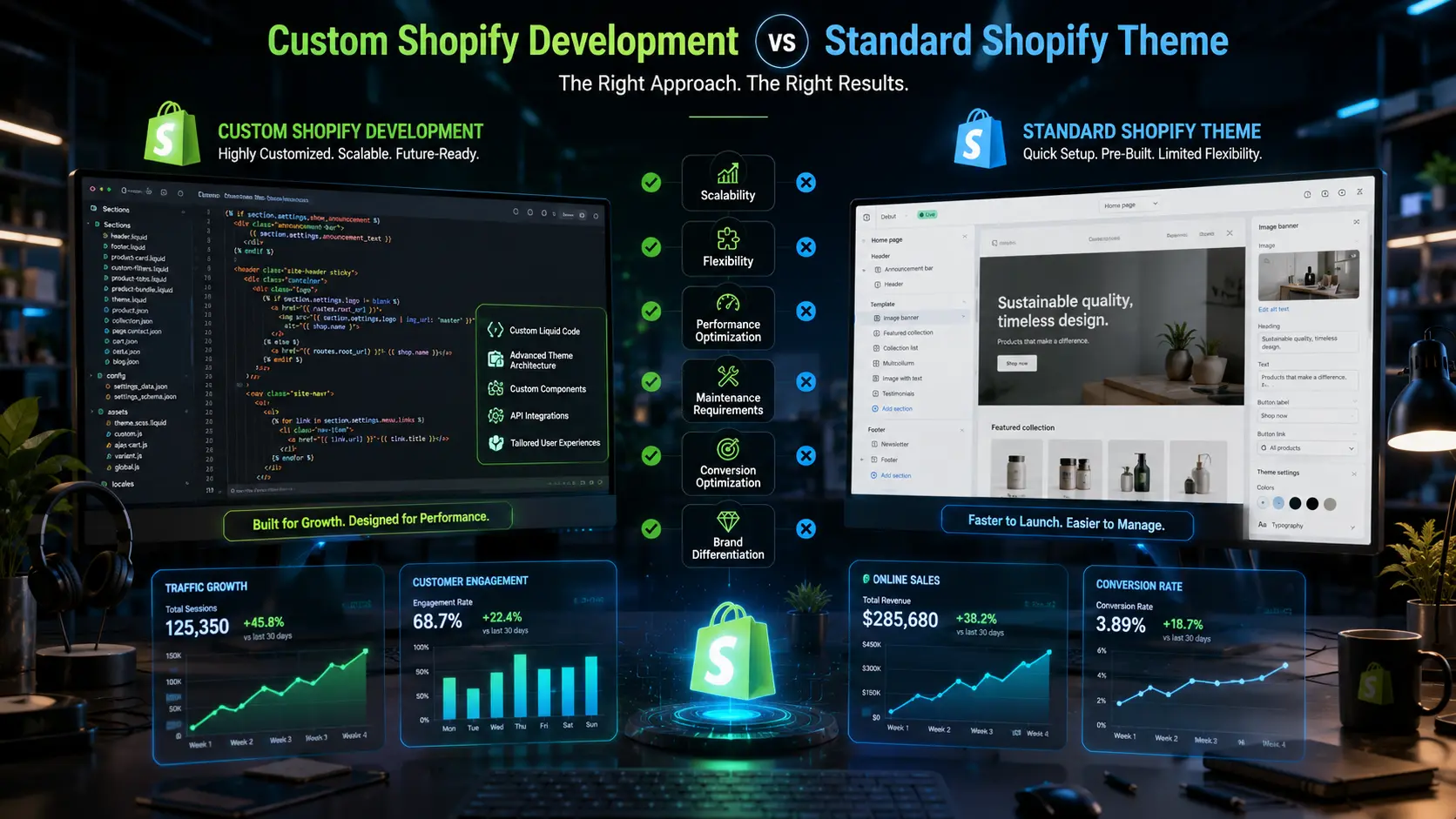
Shopify Custom Liquid vs Standard Themes: 10 Differences

Shopify Custom Liquid vs. Standard Themes: 10-Point Comparison
Your Shopify theme got you here.
But here is the hard truth — it might not get you to where you are going next.
That theme you launched with? It was perfect for Day 1. Quick to set up. Easy to customize. No developer needed. But now your store is doing real numbers, your catalog has grown, your marketing team has bigger ideas, and suddenly that theme feels like a pair of shoes you have worn two sizes too long.
You feel the friction. You just might not know exactly where it is coming from.
That is what this guide is for. We are going to break down — clearly, practically, without the jargon — exactly what separates a custom Liquid theme from a standard theme. What it costs you to stay. What you gain when you switch. And how to know when the time is right.
No fluff. Just the stuff that actually moves the needle.
Is your theme quietly costing you conversions? [Get a Free Performance Audit from MarkupMarvel
1. The Moment Every Growing Shopify Store Faces
Picture this.
You launched your store on a standard Shopify theme. Things took off. Revenue grew. Your team got bigger. Your ambitions got bigger. And slowly, without anyone planning for it, your theme started becoming the bottleneck.
Your designer wants a custom product page layout. The theme says no.
Your developer wants to remove a slow script. It is buried in the theme’s core.
Your marketing team wants a new landing page live by Monday. It takes until Wednesday.
Your PageSpeed score is sitting at 58 and nobody knows why.
Sound familiar?
This is the scalability ceiling — and almost every growing Shopify brand hits it. The question is not whether you will hit it. The question is what you do when you get there.
Option A: Stay with the standard theme and keep patching problems with more apps, more workarounds, and more compromises.
Option B: Invest in a custom Liquid build and engineer a store that is built for where you are going.
One of these options gets cheaper over time. The other one does not.
2. What Your Standard Theme Is Actually Costing You
Let’s talk about the hidden tax of a standard Shopify theme. Because it is real, and it is quietly showing up in your numbers every single month.
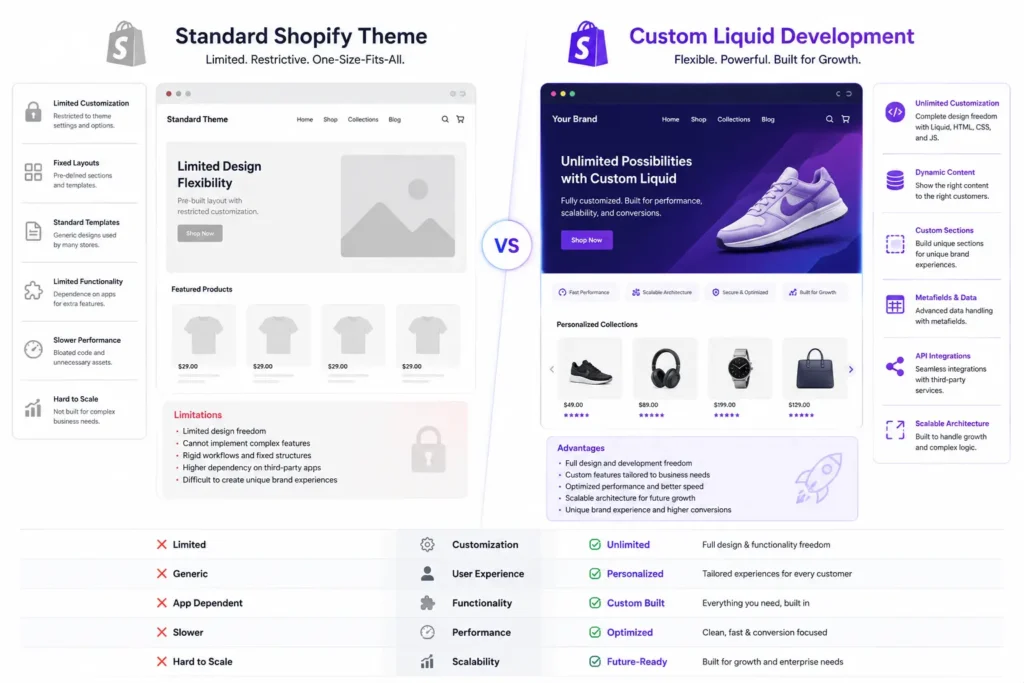
THE DEAD CODE PROBLEM
Here is something your theme developer will never tell you.
Standard Shopify themes are built to sell to thousands of merchants. That means they ship with code for every feature every merchant might ever want — sticky headers, countdown timers, mega menus, video backgrounds, parallax scrolling, you name it.
Whether you use those features or not, your customers’ browsers are downloading all of that code every single time someone visits your store.
Developers call this “dead code.” You might be using 20% of your theme’s functionality. Your visitors are paying the loading cost of 100% of it. That gap — that silent, invisible weight — is why your PageSpeed score looks the way it does.
And a slow PageSpeed score is not just annoying. It directly hurts your Google rankings and your conversion rate. Every extra second of load time is customers walking out the door before they even see your products.
You can test your store’s current speed right now using You can test your store’s current speed right now using Google PageSpeed Insights
THE DESIGN CEILING YOU KEEP BUMPING INTO
Your brand is not generic. Your theme is.
Standard themes give you color pickers and font selectors. They let you reorder some blocks and toggle some settings. But when you want to do something that actually differentiates your store — a custom product bundling layout, a unique navigation experience, a checkout flow built around how your customers actually buy — you hit a wall.
That wall is not a bug. It is a feature of how standard themes are designed. They serve the average merchant. Your brand should not be average.
THE APP SPIRAL THAT SNEAKS UP ON YOU
Every limitation in your standard theme tends to solve itself the same way: another app.
Need upsells? App.
Need reviews with filtering? App.
Need a loyalty program? App.
Need a custom popup? App.
Each app seems harmless on its own. But together? They are quietly dismantling your store’s performance. More on that in Section 5.
3. What Shopify Custom Liquid Development Actually Is
Let’s clear something up before we go further.
Custom Liquid development is not about making your store “look different.” It is about building a store that works differently — from the ground up, in clean code, with zero inherited baggage.
Shopify’s native templating language is called Liquid. When we build a custom Liquid theme at MarkupMarvel, we are not starting from someone else’s template and modifying it. We are writing every line of code with intention. Every section, every script, every stylesheet exists because it earns its place.
For a full reference on Shopify’s Liquid templating language, see the official Shopify developer documentation
Here is what that looks like in practice:
YOUR MARKETING TEAM GETS REAL AUTONOMY
We build every custom theme using a modular component architecture. That means your homepage, landing pages, product pages, and collection pages are all built from reusable, drag-and-drop sections that live right inside the Shopify Theme Editor.
Want a new campaign page live by tomorrow? Your marketing team can build it themselves. No developer ticket. No waiting. No compromise.
NOTHING IN YOUR CODE THAT DOES NOT BELONG THERE
With a standard theme, removing dead code is risky — you might break something. With a custom Liquid build, there is no dead code to begin with. Every script is deliberate. Every stylesheet is scoped. Every feature is there because it is doing a job.
That discipline is what produces stores that load in 1.2 seconds instead of 4.5.
YOU OWN YOUR PLATFORM
With a standard theme, you are at the mercy of the theme developer’s update schedule, their decisions about what features to support, and their timeline when things break.
With a custom Liquid build, the code is yours. The roadmap is yours. You decide what gets built, when it gets built, and how it evolves.
4. The Performance Reality: Speed Is Not a Feature, It Is Revenue
Let’s talk numbers for a minute.
Google’s own research shows that the probability of a visitor bouncing increases by 32% when page load time goes from one second to three seconds. On mobile — where more than 60% of eCommerce traffic now comes from — that curve is even steeper.
Every second matters. Every 100 milliseconds matters.
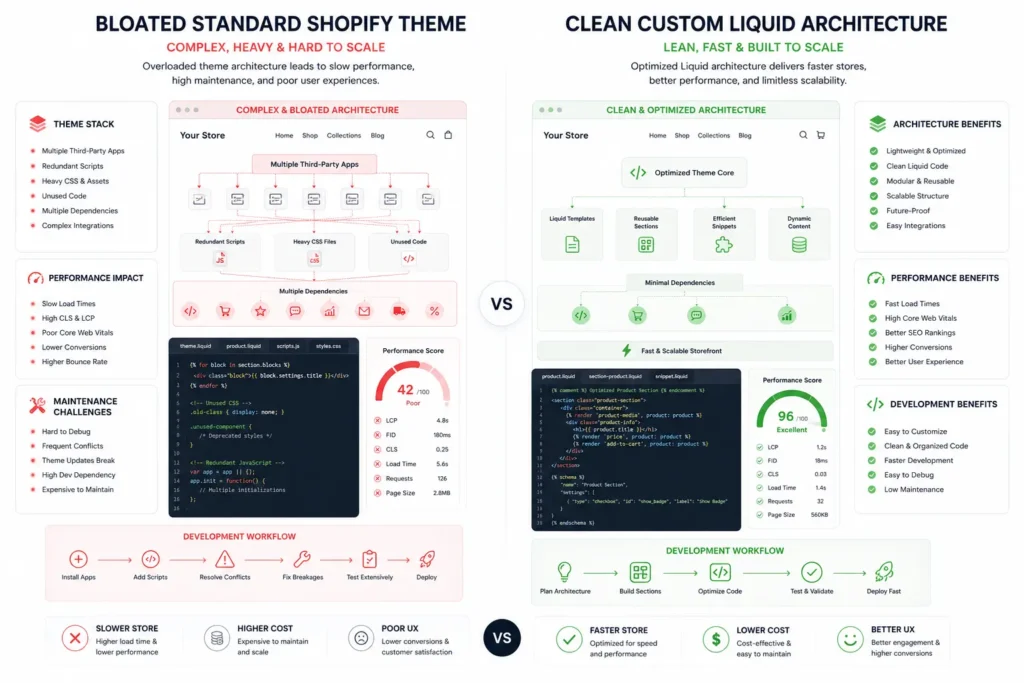
CORE WEB VITALS: THE SCORECARD GOOGLE ACTUALLY USES
Google now uses Core Web Vitals as direct ranking signals. These metrics measure three things:
— LCP (Largest Contentful Paint): How fast does your main content load?
— CLS (Cumulative Layout Shift): Does your page jump around as it loads?
— INP (Interaction to Next Paint): How quickly does your page respond when someone taps or clicks?
Standard themes — especially ones loaded up with apps and third-party scripts — routinely fail Google’s “Good” thresholds for these metrics as stores grow. The more products, the more apps, the worse it gets.
Custom Liquid builds give us precise control over how and when every asset loads. We can make sure the product image loads before anything else. We can eliminate layout shift entirely. We can make tapping “Add to Cart” feel instant. None of that is possible when you are working inside a pre-built theme’s constraints.
You can learn exactly how Google measures these signals in the official Core Web Vitals documentation
THE SEO EDGE THAT COMPOUNDS OVER TIME
Custom Liquid also means full control over your HTML structure. Clean heading hierarchies. Proper semantic tags. Precise schema markup for your products, reviews, and breadcrumbs — exactly the way Google wants to see it.
This is not the kind of SEO win you see overnight. But six months from now, twelve months from now, it is the difference between a store that consistently ranks and one that is stuck on page two for its own product names.
Stop leaving conversions on the table. [Explore Our Custom Shopify Development Services]
—
5. The App Problem Nobody Talks About Honestly
Here is a conversation we have with almost every new client:
Us: “How many apps do you have installed?”
Them: “I think around 20? Maybe 25?”
Us: “Can we look together?”
Them: “…okay, it is 47.”
This is not unusual. It is the natural endpoint of the standard theme lifecycle.
Every time a standard theme could not do something, an app got installed. Over months and years, those apps compound. And the cost is not just the monthly subscription fees — it is what they are doing to your store’s performance every single day.
THE SCRIPT AVALANCHE
Every app that touches your storefront injects code. Scripts. Stylesheets. Tracking pixels. Analytics hooks. A store with 40+ apps can trigger over 100 network requests before a customer sees their first product image.
Think about what that means for someone on a mobile connection. They tap your ad, your store starts loading, and for 4 or 5 seconds — nothing. Most of them are gone before the page finishes.
THE SILENT CONFLICTS
Apps are built in isolation. They do not know about each other. They do not test with each other. When two apps try to control the same element — the cart drawer, the product form, the checkout button — things break.
Sometimes the break is obvious. More often, it is subtle. A button that works 90% of the time. An add-to-cart that occasionally does nothing. A popup that fires twice. These silent failures are conversion killers that almost never show up clearly in your analytics.
THE REAL COST MATH
That $20/month app seems cheap. But run the real math.
If that app adds half a second to your load time, and that half-second costs you a 5% drop in conversion rate, and your store does $500,000 a year — that $20 app is costing you $25,000 annually.
Custom Liquid development replaces the functionality of those apps with native code built directly into your theme. You eliminate the monthly fees. You eliminate the performance drag. You eliminate the conflict risk. All at once.
6. Real Results: What This Actually Looks Like in Practice
We want to show you a real example. Not a hypothetical. Not a case study with the numbers polished to look better than they were.
A mid-market fashion brand came to us with a problem they had been trying to solve for months. Their store was sitting on a well-known standard theme. The products were great. The brand was strong. The marketing was working.
But their average page load time was 4.5 seconds. And they were losing roughly 30% of their mobile visitors to bounce before the page even finished loading.
Here is exactly what we did:
STEP 1 — THE APP AUDIT
We went through every installed app with the client. We identified 12 apps that were providing UI functionality — sliders, tabs, accordions, popups — that could be rebuilt directly in native Liquid code. We removed those apps and rebuilt the features inside the theme. Gone: dozens of unnecessary HTTP requests on every page load.
STEP 2 — THE PRODUCT PAGE REBUILD
The product page was the biggest performance problem. It had been patched and extended so many times that it was carrying enormous DOM weight. We rebuilt it from scratch using a clean modular component system. DOM nodes dropped by 60%. The page started rendering visibly in under a second.
STEP 3 — THE ASSET LOADING REWRITE
We restructured how CSS and JavaScript loaded across the entire store. Critical styles loaded first. Non-critical scripts were deferred. Images were lazy-loaded using Shopify’s native infrastructure. The browser could paint something useful within 800 milliseconds of the first request.
THE RESULTS — 90 DAYS LATER:
– Page load time: 4.5 seconds → 1.2 seconds
– Mobile conversion rate: up 22%
– Monthly app spend: down approximately $480
Twenty-two percent more conversions. On the same traffic. From the same ads. Just a faster, cleaner store.
That is the ROI of engineering-led Shopify development.
7. The UX Advantage That Standard Themes Cannot Give You
Here is something we want you to think about.
There is a version of your store that exists in your head. The one where the product page is laid out exactly the way your customers need it. Where the checkout flow removes every possible moment of hesitation. Where the recommendations actually feel relevant. Where the whole experience feels like it was built for your customer — because it was.
Standard themes cannot build that store. Not because the theme developers are not talented. They are. But they built their theme for everyone, which means it is optimized for the average of everyone — and your customers are not average.
Custom Liquid builds let us close the gap between what your brand needs and what your store actually delivers.
Custom product bundling logic built around how your customers actually shop.
Recommendation engines that respond to real browsing behavior.
Campaign landing pages that convert because they were engineered to, not because you found a template that was close enough.
Checkout flows designed around your specific customer journey, not a generic eCommerce pattern.
This is how the best Shopify stores in the world operate. Not by finding a better theme. By building the right one.
8. How to Know If You Have Already Outgrown Your Theme
[IMAGE 3]
File: shopify-decision-matrix.webp
Alt Text: Decision matrix showing when Shopify stores should move from standard themes to Shopify Custom Liquid development based on scale, complexity, and business goals.
Title Text: When to Move from a Standard Theme to Custom Liquid
Four honest questions. Answer them with your team.
THE PERFORMANCE TEST
Go to Google PageSpeed Insights right now and test your homepage and your best-selling product page. If either score is below 70 on mobile, your theme is actively costing you rankings and conversions — today, not eventually.
THE AUTONOMY TEST
When your marketing team needs a new landing page or a homepage update, how long does it actually take? If the honest answer involves a developer queue, theme limitations, or workarounds that take longer than they should — you have a growth bottleneck baked into your infrastructure.
THE ROADMAP TEST
Look at what your brand needs to do in the next 12 months. Custom checkout? Unique bundling? Personalized experiences? Deep integrations? If more than one of those things runs into “the theme can’t do that” — you will keep hitting that same wall, over and over.
THE APP AUDIT TEST
Count your apps. If the number is over 15, and several of them are handling things that should be native theme functionality — a tab system, an accordion, a custom section layout — you are paying a daily performance tax that shows up in your load time and your conversion rate.
Two or more “yes” answers? You have likely already crossed the line. The cost of staying is probably higher than the cost of switching, even if it does not feel that way yet.
9. What the Switch Actually Looks Like
We want to be real with you about one thing.
Moving from a standard theme to a Custom Liquid build is an investment. It takes time. It takes budget. It is not something you do because you want a new look — it is something you do because you are serious about engineering your store for the next phase of growth.
What you get on the other side:
A store that loads in under 1.5 seconds on mobile.
A codebase your team owns entirely — no third-party dependencies for core functionality.
Modular sections your marketing team can use without a developer.
A PageSpeed score that supports your organic rankings instead of fighting them.
A foundation that scales with your catalog, your traffic, and your ambitions — without needing to be rebuilt again in two years.
This is not a theme upgrade. It is an infrastructure upgrade. And for brands that are serious about scaling, it is one of the highest-ROI decisions they make.
10. The Bottom Line
Standard themes exist to help you launch. Custom Liquid development exists to help you scale.
That distinction matters more than most merchants realize until they are already feeling the friction.
At MarkupMarvel, we do not sell themes. We build Shopify infrastructure for brands that are done with workarounds and ready to compete at a higher level. Clean code. Modular architecture. Zero bloatware. Full ownership. And a team that measures success the same way you do — in speed, conversions, and revenue.
If your store is ready for that kind of foundation, we are ready to build it.
FREQUENTLY ASKED QUESTIONS (FAQ)
Q: What is Shopify Custom Liquid development?
A: It means building a Shopify theme completely from scratch using Shopify’s native Liquid templating language — without starting from a pre-built template. Every line of code is written with intention, which means no dead code, no inherited baggage, and complete control over performance, design, and functionality.
Q: How much faster is a Custom Liquid store compared to a standard theme?
A: In our experience, Custom Liquid builds typically load 2 to 4 times faster than standard themes extended with multiple apps. A store loading in 4.5 seconds on a standard theme can realistically achieve sub-1.5 second load times after a proper Custom Liquid rebuild.
Q: Is Custom Liquid development worth the investment for smaller stores?
A: For stores doing under $200K per year, a standard theme is usually the right starting point. But once you start hitting limitations — in design flexibility, performance, or marketing autonomy — the ROI on a Custom Liquid build becomes very clear, very quickly.
Q: Will my marketing team be able to update the site without a developer?
A: Yes. We build every custom theme with a modular section architecture inside the native Shopify Theme Editor. Your marketing team can build new campaign pages, update homepage layouts, and make content changes without touching a single line of code.
Q: How long does a Custom Liquid build take?
A: A focused single-template build typically takes three to five weeks. A full custom theme covering all major page types — homepage, product, collection, cart, landing pages — typically takes eight to twelve weeks depending on complexity.
Q: What happens to our existing content and products during the rebuild?
A: Your Shopify data — products, collections, customer records, orders — lives in the Shopify backend and is completely separate from your theme. A theme rebuild does not affect any of that data. We build and test the new theme in a development environment and migrate cleanly when it is ready to launch.
—
READY TO FIND OUT WHAT YOUR STORE IS ACTUALLY CAPABLE OF?
We will go through your store end to end — PageSpeed, app load, HTML structure, Core Web Vitals — and show you exactly where the bottlenecks are and what fixing them would mean for your conversion rate.
Technical debt is patient. It will wait quietly while it costs you money every single day.
The best time to fix it was six months ago. The second best time is right now.
More Blog

High-Availability Cloud Infrastructure: 5 Proven Steps

Nginx Redis Caching Optimization: 6 Proven Speed Tactics

Content Optimization for AI Search: 5 Proven Steps to Rank



