
RAG System Development: Powerful Business AI Guide 2026

How RAG System Development Helps Businesses Use AI with Internal Knowledge Bases
RAG system development is solving one of the most frustrating problems in enterprise AI adoption: the gap between what a large language model knows and what your business actually needs it to know.
Most businesses that experiment with AI tools quickly run into the same wall. You ask the AI about your internal processes, your product documentation, or your company policies — and it either gives you a generic answer that does not apply to your situation, or it confidently generates something that sounds plausible but is simply wrong. This is the hallucination problem, and it is not a minor quirk. For businesses that depend on accurate, consistent information, it is a fundamental blocker.
The reason it happens is straightforward. Large language models are trained on publicly available data. They have no knowledge of your internal documents, your workflows, your client history, or your proprietary processes. When you ask them questions that require that knowledge, they do their best with what they have — which often means filling the gaps with educated guesses.
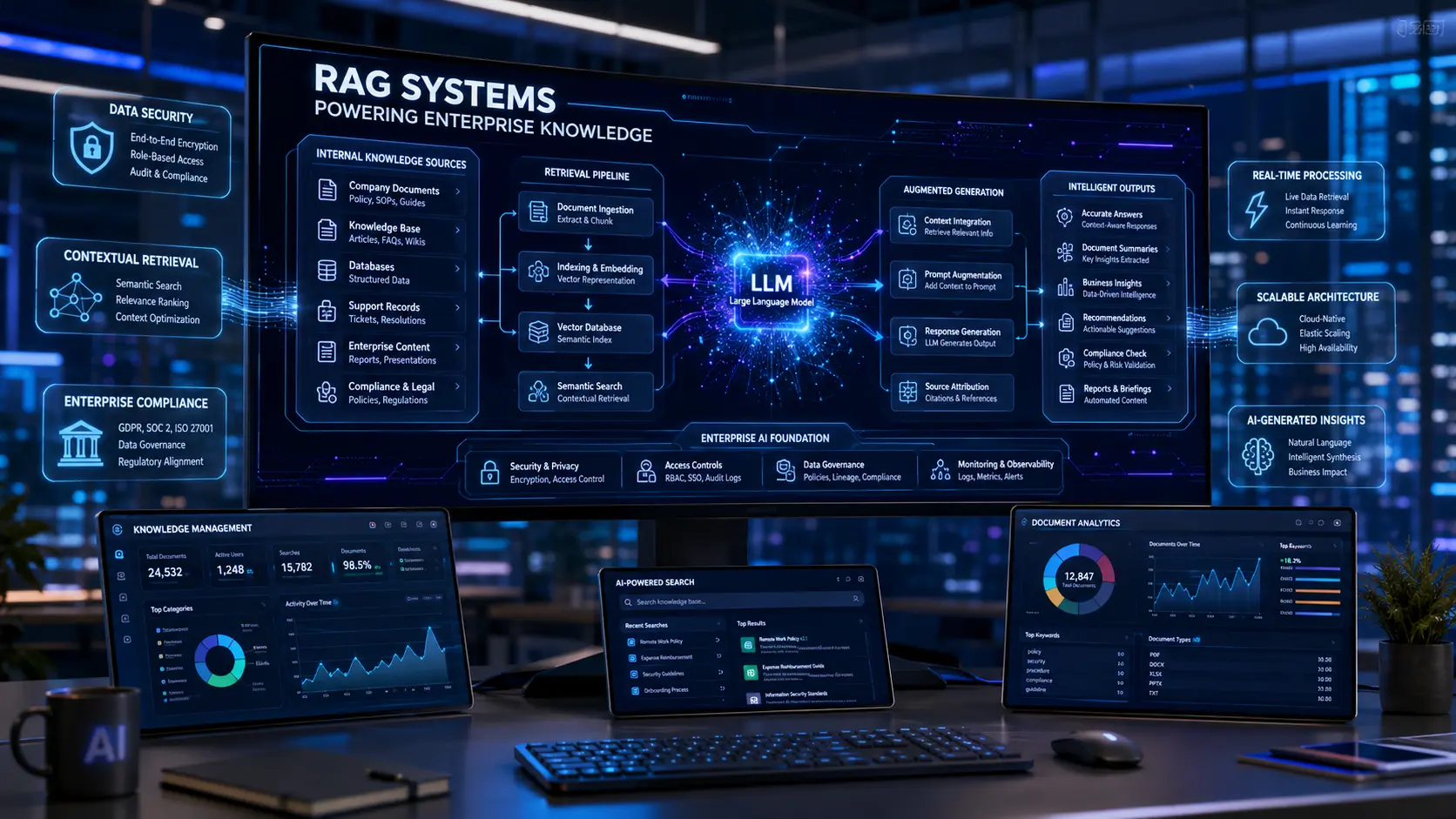
RAG system development changes this entirely. By connecting an AI model directly to your private internal knowledge base, RAG enables responses that are grounded in your actual data rather than general internet knowledge. The result is an AI system that functions as a genuine subject-matter expert on your specific business — accurate, current, and auditable.
Short Answer
Retrieval-Augmented Generation (RAG) is an AI framework that enhances a Large Language Model by first retrieving relevant information from your internal data sources — documents, databases, wikis, support records — and then using that retrieved context to generate precise, grounded responses. Instead of relying on the model’s pre-trained memory, a RAG system looks up the answer in your actual data before generating a response. This eliminates hallucinations, keeps information current without expensive model retraining, and ensures your AI stays within the boundaries of what your business actually knows
Why Standard AI Tools Fall Short for Business Use
Understanding why RAG system development matters requires understanding what standard AI tools cannot do — and why that limitation is more significant than most businesses realize when they first start experimenting with AI.
A large language model like GPT-4 or Claude is trained on a vast corpus of publicly available text. That training gives it broad general knowledge, strong reasoning capabilities, and the ability to communicate clearly across a wide range of topics. What it does not give it is any knowledge of your business specifically.
When you ask a standard AI tool “what is our refund policy for enterprise contracts?” or “how does our authentication microservice interact with the user database?”, the model has two options. It can tell you it does not know — which is honest but unhelpful. Or it can generate a plausible-sounding answer based on general patterns from its training data — which feels helpful but may be entirely wrong for your specific context.
The second outcome is more dangerous than the first. A confidently wrong answer from an AI system that employees trust leads to bad decisions, customer miscommunications, and support errors that are often harder to catch than an obvious gap.
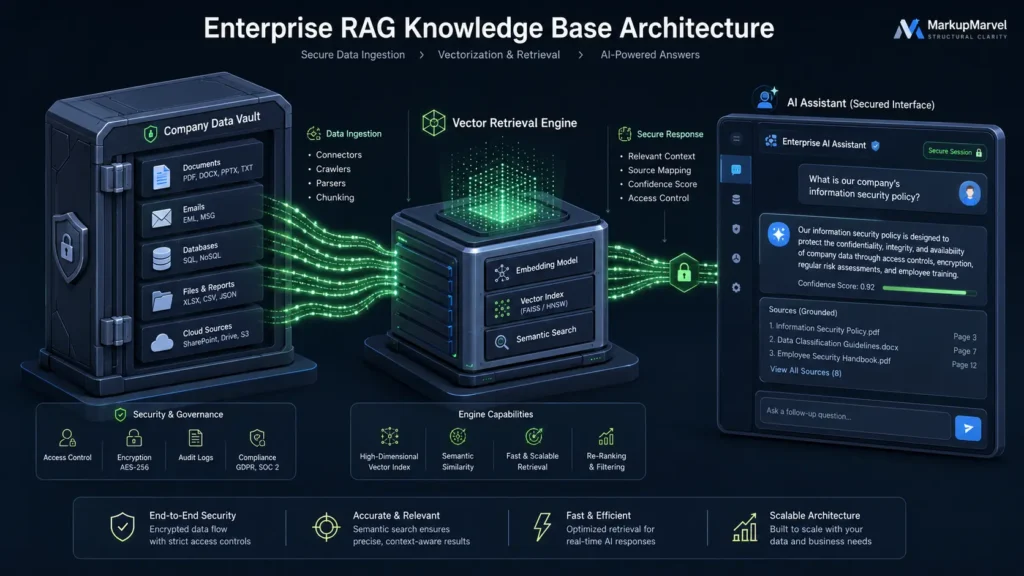
RAG system development solves this by giving the AI a third option: look it up. Before generating any response, the system retrieves the relevant sections of your actual internal documentation and uses them as the factual foundation for its answer. The model is no longer guessing — it is summarizing and explaining content that actually exists in your knowledge base.
For businesses also looking to automate content creation at scale, see our guide on AI product description generation: /ai-product-description-generation
How RAG System Development Works: The 3-Step Lifecycle
RAG operates through a structured pipeline that runs every time a user asks a question. Understanding each stage helps clarify both what makes it powerful and what needs to be built correctly for it to work reliably.
Step 1: Ingestion and Indexing
Before any queries can be answered, your internal knowledge base needs to be processed and indexed. This means taking your existing documents — PDFs, internal wikis, support ticket archives, spreadsheets, database records, Notion pages, or whatever formats your business uses — and converting them into a format the retrieval system can search efficiently.
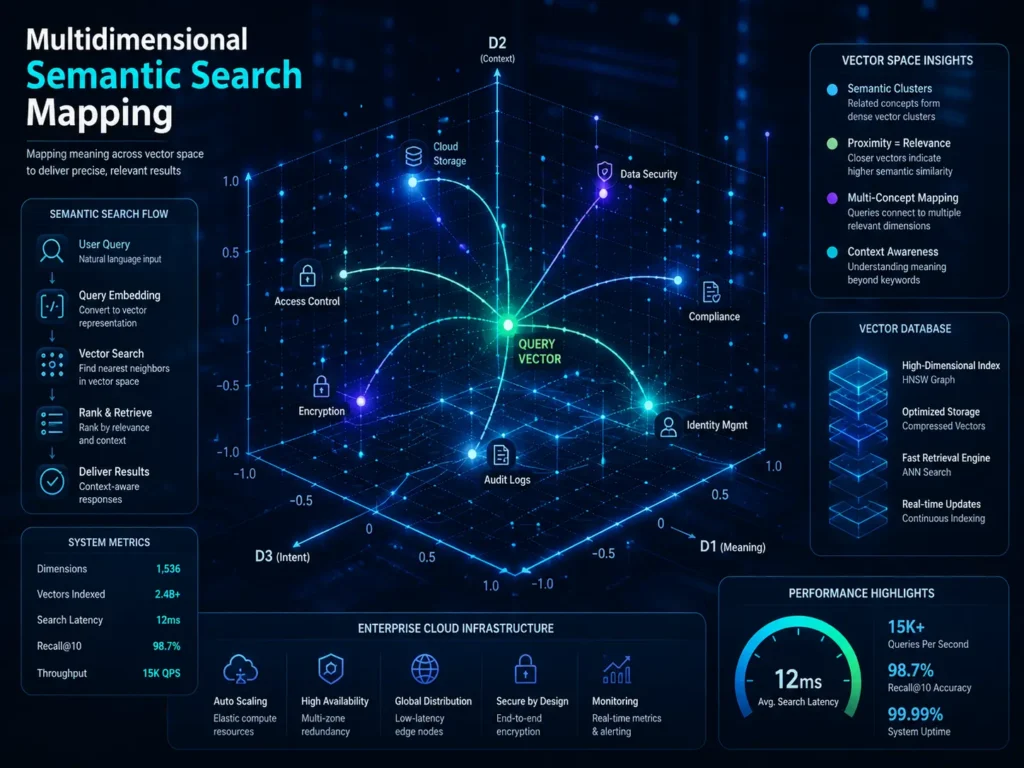
The process involves splitting documents into manageable chunks, converting each chunk into a mathematical representation called an embedding, and storing those embeddings in a specialized vector database. The vector database is designed specifically for semantic search — it can find content that is conceptually related to a query, not just content that contains the exact same keywords.
This ingestion step is where data quality matters most. A RAG system built on well-organized, accurate, up-to-date documentation produces reliable results. One built on messy, contradictory, or outdated documents will produce unreliable results regardless of how well the rest of the system is engineered.
Step 2: Retrieval
When a user submits a query, the system converts that query into an embedding vector and searches the vector database for the most semantically relevant chunks of content from your knowledge base. This is not a keyword search — it is a meaning search. A question about “how we handle enterprise contract cancellations” will retrieve relevant documentation even if those documents use different phrasing like “contract termination procedures for business accounts.”
The retrieval step returns the most relevant sections of your internal documentation, ranked by semantic similarity to the original query. These retrieved chunks become the factual context that gets passed to the language model in the next step.
Step 3: Generation
The retrieved context is combined with the original user query and sent to the language model as a single, augmented prompt. The model generates its response based on this combined input — using the retrieved documentation as its factual grounding and its language capabilities to produce a clear, well-structured answer.
The key difference from a standard chatbot interaction is that the model is explicitly working from content you provided, not from its general training. Most production RAG implementations also return citations alongside the generated response — showing the user exactly which internal documents the answer was derived from. This auditability is critical for business environments where accuracy and accountability matter.
Business Benefits of RAG System Development
Accurate Customer Support at Scale
Customer support teams spend enormous amounts of time looking up answers in product documentation, past ticket resolutions, and internal knowledge bases. A RAG-powered support assistant can retrieve and synthesize that information instantly, giving support agents accurate answers in seconds rather than minutes.
For B2B businesses where support quality directly affects contract renewals, the reduction in resolution time and improvement in answer accuracy translates directly into client satisfaction and retention.
Faster Employee Onboarding
New employees typically spend weeks navigating internal wikis, process documents, and policy guides that were not designed to be searchable. A RAG system turns that documentation into a conversational interface. Instead of searching through folders, new team members can ask questions in plain language and get precise answers drawn from your actual internal content.
Technical Documentation Retrieval
For software and engineering teams, internal documentation — API references, architecture guides, microservice specifications — tends to grow faster than anyone can keep it organized. RAG system development gives developers a way to query that documentation semantically, finding relevant information even when they do not know exactly where it lives or what it is called.
Compliance and Policy Management
For businesses in regulated industries, ensuring that employees consistently apply the correct policies is a significant operational challenge. A RAG system built on your compliance documentation gives employees a reliable, auditable source of policy guidance that is always current and always traceable to the source document.
RAG System Development vs. Fine-Tuning: Key Differences
Many businesses consider fine-tuning an existing model as an alternative to RAG. Understanding the difference helps clarify why RAG is the right choice for most enterprise knowledge base applications.
Feature | Fine-Tuning | RAG System Development
———————–|————————————–|—————————
Knowledge Source | Static model weights | Dynamic external database
Data Update Speed | Slow — requires full retraining | Real-time document sync
Hallucination Risk | High | Very Low
Data Traceability | None — black box output | Fully source-linked
Implementation Cost | Very High | Modular and scalable
Access Control | Not possible | Role-based permissions
Fine-tuning bakes knowledge into the model’s weights at training time. Once trained, that knowledge is static — updating it requires another expensive training run. There is also no way to trace which training data produced a specific output, which makes auditing unreliable.
RAG keeps your knowledge base external and dynamic. You can add, update, or remove documents at any time and the system reflects those changes immediately. Every response can be traced back to the specific documents it was derived from. And because access control can be applied at the retrieval layer, you can ensure that users only retrieve documents they are authorized to see.
For most business knowledge base applications, RAG system development is the practical and cost-effective choice.
Common RAG Implementation Mistakes
Poor Data Hygiene
The most common reason RAG systems underperform is the quality of the underlying data. If your internal documentation is disorganized, contradictory, or outdated, the system will retrieve and synthesize that bad information faithfully. Before building a RAG system, invest time in cleaning and structuring your knowledge base. Accurate, well-organized source documents are the foundation everything else depends on.
Choosing the Wrong Vector Database
Not all vector databases are built for the same scale. A database that works well in development with a few hundred documents may struggle significantly in production with tens of thousands. Choose your vector database based on your realistic production requirements, not your development environment. Popular options include Pinecone, Weaviate, and pgvector for PostgreSQL environments.
Missing Access Control
One of the most serious architectural mistakes in RAG system development is failing to implement access controls at the retrieval layer. Without permission filtering, a junior employee querying the system could potentially retrieve executive financial documents or confidential HR records — not because of a security breach, but because the retrieval system has no awareness of who is asking.
Access control must be enforced at the vector database query level, not just at the application layer. Every retrieval query should inherit the permissions of the authenticated user making the request, so restricted documents are never returned to unauthorized users regardless of how the query is phrased. You can read more about implementing secure enterprise AI pipelines in OWASP’s LLM Application Security guidelines.
No Feedback Loop
A RAG system that is deployed and forgotten will drift in quality over time. User feedback — flagging unhelpful or inaccurate responses — is the primary signal for identifying retrieval gaps and improving the system. Build feedback collection into the interface from day one and review it regularly.
Hardcoded System Prompts
Rigid, static system prompts that do not adapt to the retrieved context limit the quality of responses the model can generate. Your prompt structure should allow the retrieved document chunks to be injected dynamically, giving the model the flexibility to work with whatever content is most relevant to each specific query.
Frequently Asked Questions
Q: What is the biggest advantage of RAG system development over a standard chatbot?
A: The primary advantage is factual accuracy. Standard chatbots generate responses based on their training data, which means they hallucinate when asked about your specific business context. RAG system development grounds every response in your actual internal documents, so answers are accurate, current, and auditable rather than probabilistic guesses.
Q: Is my company data safe in a RAG system?
A: Yes, when the system is properly architected. Your internal documents stay within your infrastructure — they are not sent to or stored by the AI model provider. Role-based access controls at the retrieval layer ensure that users only receive information they are authorized to access. The AI model only sees the specific document chunks that are retrieved for each query.
Q: Do I need a large amount of internal data to start?
A: Not at all. RAG systems work effectively even with a focused set of well-organized documents. A company handbook, a product documentation library, or a support knowledge base is more than sufficient to demonstrate meaningful value. Data quality and organization matter far more than raw volume.
Q: Can RAG system development integrate with our existing WordPress or Shopify platform?
A: Yes, via API-based integration. A RAG system operates as a separate service that can be connected to virtually any existing platform through standard API calls. Whether you want to power a support chatbot on your WordPress site or automate product information retrieval for a Shopify store, the integration is straightforward with the right architecture.
Q: How does RAG system development affect SEO?
A: RAG systems operate as private internal tools, so they do not directly affect SEO. Indirectly, they can improve the speed and quality of content production, help teams generate more accurate structured data, and accelerate the creation of well-researched, technically accurate content — all of which benefit SEO over time.
Q: How is RAG different from just uploading documents to a chatbot?
A: Uploading documents to a consumer chatbot means those documents enter that company’s infrastructure and may be used in ways you cannot control. A properly built RAG system keeps your documents within your own infrastructure, applies your own access controls, and gives you full auditability over what is retrieved and why. It is also significantly more scalable — consumer chatbots have context window limits that make working with large document libraries impractical.
Q: How long does RAG system development typically take?
A: A focused RAG implementation for a specific use case — a support assistant, an HR policy bot, or a technical documentation search tool — can be built and deployed in four to eight weeks for a well-defined scope. Enterprise-grade implementations with multiple data sources, complex access control requirements, and custom frontend interfaces typically take longer depending on the complexity of the existing data infrastructure.
The Bottom Line
RAG system development is the most practical path available right now for businesses that want to deploy AI that is genuinely useful for internal operations rather than just impressive in a demo.
The hallucination problem that makes standard AI tools unreliable for business use is not a fundamental limitation of AI — it is a limitation of AI that has no access to your specific information. RAG solves that limitation directly, by giving the model exactly the context it needs to answer your questions accurately.
The businesses that benefit most from this investment are the ones that treat it as an infrastructure project rather than a software purchase. The quality of your knowledge base, the rigor of your access controls, and the discipline of your ongoing maintenance determine how well the system performs — more than any choice of model or vendor.
If your team is spending significant time searching for information that already exists somewhere in your internal documentation, RAG system development is one of the highest-leverage technology investments available to you right now.
Ready to Build Your RAG System?
We design and build production-grade RAG systems for businesses that need AI grounded in their own data — secure, auditable, and built to scale with your knowledge base.
More Blog

High-Availability Cloud Infrastructure: 5 Proven Steps

Nginx Redis Caching Optimization: 6 Proven Speed Tactics

Content Optimization for AI Search: 5 Proven Steps to Rank



