
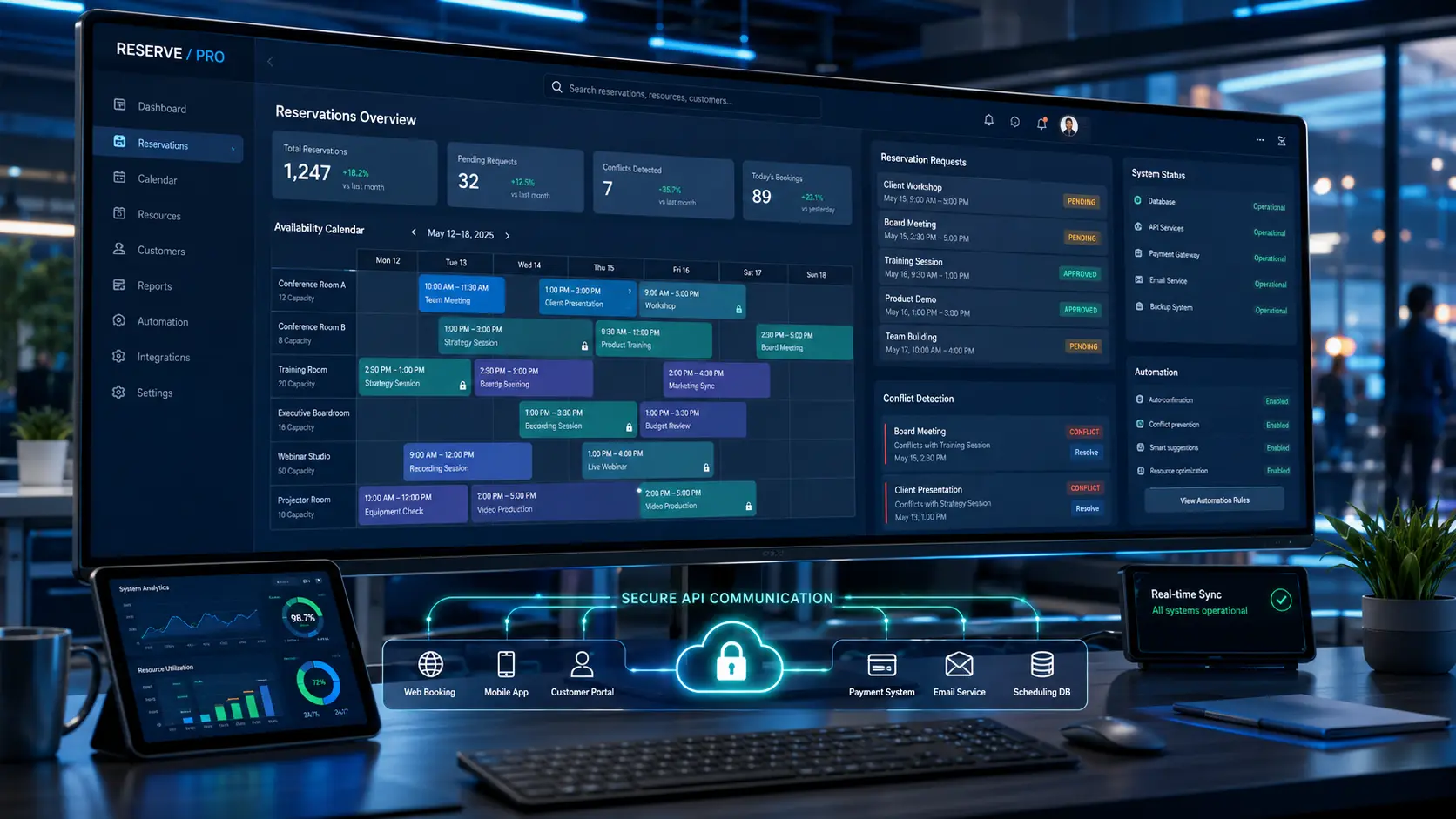
Prevent Double Bookings: 5 Proven Strategies

Prevent Double Bookings: 5 Proven Strategies
If your booking platform has ever confirmed two customers into the same time slot, you already know what it costs — not just in refunds and apologies, but in the quiet erosion of trust that follows. Learning how to prevent double bookings is not just a technical checkbox. For any business that depends on reservations for revenue, it is the foundation everything else is built on.
The frustrating part is that most double bookings are not caused by bad code. They are caused by an architectural gap that is completely invisible until your platform reaches real traffic. Two users open your booking page at the same moment, both see the same slot available, both click confirm — and your system, without the right safeguards in place, says yes to both of them.
This guide walks through exactly why that happens, and the specific technical strategies that prevent it — from database-level locking to Redis caching to real-time calendar sync — explained in plain language for both developers and the business owners who commission them.
Short Answer
To prevent double bookings, you must implement database-level transactional locks — such as SELECT FOR UPDATE in SQL — that ensure only one process can modify a resource’s availability at a time. See the PostgreSQL explicit locking guide for full reference. Move away from client-side validation alone and rely on a robust backend architecture that validates availability immediately before the final commit. For high-traffic platforms, Redis-based distributed locking serializes simultaneous requests before they ever reach the database, maintaining data integrity across all booking channels.
Why Double Bookings Keep Happening
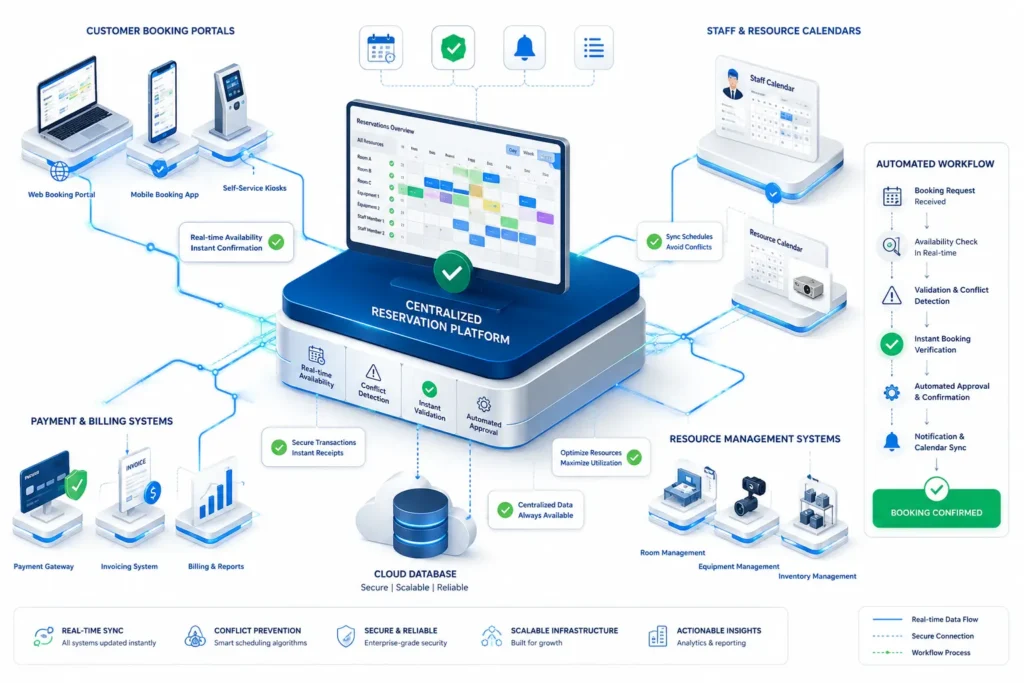
Most entry-level or off-the-shelf booking tools rely on simple check-and-save logic. It works fine when traffic is low. But under real conditions — multiple users browsing and booking simultaneously — this approach has a fundamental vulnerability.
Here is what actually happens. User A checks availability for a time slot. The database says it is free. A few milliseconds later, before User A’s booking has been written to the database, User B checks the same slot. The database still says it is free — because User A’s transaction has not completed yet. Both users proceed. Both bookings are confirmed. One slot, two customers.
This is called a race condition, and in a high-traffic environment it is not just possible — it is statistically inevitable. The solution is not faster code. It is atomic transactions: a design pattern that ensures the entire check-then-reserve sequence happens as a single, indivisible operation that cannot be interrupted by a competing process.
Understanding this distinction is what separates a booking system that works in testing from one that works reliably in production.
Why This Problem Is More Expensive Than It Looks
Most businesses treat double bookings as an operational annoyance. The reality is that they are a revenue and reputation problem that compounds over time.
Every scheduling conflict requires staff time to resolve — rescheduling, refunding, apologizing. At low volume, this is manageable. At scale, it becomes a serious operational drain that pulls your team away from work that actually grows the business.
Beyond the immediate cost, there is the trust problem. A customer who gets bumped from a confirmed reservation experiences your platform at its worst. Even if the issue gets resolved quickly, something has shifted in how they see your business. That impression influences whether they book again, and whether they recommend you to others.
For industries where scheduling errors carry legal or financial consequences — medical appointments, luxury hospitality, rental services — the stakes are even higher. A system that cannot reliably prevent double bookings is a liability, not just an inconvenience.
The good news is that all of these problems are preventable. The architecture exists. It is proven. It just needs to be built correctly from the start.
5 Proven Strategies to Prevent Double Bookings
1. Database-Level Transactional Locking
This is the most reliable foundation for any system designed to prevent double bookings. When a user begins the checkout process for a specific slot, your database places a row-level lock on that record. Any competing request for the same slot is queued and forced to wait until the first transaction either completes or times out.
In SQL, this looks like SELECT … FOR UPDATE inside an atomic transaction block. The key word is atomic — the check and the write happen together as a single operation. There is no window between them where a second request can slip through.
For platforms where availability is strictly limited — event tickets, luxury rentals, medical appointment slots — pessimistic locking like this is the right default. It is slightly more resource-intensive than the alternatives, but it provides absolute guarantees.
2. Optimistic Concurrency Control
For platforms with high traffic but lower competition for individual slots, Optimistic Concurrency Control (OCC) is a more performance-friendly approach. Instead of locking the row upfront, the system adds a version number or timestamp to each reservation record.
When a write is attempted, the system checks whether the version number matches what was read at the start of the session. If another user modified the record in the meantime, the version numbers will not match, and the second request is safely rejected. No lock was held during the entire process, which keeps the system fast and lean under load.
OCC works well for B2B SaaS platforms and standard scheduling applications where the same slot being claimed by two users simultaneously is relatively rare.
3. Redis-Based Distributed Locking
For high-volume SaaS platforms, checking the database for every availability request can become a bottleneck. Redis — an in-memory data store — offers a faster alternative for the initial lock.
Before the database is even queried, the system checks Redis to see if a given slot is currently in-flight for another user. If it is, the request is queued or rejected immediately, without touching the database at all. This dramatically reduces database load during traffic spikes and keeps response times fast even when hundreds of users are booking simultaneously.
Redis locks operate in microseconds, making them ideal for enterprise-scale platforms where database-level locking alone would create performance problems.
4. The Soft Hold Pattern
Rather than waiting for final payment confirmation to mark a slot as booked, implement a temporary reservation. When a user begins the booking flow, the system reserves the slot for a fixed window — typically five to ten minutes. If the user does not complete the transaction within that window, the slot is automatically released back into the available pool.
This solves a real user experience problem: without soft holds, a user can reach the final checkout step only to be told the slot they spent two minutes filling out a form for is no longer available. With soft holds, the slot is guaranteed for them as long as they complete the process in time.
It also protects against a specific type of race condition where the payment processing delay itself creates a window for conflict.
5. API-Level Final Validation
Whether you are building a fully custom system or integrating with third-party calendars like Google Calendar or Outlook, every booking must pass through a final server-side validation check immediately before the reservation is confirmed.
This is the last line of defense. Even if something slips through earlier in the flow — a caching delay, a network timing issue, a frontend bypass — the API validation layer catches it. The check happens synchronously, against the live state of the database, at the exact moment of commit. If the slot is no longer available, the transaction is rejected before any data is written.
Never treat frontend validation as the source of truth. Client-side checks can be bypassed. Backend validation cannot be skipped.
For platforms that also sync with Google Calendar or Outlook, see our full guide on Calendar API integration for enterprise booking systems: /calendar-api-integration-enterprise-bookin
Comparing Concurrency Management Approaches
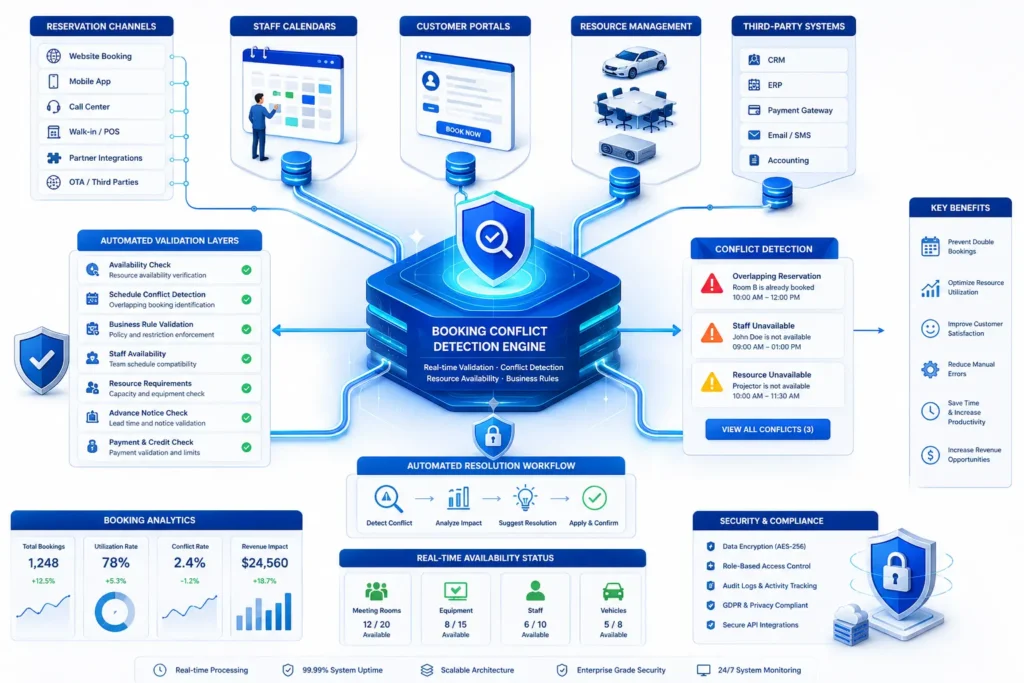
Different platforms have different needs. Here is how the main strategies compare:
Pessimistic Row Locking — Complexity: Moderate | Best For: High-demand tickets, luxury rentals
Optimistic Concurrency — Complexity: Moderate | Best For: B2B SaaS, standard scheduling
Redis Distributed Locking — Complexity: High | Best For: Enterprise SaaS, high-traffic platforms
Message Queue Serialization — Complexity: High | Best For: Multi-tenant apps, viral events
For most growing businesses, the right answer is a combination of these approaches — Redis for speed at the outer layer, database-level locking for absolute integrity at the inner layer, and API validation as the final checkpoint before every commit.
Checklist: Is Your Reservation System Reliable?
Row-Level Locking — Critical | Prevents race conditions at the database level
Atomic Transactions — Critical | Ensures the whole booking succeeds or fails together
Soft Hold / Time Limit — Important | Protects resources during checkout without UX friction
API Final Validation — High | Catches conflicts that slip through earlier layers
Real-Time Calendar Sync — High | Keeps Google and Outlook integrations accurate
UTC Timestamp Storage — High | Prevents timezone-related overlap errors
Redis Caching Layer — Medium | Keeps availability checks fast under load
Common Mistakes That Let Double Bookings Through
Relying on Frontend Validation
Disabling a button in JavaScript does not stop automated scripts or direct API requests. Frontend checks are useful for user experience, but they must never be treated as the final word on availability. All core validation must happen on the server.
Setting Lock Timeouts Too Long
If your database locks hold rows for too long — because a payment gateway is slow or a user walked away mid-checkout — you create a bottleneck that freezes your booking queue for everyone else. Always set strict, reasonable timeout limits and pair them with the soft hold pattern so users are notified cleanly when a hold expires.
Ignoring Time Zone Handling
Storing reservation times in local time zones instead of UTC is a slow-burning problem. As your platform serves users across regions, inconsistent time zone handling creates overlapping slots that your system genuinely cannot detect. Always normalize to UTC at the database level and convert to local time only at the display layer.
Missing Composite Database Constraints
Even with all your application-level logic working correctly, adding unique composite keys across your time and resource columns in the database gives you a final safety net. If something slips through every other layer, the database itself will reject the duplicate write.
Skipping Error State Design
When a transaction fails — because the slot was taken, a lock timed out, or a payment did not process — the system needs to handle it gracefully. Users should receive a clear, friendly explanation and be offered alternatives. Silent failures that leave users confused about whether their booking went through are a support ticket waiting to happen.
Frequently Asked Questions
Q: Does my website really need custom code to prevent double bookings?
A: If you are using a standard plugin with low traffic, maybe not. But if your business depends on reservations for revenue — especially at scale — custom development provides the transactional integrity that off-the-shelf tools often lack. Most plugins do not implement atomic transactions or distributed locking, which means they are vulnerable to race conditions under real traffic conditions.
Q: What is a race condition in the context of bookings?
A: A race condition occurs when two users attempt to book the same slot at the same moment. If your system checks availability and writes the booking as two separate steps — rather than as a single atomic operation — both users can pass the availability check before either booking is written. The result is two confirmed bookings for one slot.
Q: Does database row locking slow down my platform?
A: When implemented correctly, the performance impact is minimal. Row locks only affect users competing for the exact same slot at the exact same moment, which is a small fraction of total traffic. Combining database locking with Redis caching at the outer layer keeps your platform fast for the vast majority of users while maintaining absolute integrity for the edge cases.
Q: Can you integrate a reservation system with Google Calendar?
A: Yes. Real-time bi-directional API integration ensures your internal reservation database stays perfectly in sync with Google Calendar, Outlook, or Apple Calendar. The moment a slot is confirmed or released on either side, both systems update instantly via webhook notifications.
Q: How does a soft hold improve user experience?
A: It prevents the frustration of a user reaching the final checkout step only to be told the slot they just spent time filling out a form for is no longer available. By reserving the slot for the duration of the checkout window, you guarantee the user their time if they complete the transaction — while still releasing it back to the pool if they abandon the process.
Q: Is database locking the only solution to double bookings?
A: Database locking is the most reliable single layer, but a production-grade system should combine multiple approaches: Redis locking for speed, atomic database transactions for integrity, soft holds for UX, and final API validation as the last checkpoint. No single layer is completely foolproof on its own.
Q: How do time zone differences cause double bookings?
A: If your system stores reservation times in local time zones rather than UTC, a slot booked at 9 AM by a user in one region can appear as available to a user in another region whose local time reads differently. Always store in UTC and convert to local time at the display layer only.
The Bottom Line
Preventing double bookings is not about finding a single fix. It is about building a system where every layer — the database, the cache, the API, the frontend — works together to make conflicts structurally impossible rather than just unlikely.
The businesses that get this right invest in the architecture early, before scaling pressure exposes the gaps. The ones that get it wrong spend far more patching problems in production, managing angry customers, and rebuilding trust that took years to establish.
If your platform is still relying on basic check-and-save logic, the risk is real — and the fix is well within reach. The patterns described in this guide are proven, well-documented, and implementable at any stage of your platform’s development.
Ready to Build a Conflict-Free Booking System?
We design and build custom reservation platforms with the database architecture, caching layers, and API integrations that eliminate scheduling conflicts before they happen.
More Blog

High-Availability Cloud Infrastructure: 5 Proven Steps

Nginx Redis Caching Optimization: 6 Proven Speed Tactics

Content Optimization for AI Search: 5 Proven Steps to Rank



