

OpenAI API vs Self-Hosted AI: 5 Powerful Facts for Business

OpenAI API vs Self-Hosted AI Models: Which Is Better for Business Workflows?
The decision between OpenAI API vs self-hosted AI is one of the most consequential infrastructure choices a business can make right now — and it is being made too quickly by too many teams.
On the surface, it looks like a simple cost comparison. API pricing versus server costs. But the real trade-offs go much deeper than that. The infrastructure path you choose determines how quickly you can ship, how much control you have over your data, what your costs look like as you scale, and how much engineering capacity gets consumed by infrastructure maintenance versus actual product development.
Neither option is universally better. The OpenAI API vs self-hosted AI debate comes down to what your business actually needs — and on being honest about the operational realities of each approach, not just the theoretical advantages.
This guide walks through every dimension of the decision: cost, performance, data privacy, compliance, scalability, and operational burden — so you can make the choice that fits your specific situation rather than following a trend.
Short Answer
For most businesses, the OpenAI API is the better starting point. It requires minimal setup, no infrastructure management, and gives you immediate access to high-performance models. Self-hosted AI models make sense when you have strict data residency requirements, very high and predictable inference volumes, or a specific need to operate entirely outside third-party ecosystems. The most practical path for most companies is to start with an API, validate the use case, and evaluate self-hosting only when compliance or long-term cost efficiency at scale makes it the clear choice.
Why This Decision Matters More Than Most Businesses Realize
Choosing between OpenAI API vs self-hosted AI is not just a technical preference. It is a decision that touches your operating costs, your data security posture, your engineering team’s capacity, and your ability to move quickly when the market demands it.
Get it right and your AI infrastructure becomes a competitive advantage — fast to deploy, cost-appropriate for your scale, and aligned with your compliance requirements. Get it wrong and you end up in one of two painful situations: an API bill that grows faster than your revenue, or an engineering team spending most of its time managing infrastructure instead of building the product.
The financial stakes are real. API costs that seem negligible at low volume can become significant at scale. Self-hosting costs that seem manageable on paper can balloon when you factor in the full reality of GPU infrastructure, engineering hours, and the operational overhead of keeping a machine learning system running reliably in production.
Understanding the full picture of each approach — not just the headline numbers — is what makes this decision something you can get right rather than something you have to fix later.
What Each Approach Actually Means
Before comparing the two, it helps to be precise about what you are actually choosing between.
OpenAI API: Managed Intelligence
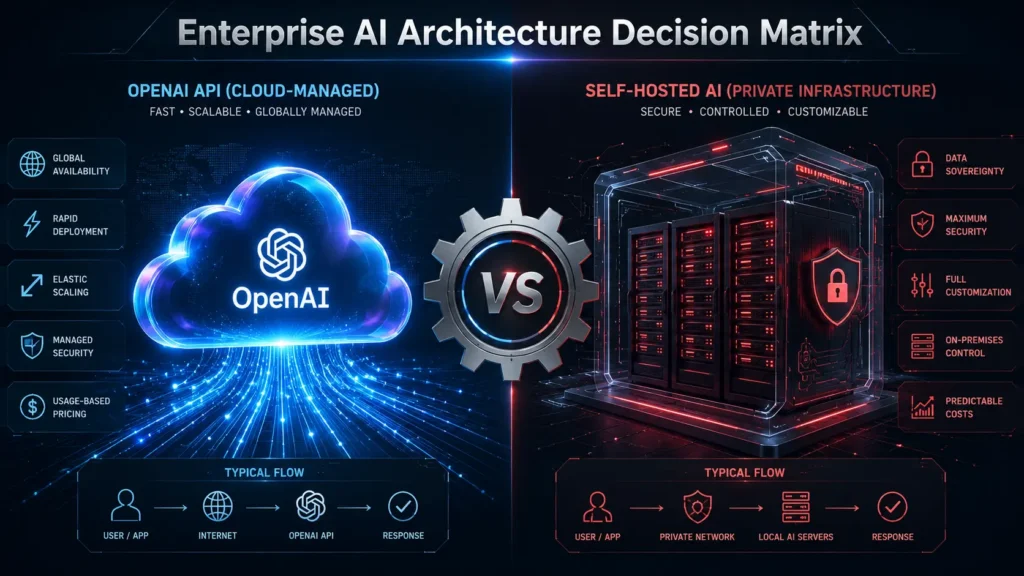
When you use the OpenAI API, you are sending requests to OpenAI’s infrastructure and receiving responses. Your application does not run the AI model — it communicates with a model that OpenAI hosts, maintains, and updates. You pay per token consumed. The model’s weights, the servers it runs on, the hardware optimization, the security patching — none of that is your responsibility.
This is the same model that powers ChatGPT, which means you are accessing genuinely frontier-level performance. The tradeoff is that your data leaves your infrastructure when you make an API call, and your costs are variable based on usage volume.
Self-Hosted AI: Private Deployment
When you self-host an AI model, you download an open-weights model — such as Meta’s Llama series or Mistral — and run it on infrastructure you control. That infrastructure might be your own servers, a private cloud environment on AWS or Google Cloud, or a dedicated GPU provider.
Your data never leaves your infrastructure. Your costs are largely fixed regardless of query volume. But you are now responsible for everything: the hardware, the model serving software, performance optimization, security updates, scaling, and the engineering expertise to keep it all running.
Neither of these is a simple solution. Both come with real operational implications that are easy to underestimate before you have lived with them.
5 Key Dimensions of the OpenAI API vs Self-Hosted AI Decision
1. Speed to Market
If your goal is to launch an AI-powered feature quickly — whether that is a chatbot, a content generation tool, a document summarizer, or an internal assistant — the OpenAI API is dramatically faster to implement. You get an API key, make your first call in a few lines of code, and you are running. There is no infrastructure to provision, no model to download and configure, no serving environment to set up.
Self-hosting requires building an entire inference stack before you can make your first request. Depending on your team’s familiarity with the tooling, that setup process can take days to weeks. For a business trying to validate whether an AI feature is worth building at all, that delay has real cost.
2. Data Privacy and Compliance
This is where self-hosting has a clear and significant advantage that no amount of API optimization can fully replicate.
When you use the OpenAI API, your prompts and the data within them travel to OpenAI’s servers. OpenAI has strong data privacy commitments — enterprise agreements that include data processing terms, and a clear policy that API data is not used for model training by default. For many businesses, that is sufficient.
For others, it is not. Healthcare organizations handling protected health information, financial institutions with strict data residency requirements, government contractors operating under specific security frameworks, and any business where legal or regulatory requirements mandate that sensitive data must never leave a controlled environment — these organizations often cannot use a managed API for certain workflows, regardless of the vendor’s privacy commitments.
For these use cases, self-hosting is not a cost optimization. It is a compliance requirement.
3. Cost at Scale
At low to medium request volumes, the OpenAI API vs self-hosted AI cost comparison almost always favors the API when you factor in total cost of ownership. You pay only for what you use. There is no idle infrastructure, no GPU sitting unused at 3 AM, no engineering team managing servers.
At very high and consistent volumes — millions of requests per month with predictable load patterns — self-hosting can become cheaper. The fixed cost of infrastructure and engineering is spread across a large volume of requests, and the per-request cost drops significantly compared to API pricing.
The key word is consistent. Self-hosting economics only work in your favor when your inference volume is high enough and stable enough to keep your infrastructure utilized efficiently. Spiky, unpredictable workloads tend to favor API pricing because you only pay for what you actually use.
4. Model Performance
For most business applications, the performance gap between frontier API models and the best available open-weights models has narrowed significantly in recent years. For standard tasks — summarization, classification, content generation, question answering — self-hosted models can perform excellently.
Where managed APIs still hold a meaningful advantage is at the frontier of reasoning, complex multi-step problem solving, and advanced multimodal capabilities. The most capable models available today are proprietary, and accessing them requires using an API. If your workflow depends on the absolute best available performance, self-hosting will likely require accepting some performance trade-off.
5. Operational Burden
This is the dimension that businesses most consistently underestimate when they first consider self-hosting.
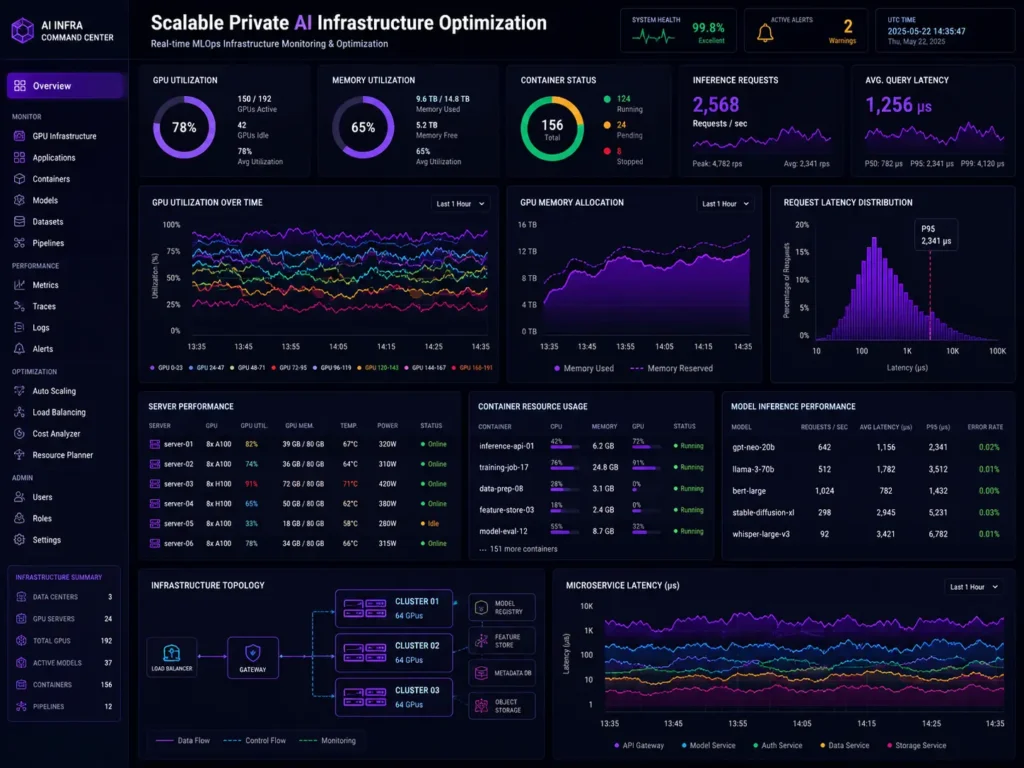
Running an AI model in production is not like running a web server. Models require specific hardware, careful memory management, and ongoing maintenance as new versions are released. Performance can degrade in unexpected ways. When something breaks at an inconvenient time, someone on your team needs to fix it.
If your engineering team’s core competency is building software products rather than managing machine learning infrastructure, the operational burden of self-hosting will consistently compete with your product roadmap for engineering attention. That is a real cost that does not appear in any infrastructure pricing comparison.
Common Mistakes When Choosing Between OpenAI API vs Self-Hosted AI
Assuming Self-Hosting Is Free
Open-weights models are free to download. Running them is not. GPU infrastructure, storage, networking, and the engineering hours required to build and maintain a production inference environment add up quickly. Many businesses discover this only after committing to self-hosting and facing their first infrastructure invoice.
Underestimating Operational Overhead
A self-hosted AI system needs someone responsible for it around the clock. Model updates, security patching, performance degradation, unexpected failures — these are not hypothetical edge cases. They are routine realities of running infrastructure. If your team does not have dedicated capacity for this, the ongoing burden will surface as delays, incidents, and distraction from your core product.
Self-Hosting Before Validating the Use Case
Choosing to self-host before you have proven that your AI feature delivers business value is a common and expensive mistake. Building infrastructure for an unvalidated use case means you may spend significant resources on something that turns out not to work as expected. Validate with an API first, then optimize infrastructure once the value is clear.
Ignoring the Vendor Lock-In on Both Sides
API integrations create dependency on a specific provider’s pricing, availability, and policy decisions. But poorly architected self-hosted pipelines can be equally rigid — harder to update, harder to migrate, and harder to hand off to a new team. Good architecture keeps both options flexible.
Not Building Evaluation Pipelines
Regardless of which approach you choose, failing to build automated testing for your model outputs leads to inconsistent results that erode user trust over time. Evaluation pipelines should be part of your implementation from day one, not something added after problems emerge.
For businesses also managing AI-powered content workflows, see our guide on AI product description generation: /ai-product-description-generation
Frequently Asked Questions
Q: Is self-hosting actually cheaper than the OpenAI API?
A: Only at very high and consistent inference volumes. For most small to mid-sized businesses, the combined cost of GPU infrastructure, engineering hours, and operational overhead exceeds the per-token costs of an API. Self-hosting economics only favor businesses with millions of monthly requests and stable, predictable load patterns.
Q: Can I use the OpenAI API in a regulated industry?
A: Yes, in many cases. OpenAI offers enterprise agreements that include data processing commitments, and many healthcare and financial organizations use managed APIs with appropriate legal agreements in place. However, some regulatory frameworks mandate that certain data types must never leave your controlled infrastructure — in those cases, self-hosting may be required for specific workflows.
Q: What is the biggest operational risk of self-hosting?
A: The biggest risk is the ongoing maintenance burden and the cost of unexpected downtime. When a self-hosted inference server fails, your team is responsible for diagnosing and fixing it. This requires dedicated engineering capacity that many businesses underestimate when they first plan a self-hosting strategy.
Q: Can I start with the OpenAI API and switch to self-hosting later?
A: Yes, and this is the recommended path for most businesses. Start with an API to validate your use case and build your application logic. Once you have proven the value and have a clear picture of your inference volume, you can evaluate whether self-hosting makes financial or compliance sense for specific workflows.
Q: Which option gives better AI performance?
A: Managed APIs currently provide access to the most capable frontier models, which gives them an edge for complex reasoning and advanced capabilities. For standard business tasks — summarization, classification, document processing — well-configured open-weights models can perform comparably. The performance gap is narrowing, but frontier models remain behind managed APIs.
Q: What open-weights models are worth considering for self-hosting?
A: Meta’s Llama series and Mistral’s models are among the most capable open-weights options currently available. The right choice depends on your specific task requirements, your infrastructure capacity, and the performance benchmarks most relevant to your use case.
Q: How do I decide which approach is right for my business?
A: Start by answering three questions. Does your compliance or legal framework require that data stays within your infrastructure? If yes, self-hosting is likely required for sensitive workflows. Is your expected inference volume high enough and consistent enough to make fixed infrastructure costs competitive with per-token pricing? If yes, self-hosting may be worth evaluating. Does your team have the engineering capacity to build and maintain an ML inference stack without significantly impacting your product roadmap? If no, the API is almost certainly the better choice regardless of other factors.
The Bottom Line
The OpenAI API vs self-hosted AI decision does not have a universal right answer. It has a right answer for your specific business at your specific stage — and that answer is most likely to change over time as your scale, compliance requirements, and engineering capacity evolve.
For most businesses today, the API is the better starting point. The speed advantage, the zero infrastructure overhead, and the access to frontier model performance make it the right choice for validating use cases and building initial products. The businesses that benefit most from self-hosting are those with genuine compliance requirements that cannot be met by vendor agreements, or those operating at a scale where the fixed cost of infrastructure is clearly lower than variable API pricing.
The most important thing is to make the decision deliberately — with a clear-eyed view of the full operational cost of each option, not just the headline pricing. And to build your architecture in a way that keeps future migration possible, whichever direction you start from.
Ready to Build Your AI Infrastructure?
We help businesses design and implement the right AI architecture for their specific needs — whether that means connecting managed API endpoints, building self-hosted inference pipelines, or designing hybrid systems that use both.
More Blog

High-Availability Cloud Infrastructure: 5 Proven Steps

Nginx Redis Caching Optimization: 6 Proven Speed Tactics

Content Optimization for AI Search: 5 Proven Steps to Rank



