

Node.js vs Laravel SaaS: 7 Proven Backend Differences

Node.js vs Laravel SaaS: 7 Proven Backend Differences
Key Takeaways: Quick Summary for SaaS Founders
Understanding the Node.js vs Laravel SaaS comparison is critical before making any architectural decision.
Laravel’s Strengths: Best for rapid MVP launches, traditional B2B SaaS platforms, and heavy CRUD architectures due to its built-in subscription billing, authentication, and structured queues.
Node.js’s Strengths: Ideal for highly interactive, real-time collaboration platforms, live streaming applications, and event-driven microservices requiring extreme concurrency.
Time-to-Market: Laravel significantly lowers initial development time by eliminating infrastructure setup complexity. Node.js offers limitless flexibility but requires building core systems from scratch.
Stack Uniformity: Node.js allows a unified frontend and backend language in JavaScript or TypeScript, whereas Laravel enforces strict structural guidelines that guarantee long-term code maintainability.
Introduction: The High-Stakes Backend Decision
If you are planning to build a scalable SaaS application, choosing the right backend is one of the most consequential technical decisions you will make. Pick the right stack, and you accelerate your time-to-market while laying a solid foundation for growth. Choose incorrectly, and your engineering team will spend months dealing with technical debt and structural bottlenecks instead of shipping features that drive revenue.
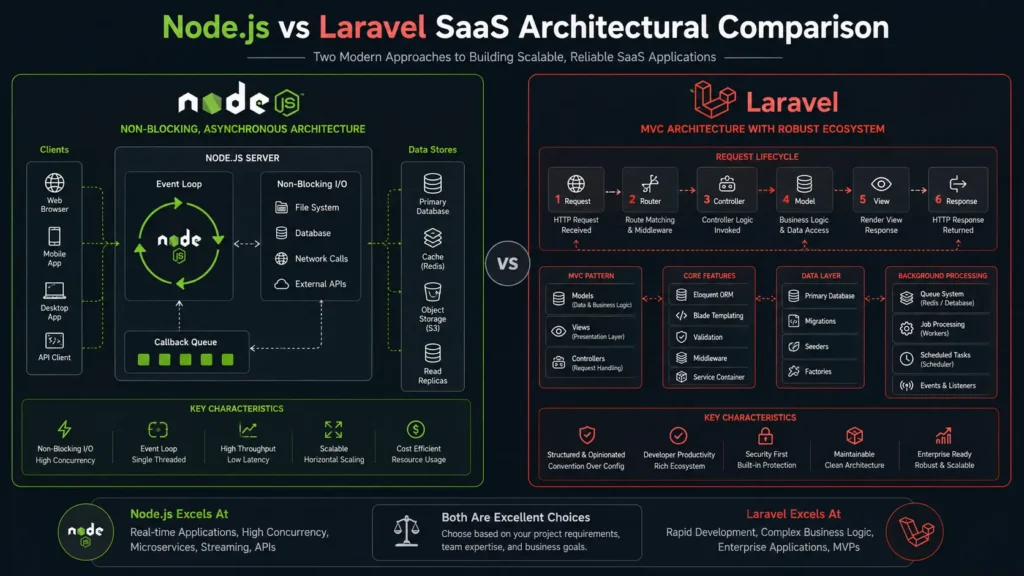
The Node.js vs Laravel SaaS debate is one of the most important architectural choices a founder can make. Both are battle-tested and power some of the most successful web platforms in the world. However, they solve engineering problems using fundamentally different philosophies. Laravel offers a structured, batteries-included ecosystem built for rapid business application development. Node.js provides a lightweight, highly concurrent, event-driven runtime ideal for real-time data streaming and microservices.
From an engineering perspective, this is not just a language debate between JavaScript and PHP — it is a strategic business decision about how you plan to scale, manage your technical team, and deliver your product to market. According to the Stack Overflow Developer Survey 2024, Node.js is the most-used web technology for the twelfth consecutive year, while PHP continues to power a significant portion of the world’s web infrastructure — giving both choices a deep and active talent pool to draw from.
Quick Answer: Node.js vs Laravel SaaS — Which Should You Choose?
Choose Laravel for your SaaS backend if you need rapid MVP development, built-in subscription billing, robust security, and a ready-made structure for traditional business logic. Choose Node.js if your SaaS product relies heavily on real-time collaboration, live data streaming, or high-concurrency microservices. Both scale effectively, but Laravel reduces initial development time and costs significantly, while Node.js maximizes raw I/O performance and enables a unified JavaScript stack across frontend and backend.
1. Why This Decision Matters for Your Business
When product owners evaluate the Node.js vs Laravel SaaS options, they are often overwhelmed by technical jargon. Here is why this decision has direct business consequences beyond the code.
Cost Impact and Time-to-Market: The framework you choose determines how many third-party tools you need to integrate manually. A batteries-included framework like Laravel accelerates your launch and saves significant engineering costs in the early stages, letting you validate your product faster before committing to larger infrastructure investments.
Scalability: As your user base grows, your backend must keep up. Your framework choice determines whether you scale horizontally through microservices or vertically through caching and server upgrades. Both Node.js vs Laravel SaaS architectures support enterprise-scale traffic — but through different approaches that need to be planned from the start.
Maintenance Impact: Over a three to five year product lifecycle, maintenance accounts for the majority of software costs. A well-structured codebase lets new developers onboard quickly, while a loosely organized runtime can lead to inconsistent architecture if coding standards are not strictly enforced from day one.
User Experience and Conversion: Slow API response times create a sluggish frontend experience. If your SaaS feels unresponsive, users leave. The right backend choice optimizes server response times and ensures a snappy, reliable experience that keeps paying customers engaged.
SEO and Discoverability: For user-facing SaaS products and marketing sites, fast server-side rendering and efficient database queries are critical for technical SEO performance and passing Core Web Vitals standards.
Risk Reduction: Established frameworks provide built-in protection against common vulnerabilities like SQL injection, CSRF, and XSS attacks, protecting your customer data and reducing your legal compliance exposure.
2. Core Concepts: Understanding Node.js and Laravel
To make an informed Node.js vs Laravel SaaS decision, it helps to understand what each technology actually is and how they differ at a fundamental level.
Node.js — The Event-Driven JavaScript Runtime: Node.js is not a framework — it is a backend runtime environment built on Google Chrome’s V8 JavaScript engine. It executes JavaScript on the server side and is well known for its non-blocking, event-driven architecture. Node.js can handle thousands of concurrent requests simultaneously without waiting for slow tasks like database queries to complete before processing the next request. Because it is unopinionated by nature, it relies on external frameworks like Express.js or NestJS to provide application structure.
Laravel — The Batteries-Included PHP Framework: Laravel is a comprehensive Model-View-Controller (MVC) framework built on PHP. Unlike Node.js, which requires you to assemble your own package stack, Laravel comes with standardized solutions for almost everything a SaaS business needs out of the box — authentication, database management through Eloquent ORM, background job queues, email handling, and API scaffolding. Its predictable structure means any experienced developer can step into an existing codebase and immediately understand how it is organized.
3. Architecture and Development Speed
In the Node.js vs Laravel SaaS development comparison, speed is rarely about processor execution — it is about how quickly your team ships features.
With Laravel, development speed is exceptionally high for traditional SaaS models. Because it includes a complete ecosystem — Laravel Cashier for Stripe and Paddle subscription billing, Laravel Sanctum for API authentication, and robust database migration tools — developers do not need to rebuild common systems from scratch. A small engineering team can launch a secure, multi-tenant SaaS application in a fraction of the time compared to assembling a custom stack. The convention-over-configuration approach eliminates setup decision fatigue and keeps the team focused on building product.
Node.js, by contrast, takes a build-it-yourself approach. Because the runtime is unopinionated, your team must choose a routing library, decide how to handle database connections using tools like Mongoose or Prisma, and architect authentication from the ground up. While this provides unlimited flexibility and works well for highly custom microservices, it naturally slows down the initial MVP phase of a standard SaaS product. Time is spent configuring infrastructure rather than building the business logic that generates revenue.
4. Performance, Scalability, and Concurrency
When comparing Node.js vs Laravel SaaS performance, it is important to separate raw execution benchmarks from real-world application performance under production conditions.
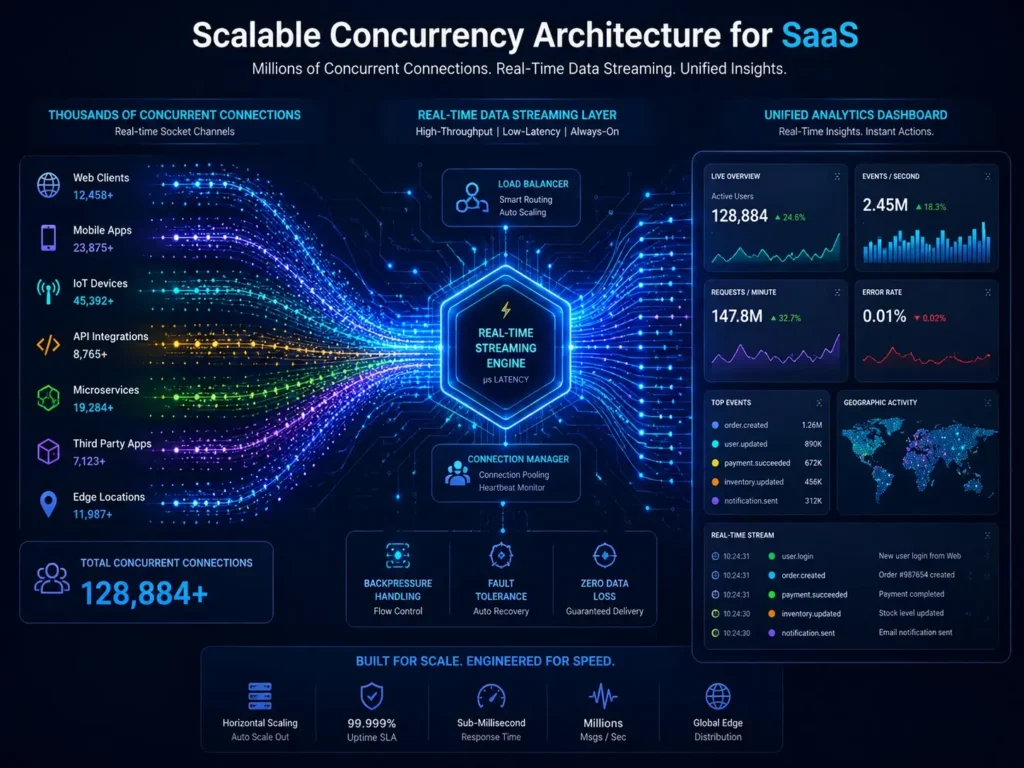
Node.js dominates in high-concurrency environments. Its asynchronous, single-threaded event loop handles thousands of simultaneous operations with minimal CPU overhead. If your SaaS is an analytics dashboard processing millions of real-time events, or a large IoT management platform, Node.js is purpose-built for this workload. It scales horizontally with ease, making it a natural fit for enterprise microservices architectures.
With modern tools like Laravel Octane keeping the application loaded in memory, Redis caching, and intelligent database indexing, Laravel applications handle massive enterprise workloads without issue.
5. Real-Time Capabilities and Modern Web Use Cases
If real-time interaction is the core value of your SaaS product, the Node.js vs Laravel SaaS choice leans clearly in one direction.
Node.js feels native to real-time development. WebSockets and WebRTC integrate seamlessly with Node.js, making it the top choice for collaborative tools like Figma or Notion-style editors, live streaming backends, multiplayer game servers, and live financial trading dashboards. Its non-blocking architecture means it handles thousands of persistent open connections without degrading performance.
Laravel can handle real-time features using first-party tools like Laravel Reverb or third-party integrations like Pusher and Socket.io. However, if your entire application is built around continuous two-way real-time data flow, Node.js provides a more natural and resource-efficient architecture that requires fewer workarounds to maintain at scale.
6. Security and Compliance in SaaS Backends
When evaluating Node.js vs Laravel SaaS security, Laravel has a clear advantage out of the box.
Security is non-negotiable in SaaS development, particularly when handling sensitive user data, financial transactions, or healthcare records.
Laravel provides strong built-in security from day one. It natively protects against the most common web vulnerabilities including SQL injection, cross-site scripting (XSS), and cross-site request forgery (CSRF). Its Eloquent ORM uses PDO parameter binding by default, ensuring secure database queries. Because these protections are tightly integrated into the framework itself, the risk of developer error introducing a security gap is significantly lower.
Node.js is highly capable from a security standpoint, but the responsibility falls entirely on the development team. Because you assemble multiple third-party npm packages for authentication, input validation, and session management, the attack surface is wider. Maintaining security in a Node.js environment requires strict dependency monitoring, regular package updates, and experienced engineering oversight to ensure vulnerabilities are not introduced through outdated modules.
7. Total Cost of Ownership and Ecosystem Lifespan
The Node.js vs Laravel SaaS total cost comparison often surprises founders who focus only on hourly development rates.
Total Cost of Ownership covers hosting, server maintenance, technical debt resolution, and developer salaries across the full lifespan of the product.
Laravel typically delivers a lower total cost for bootstrapped startups, mid-sized businesses, and lean agencies. PHP hosting is widely available and inexpensive. More importantly, Laravel’s strict conventions mean that if an agency builds the MVP and later hands the project over to an internal team, the new developers can take over quickly without needing an extended onboarding period. The standardized structure prevents the inconsistent codebase patterns that often appear in rapidly built applications.
Node.js enables a unified JavaScript stack, often referred to as the MERN stack — MongoDB, Express, React, and Node.js. Using a single language across frontend and backend means you can hire versatile full-stack developers who can contribute anywhere in the codebase. However, because Node.js supports such diverse architectural approaches, a poorly managed codebase can accumulate technical debt quickly. Without strong technical leadership enforcing consistent standards, a fragmented Node.js SaaS becomes expensive to maintain over time.
8. Decision Framework: Choosing Between Node.js and Laravel
Choose Laravel if:
– You are building a standard B2B SaaS, CRM, LMS, eCommerce backend, or multi-tenant portal.
– You need to launch a secure MVP quickly on a reasonable budget.
– Your application relies heavily on complex business logic, CRUD operations, and relational databases like MySQL or PostgreSQL.
– You want built-in tools for background jobs, queued emails, and subscription billing without assembling third-party packages.
Choose Node.js if:
– You are building a highly interactive real-time collaboration tool.
– You anticipate massive concurrent API traffic and need a microservices architecture from day one.
– Your application requires heavy data streaming, WebRTC, or thousands of persistent socket connections.
– Your team is deeply invested in a JavaScript and TypeScript ecosystem and wants a unified full-stack workflow.
9. Node.js vs Laravel: Technical Feature Matrix
Feature | Node.js (Express/NestJS) | Laravel (PHP)
—|—|—
Architecture | Event-driven, non-blocking I/O | MVC, synchronous request-response
Best For | Real-time apps, streaming, microservices | SaaS products, CRUD apps, custom portals
Development Speed | Moderate (requires custom assembly) | Very Fast (batteries-included ecosystem)
Built-in SaaS Tools | No (relies on external npm packages) | Yes (auth, billing, queues built-in)
Concurrency Handling | Excellent (native async event loop) | Good (requires cache and queue setup)
Security Handling | Manual (requires package configuration) | Built-in (CSRF, XSS, SQLi protection)
Primary Language | JavaScript / TypeScript | PHP
10. Common Mistakes to Avoid When Choosing a SaaS Stack
When selecting a backend for a SaaS application, engineering teams and founders fall into the same predictable traps. Here are the most common Node.js vs Laravel SaaS mistakes to avoid.
Choosing Node.js purely for speed without actually needing it: A very common mistake is selecting Node.js because benchmarks show it is faster, even when the SaaS product is a straightforward CRUD application. The setup overhead is often wasted when the application does not require real-time capabilities or extreme concurrency.
Underestimating Laravel’s ability to scale: Many founders wrongly assume PHP cannot handle high traffic. In real-world projects, poor database indexing, missing caching layers, and unoptimized queries cause bottlenecks — not the Laravel framework itself. With horizontal scaling and load balancers in place, Laravel handles enterprise-grade traffic reliably.
Forcing microservices too early: Startups often choose Node.js specifically to build a microservices architecture from day one. This introduces significant DevOps overhead before the product has validated its market fit. A well-structured Laravel application is usually faster to build, easier to deploy, and simpler to maintain during the early years of a SaaS product.
Pro Tip: Focus on building a clean, well-organized single application during your early growth phase. Moving to separate services should only happen when specific parts of your product face traffic demands that genuinely require independent scaling.
Ignoring team expertise: Selecting a backend technology that your current team does not know well will slow your launch significantly. The best technology is often the one your engineers can execute confidently and consistently.
Neglecting long-term maintainability: Choosing an unopinionated stack like Node.js without enforcing strict coding standards leads to a fragmented codebase as different developers introduce their own preferred packages and patterns over time.
Overlooking ecosystem maintenance costs: With Laravel, tools for routing, validation, and email are built and maintained by the framework team. With Node.js, you must continuously monitor, update, and patch dozens of individual third-party packages, which increases both security risk and ongoing maintenance time.
Failing to plan for background jobs: SaaS applications need reliable background job processing for tasks like sending emails, processing payments, and generating reports. Laravel has an exceptional built-in queue system for this. If you choose Node.js, establish a clear strategy using tools like Redis or BullMQ to handle background processing without blocking the main event loop.
11. Frequently Asked Questions
Q: Which is better for a SaaS MVP — Node.js or Laravel?
A: For most traditional SaaS MVPs, Laravel is the stronger choice. Its batteries-included ecosystem provides ready-made tools for authentication, database management, and email routing, allowing teams to launch a functional and secure MVP significantly faster than assembling a custom Node.js stack from scratch.
Q: Can Laravel handle high traffic and scale effectively?
A: Yes. While Laravel uses a synchronous request model, it scales very well through horizontal server scaling, Redis caching, database read and write splitting, and background job queues. Tools like Laravel Octane boost performance further, allowing it to handle enterprise-level traffic reliably.
Q: Why is Node.js preferred for real-time applications?
A: Node.js uses a non-blocking event loop that keeps thousands of connections open simultaneously without consuming excessive server memory. This makes it the natural choice for live chat tools, collaborative editing platforms, and real-time data streaming where instant two-way communication is essential.
Q: Is it cheaper to host Laravel or Node.js?
A: Generally, Laravel is cheaper and easier to host in the early stages. PHP runs efficiently on standard, low-cost virtual private servers and shared hosting environments. Node.js often requires slightly more involved DevOps configuration, though modern cloud platforms have significantly narrowed this gap in recent years.
Q: Do I need a microservices architecture for my SaaS?
A: Most SaaS platforms do not need microservices from day one. A well-organized single application — often built with Laravel — is easier to maintain, test, and deploy. Microservices built with Node.js should only be adopted when specific parts of your product face traffic volumes that require truly independent scaling.
Q: Can I use Node.js and Laravel together?
A: Yes. A common enterprise pattern is a hybrid approach — using Laravel to manage core application logic, subscription billing, and standard APIs, while deploying a separate Node.js service to handle real-time components like live messaging or WebSocket connections.
Q: What is the final verdict on Node.js vs Laravel SaaS development?
A: The Node.js vs Laravel SaaS decision depends entirely on your product type and team strengths. Laravel wins for rapid MVP development and structured business logic. Node.js wins for real-time, high-concurrency applications. Both are production-ready and proven at scale — your specific use case and team expertise determine the right choice.
12. Conclusion: Launching Your SaaS on a Resilient Foundation
Designing a scalable SaaS architecture requires more than picking a popular programming language — it requires technical foresight and a clear understanding of how your product needs to grow. Whether you are evaluating the Node.js vs Laravel SaaS options for the first time or reconsidering an existing stack, the right choice comes down to your product type, your team’s strengths, and your timeline.
Laravel delivers the fastest path to a secure, structured MVP with the lowest initial overhead. Node.js delivers maximum concurrency and flexibility for real-time, high-traffic products built around a unified JavaScript team. Neither is universally better — both are excellent choices when matched correctly to the product they are powering.
At MarkupMarvel, we help agencies, SaaS founders, and enterprise teams navigate these architectural decisions and build platforms that scale without accumulating crippling technical debt. Whether your product needs the real-time power of a <a href=”/services/mern-stack-saas-development/”>MERN Stack and SaaS Development</a> setup, or the rapid structured stability of <a href=”/services/laravel-development/”>Laravel Engineering</a>, our consultants audit your business logic, evaluate your growth projections, and implement the right architecture for your product.
From <a href=”/services/rapid-mvp-development/”>Rapid MVP Development</a> to full-scale <a href=”/services/headless-web-architecture/”>Headless Web Architecture and API Integration</a>, our team ensures your backend is secure, performance-optimized, and built to generate revenue without technical debt. Learn more at <a href=”https://markupmarvel.com”>MarkupMarvel.com</a>.
Secure Your SaaS Infrastructure Today
Do not build your business on an unoptimized technical foundation. Partner with our senior consultants to build a reliable, enterprise-grade Node.js vs Laravel SaaS architecture optimized for user conversion and long-term scalability.
More Blog

High-Availability Cloud Infrastructure: 5 Proven Steps

Nginx Redis Caching Optimization: 6 Proven Speed Tactics

Content Optimization for AI Search: 5 Proven Steps to Rank



