
Next.js SSG vs SSR: 3 Proven Strategies for Better SEO

Next.js SSG vs SSR: SEO & Performance Guide
Next.js SSG vs SSR is one of the most important decisions you will make when building a project on Next.js. As more platforms move toward faster, more resilient, and more interactive experiences, Next.js has become the default framework for serious React development. But the flexibility it offers — the ability to hand-pick exactly how each page gets rendered — is a double-edged sword for teams that need to make a long-term infrastructure commitment without fully understanding the tradeoffs.
Choosing between Static Site Generation and Server-Side Rendering is not really a technical preference. It is a business decision. The rendering strategy you choose directly shapes your infrastructure costs, your Core Web Vitals scores, your organic search visibility, and ultimately how much it costs you to acquire a customer. A site leaning too heavily on server computation can rack up enormous hosting bills during a traffic spike, while a purely static site might fail to deliver the personalized, real-time experience modern users have come to expect.
This guide breaks down both approaches in practical terms, looks at where each one genuinely shines, and walks through the hybrid strategies that let you get the best of both within a single Next.js application.
Next.js SSG vs SSR — The Short Answer
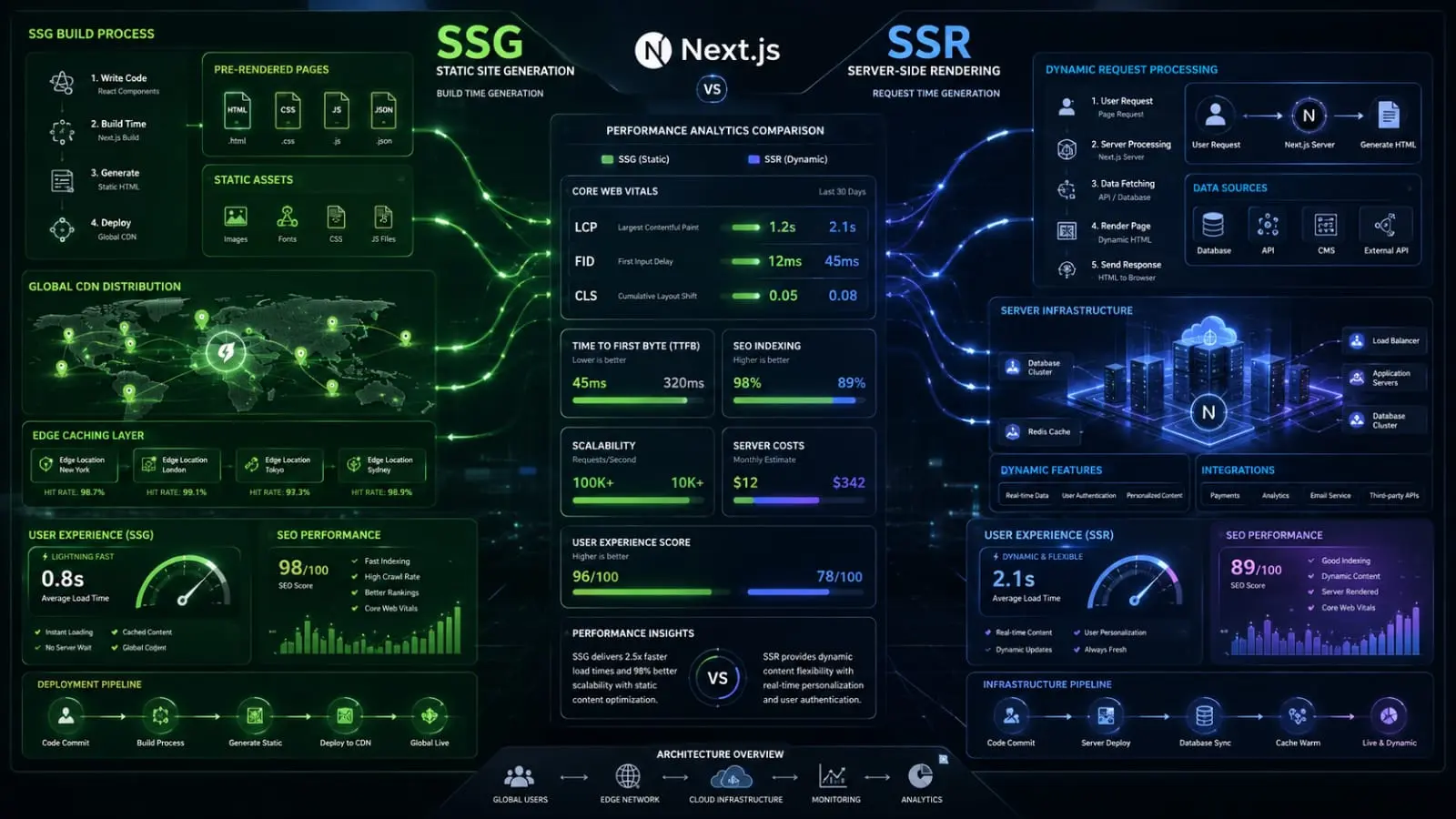
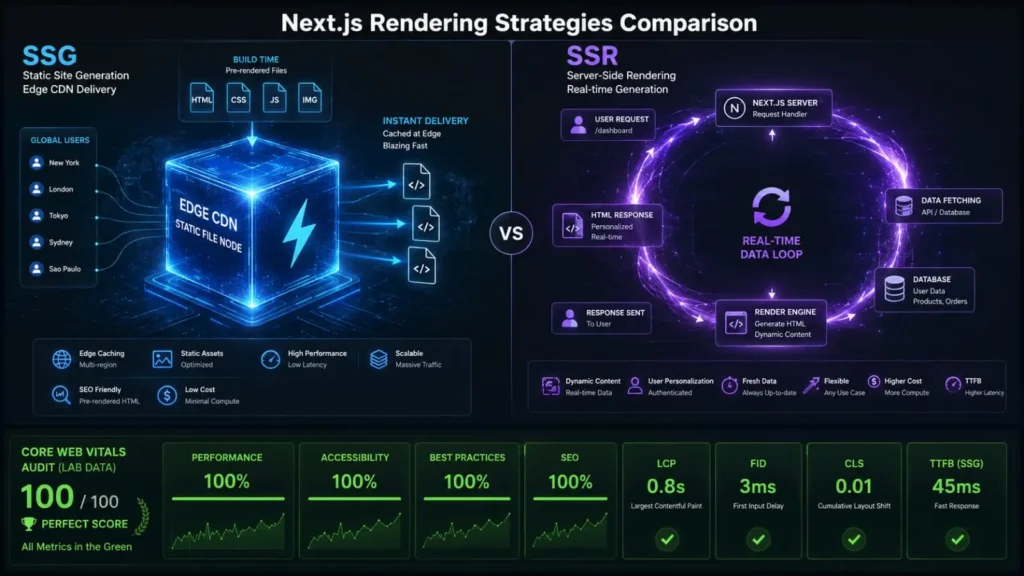
The core tradeoff in Next.js SSG vs SSR comes down to speed versus data freshness. Static Site Generation pre-builds your pages at deployment time, so they can be delivered instantly from a CDN — ideal for marketing sites, blogs, and anything that does not change minute to minute. Server-Side Rendering generates HTML fresh for every single request, which makes it the right tool for live inventory, personalized SaaS dashboards, or anything that genuinely needs to reflect real-time, user-specific data.
Neither one is universally “better.” The right choice depends entirely on how often your content changes and how personalized it needs to be for each individual visitor.
Why Your Rendering Strategy Matters for Business Growth
Speed has become one of the more direct revenue drivers in modern web business, and the rendering strategy you choose shapes far more than just code architecture.
Financial Scalability
SSR requires active server computation for every single visitor that hits a page. As your traffic grows, your server load and your hosting costs grow right along with it. SSG, by contrast, relies on cached static files served from a CDN, which is dramatically cheaper to run and can absorb huge traffic spikes without needing additional compute resources behind the scenes.
Global Distribution and Latency
Static files generated through SSG can be replicated across thousands of edge locations around the world, so a visitor is served from a server physically close to them, resulting in a Time to First Byte that is nearly instant. SSR, on the other hand, requires the visitor to wait while the server processes a database query and renders HTML on the spot, which inherently adds latency no matter how well-optimized your backend is.
Technical SEO Stability
Both rendering methods are fully crawlable by Google, but the raw speed advantage of SSG tends to translate into better Core Web Vitals scores across the board. Stronger Largest Contentful Paint and Cumulative Layout Shift numbers are direct ranking factors, and they increasingly influence whether your content gets surfaced in AI-driven search results as well.
Business Continuity and Reliability
One underrated advantage of SSG is what amounts to offline durability. If your backend database or API goes down entirely, an SSG site keeps functioning normally because the HTML was already generated and cached ahead of time. SSR sites are tethered to the database at the moment of the request — if that database fails, the request fails with it, which can mean a site-wide outage rather than a contained problem.
Understanding SSG and SSR Through a Restaurant Analogy
A useful way to think about the difference between these two approaches is to picture two very different restaurants.
Static Site Generation works like a pre-prepared banquet at a large wedding. The catering staff prepares every dish hours in advance. When guests sit down, the food arrives immediately — there is no wait for the kitchen, and every plate is consistent. The tradeoff is flexibility: if a guest asks for a last-minute change to the recipe, the staff simply cannot accommodate it, because the meal is already plated and ready to go.
Server-Side Rendering, by contrast, is an à la carte experience at a small bistro. The chef does not start cooking until the order is actually placed, which allows for genuine customization — a different sauce, a noted allergy, a swapped ingredient. The cost of that flexibility is wait time, and the restaurant needs a larger, more capable kitchen staff to keep up if a lot of customers place custom orders at once.
The good news in modern Next.js development is that you are not locked into a single restaurant model for your entire site. You can build your homepage and your “About Us” page using the banquet model, and your customer account area using the boutique model, all within the same application.
3 Proven Strategies for Choosing Between SSG, SSR, and ISR
Strategy 1 — Default to Static Site Generation Wherever Possible
SSG works by fetching data and generating the complete HTML file during your build process, typically triggered by your CI/CD pipeline. Because the page is fully pre-computed, the browser receives a finished, ready-to-render file instantly — which produces a strong performance baseline even on slower mobile connections or weaker devices.
There is also a meaningful security advantage here. Since there is no live, runtime connection between your public-facing page and your database, the attack surface is significantly smaller. This makes SSG the natural default for content-driven, marketing-focused websites, including corporate and B2B sites, large documentation sites, blogs and editorial content, and product listing pages where pricing does not change moment to moment.
Strategy 2 — Use Server-Side Rendering for Genuinely Personalized Content
SSR is a dynamic rendering approach where the server constructs the HTML fresh for every request. For the official technical reference on how this works inside Next.js specifically, the framework’s own rendering documentation is worth reviewing.
The real advantage of SSR is the ability to read user-specific headers, cookies, and authentication tokens before the browser ever sees the page, so the response can be tailored from the start. This avoids the awkward “flash of unstyled content” or loading spinners that often show up with purely client-side rendering. SSR is the right call for anything that genuinely must be personalized — a dashboard greeting a user by name, a cart page reflecting real-time inventory and loyalty discounts, complex SaaS dashboards with heavy user-specific data, transactional portals with rapidly changing inventory, and search filter pages where the results depend entirely on what the user just typed.
Strategy 3 — Use Incremental Static Regeneration as the Middle Ground
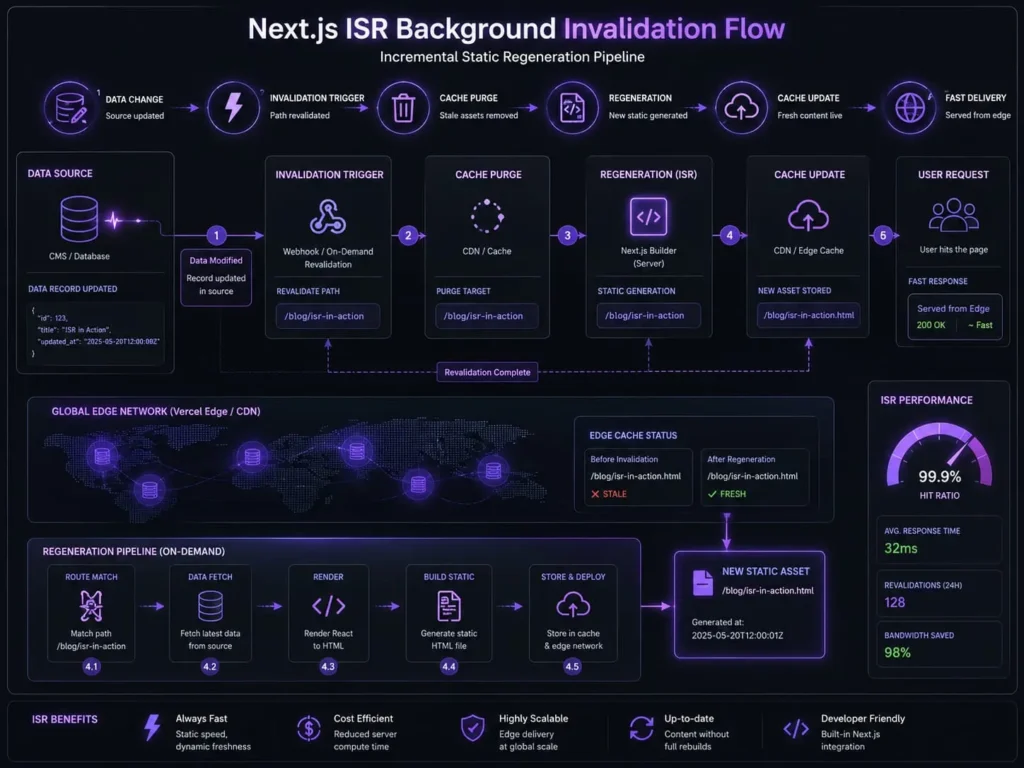
The most common friction point in the SSG versus SSR debate shows up when a site has thousands of pages that change only occasionally. Rebuilding the entire site for one small update is wasteful, but committing to full SSR for that content is overkill.
Incremental Static Regeneration solves exactly this problem. It lets you generate static pages at build time and then quietly update them in the background on a schedule you define — every sixty seconds, for example. A visitor requesting the page sees the cached version immediately, while Next.js regenerates that page behind the scenes for the next person who asks for it. The result is the speed profile of a static site combined with the data accuracy of a dynamic one, without needing to choose one extreme or the other.
SSG vs SSR vs ISR — A Direct Comparison
When Each One Generates
SSG generates pages at build and deployment time. SSR generates a page fresh on every single user request. ISR generates pages initially at build time, then regenerates them in the background on a revalidation schedule.
Time to First Byte Performance
SSG delivers near-instant response times because pages are served directly from a CDN. SSR is comparatively slower, since the server has to process the request and render HTML before responding. ISR matches SSG’s near-instant delivery because the cached version is what gets served immediately.
Data Freshness
SSG has the lowest data freshness of the three, since content only updates when the site is rebuilt. SSR has the highest freshness, reflecting real-time data on every request. ISR sits in between, offering fresh-enough data through scheduled background regeneration without sacrificing speed.
Hosting Cost
SSG is the cheapest option, relying on lightweight CDN-served static files. SSR is the most expensive, since it requires ongoing compute resources for every request. ISR keeps costs low, closer to SSG, because most requests are still served from cache.
What Each One Is Best Suited For
SSG is best for content and marketing pages. SSR is best for dashboards and authenticated, highly personalized experiences. ISR is best for large catalogs, news content, and any large-scale site where rebuilding everything constantly would be impractical.
Common Architectural Mistakes to Avoid
– Defaulting to SSR out of habit: Many teams reach for SSR even for genuinely static content, simply because it is the more familiar pattern. This unnecessarily inflates hosting costs and exposes pages to latency they did not need to have. Use SSG wherever the content allows for it.
– Skipping caching layers entirely: If you do choose SSR, you need a real caching strategy — something like Redis or a CDN-level data cache. Without one, every single request triggers a fresh database query, which is a reliable way to cause a production outage during a genuine traffic spike.
– Trying to pre-build too many pages at once: For a massive eCommerce catalog with hundreds of thousands of products, attempting to statically build every single page at deployment time will eventually cause build timeouts. ISR is the better fit here — selectively generate your highest-traffic pages and let infrequently visited long-tail pages render on demand.
– Neglecting image optimization: Regardless of whether you go with SSG or SSR, image loading is usually the single biggest performance bottleneck on a page. Always lean on Next.js’s built-in image optimization to serve properly sized, modern-format images automatically.
– Skipping real-time monitoring: A surprisingly common mistake is never setting up proper monitoring. Without a tool like Sentry or New Relic watching your SSR processes, you typically will not know your server is approaching memory limits until the site has already become unresponsive.
How MarkupMarvel Approaches Next.js Rendering Strategy
At MarkupMarvel, we treat rendering strategy as a genuine architectural decision rather than a default setting left over from a starter template. We map your actual business needs — content churn rate, personalization requirements, database complexity, expected traffic patterns — onto the rendering approach that fits, often combining SSG, SSR, and ISR within the same application rather than forcing everything into one mold.
This kind of architectural thinking pairs closely with the infrastructure work covered in our guide on high-availability cloud infrastructure, since the right rendering strategy and the right hosting setup need to be designed together rather than as two separate afterthoughts.
Whether you are starting a new Next.js build from scratch or trying to figure out why an existing site’s hosting bill keeps climbing, getting this decision right early tends to save a significant amount of both money and engineering time down the line.
Frequently Asked Questions About Next.js SSG vs SSR
Q: How do I decide which rendering strategy to use for my product pages?
A: If your product descriptions and images stay mostly static, SSG is the right fit. If pricing or stock levels change frequently based on user location or real-time inventory, ISR or SSR is a better match.
Q: Can a single Next.js site use both SSG and SSR together?
A: Yes, and this is exactly how Next.js is designed to be used. A blog section can run on SSG while a client portal on the same domain runs on SSR, configured independently page by page.
Q: What should I do if I have a million blog posts to manage?
A: Use ISR rather than trying to pre-build every single page. Statically generating a million pages at once would slow your deployment process down dramatically, while ISR lets pages generate on demand or be revalidated as needed.
Q: Is server-side rendering bad for SEO?
A: Not at all. SSR is perfectly fine for SEO, but it does require careful server monitoring to make sure latency from the rendering process does not start dragging down your Core Web Vitals scores.
Q: What is generally the most cost-effective rendering approach?
A: Defaulting to SSG or ISR first is usually the more cost-effective starting point. Reserve full SSR for the specific pages where the data is genuinely too volatile or personalized for any form of caching to work.
Q: Does static site generation work with data pulled from external APIs?
A: Yes. During the build process, Next.js can fetch data from any external API and bake the result directly into the generated static HTML, so the page still loads instantly for visitors.
Final Thoughts
The Next.js SSG vs SSR decision is not really about picking a winner once and sticking with it forever. It is about understanding what each page on your site actually needs — speed, personalization, or some blend of both — and configuring your architecture accordingly, page by page, rather than forcing every part of your application through the same rendering pipeline.
Getting this right early in a project tends to be far cheaper than discovering the wrong choice after your hosting bill has already ballooned or your Core Web Vitals scores have already started dragging down your search rankings.
More Blog

High-Availability Cloud Infrastructure: 5 Proven Steps

Nginx Redis Caching Optimization: 6 Proven Speed Tactics

Content Optimization for AI Search: 5 Proven Steps to Rank



