

MVP to Production: 5 Powerful Steps to Scale Without Risk

MVP to Production: How to Refactor, Scale, and Reduce Technical Debt
The transition from MVP to production is where a surprising number of promising products stall. Not because the product failed to find market fit — but because the codebase that worked well enough for a few hundred beta users starts breaking down under the demands of real scale, and the team discovers that fixing it is significantly harder than building it was.
This is not a failure of the MVP process. It is an expected consequence of building for validation speed. When you build an MVP, you make deliberate trade-offs — choosing the fastest path to a working product over the most maintainable architecture, using shortcuts that reduce development time at the cost of long-term flexibility. Those trade-offs are rational in the validation phase. They become problems when the product needs to scale.
The transition from MVP to production is the process of systematically addressing those trade-offs before they become serious operational problems. It requires a different mindset than the MVP phase — less focus on new features, more focus on the structural foundation that everything else depends on. Done well, it turns a fragile prototype into a platform that can support sustained growth. Done poorly, or not done at all, it leads to escalating maintenance costs, performance problems, and eventually a rewrite that costs far more than the refactoring would have.
This guide walks through how to manage the MVP to production transition systematically — what to audit, what to refactor, how to implement the infrastructure that production systems require, and the common mistakes that make the process harder than it needs to be.
Short Answer
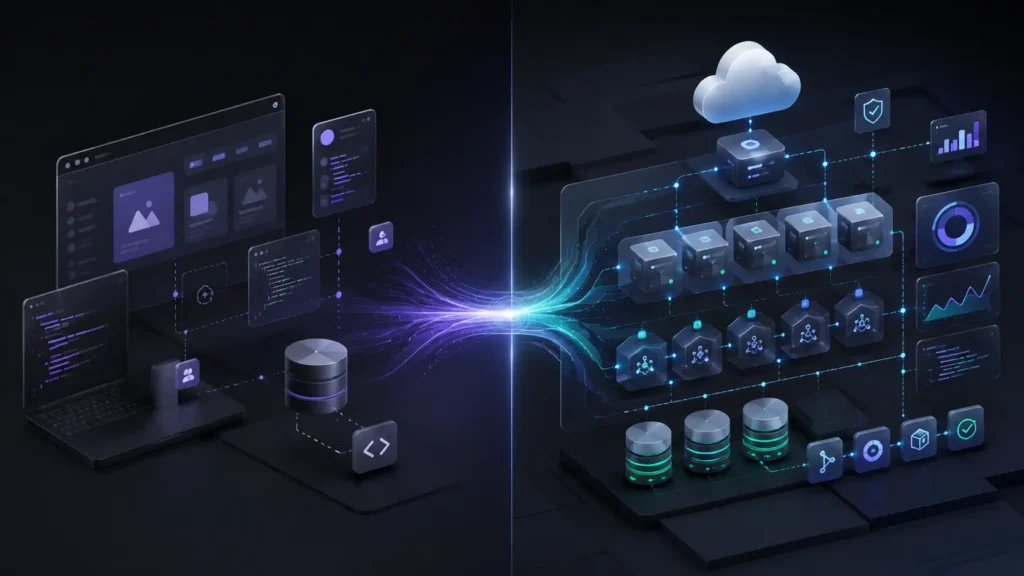
Moving from MVP to production requires shifting focus from feature speed to system stability, security, and scalability. The transition involves refactoring code that was written for speed rather than maintainability, implementing automated CI/CD pipelines to replace manual deployments, optimizing database performance, and addressing technical debt that accumulated during rapid prototyping. The goal is to move from a codebase that works for hundreds of users to one that can handle tens of thousands — without downtime, security vulnerabilities, or escalating maintenance costs.
Why the MVP to Production Transition Matters More Than Most Teams Think
Technical debt is a useful concept but it is often misunderstood. It is not simply bad code. It is the accumulated consequence of deliberate trade-offs made under time pressure. When you build an MVP, you take on technical debt intentionally — you borrow development time from your future self to get to market faster. The debt comes due when you need to scale.
The problem is that technical debt compounds. A codebase with unindexed database queries, tightly coupled components, and minimal test coverage is manageable when traffic is low. As traffic grows, query performance degrades, small changes in one part of the system break things in unexpected places, and deployments become increasingly risky. Each new feature takes longer to build and carries a higher risk of introducing regressions.
Left unaddressed, this creates a ceiling on growth. The team spends more and more time maintaining and firefighting rather than building. New features take twice as long as they should because of the complexity of working around existing debt. Engineers spend hours debugging issues in code they did not write and cannot easily read. Eventually, the cost of continuing on the existing foundation exceeds the cost of rebuilding — and a full rewrite becomes necessary.
The purpose of the MVP to production transition is to avoid that ceiling by addressing technical debt deliberately and incrementally, before it reaches the point where it constrains the business.
For teams who have recently launched their MVP and are thinking about the right architecture for scale, see our guide on how to build an MVP: /build-mvp-market-validation
Understanding Technical Debt Before You Fix It
Before you can address technical debt effectively, you need to understand what you are actually dealing with. Not all technical debt is equal, and not all of it needs to be addressed immediately.
Types of Technical Debt in MVP Codebases
Architectural debt is the most significant and the hardest to fix. It occurs when the overall structure of the codebase — how components relate to each other, how data flows through the system, how the application is deployed — is not suited to the demands of a production system. A monolithic architecture that worked fine for an MVP may need to be decomposed into more modular components before it can scale effectively.
Code quality debt is more granular. It includes unreadable or undocumented code, duplicated logic, inconsistent naming conventions, and functions that do too many things. This debt slows down development and increases the risk of bugs, but it is generally easier to address incrementally than architectural debt.
Infrastructure debt is the gap between the quick and cheap infrastructure choices made for the MVP and the reliable, scalable infrastructure that production systems require. This includes things like moving from shared hosting to managed cloud infrastructure, implementing proper backup and disaster recovery, and setting up monitoring and alerting.
Security debt is particularly important to address early in the MVP to production transition. Prototype environments often have simplified authentication, minimal input validation, and limited access controls. These gaps are acceptable for a private beta but unacceptable for a production system handling real user data.
Prioritizing What to Fix First
Not everything needs to be fixed before you can call a system production-ready. The right approach is to prioritize based on risk and impact.
Fix security vulnerabilities first — these have the highest potential for serious harm. Address performance bottlenecks that are already affecting user experience second. Tackle architectural issues that will block specific scaling milestones third. Leave lower-priority code quality improvements for ongoing maintenance cycles rather than trying to clean everything up at once.
5 Steps to Successfully Transition from MVP to Production
Step 1: Conduct a Thorough System Audit
Before you start making changes, you need a clear picture of what you are working with. A system audit examines every layer of your application — code quality, database design, infrastructure configuration, security posture, and performance characteristics — and produces a prioritized list of issues to address.
For code quality, look for tightly coupled components that are difficult to modify independently, duplicated logic that needs to be consolidated, and areas where test coverage is thin or absent. For database performance, identify queries that are not using indexes, relationships that are not properly normalized, and data volumes that are already causing slow query times.
For infrastructure, assess whether your current hosting environment can handle your projected growth, whether you have proper backup and recovery procedures in place, and whether your deployment process is reliable and repeatable.
Document everything you find. The output of the audit is your technical debt register — a prioritized list of issues that guides the entire transition process.
Step 2: Refactor for Performance and Security
Refactoring is not rewriting. The goal is to improve the structure of existing code without changing its external behavior — making it cleaner, more maintainable, and better suited to the demands of a production system.
Start with the areas that pose the highest risk or have the highest impact on performance. Unoptimized database queries that are slowing down your most-used endpoints are a good starting point — fixing these often produces immediately visible performance improvements. Tightly coupled components that make the codebase brittle are the next priority.
On the security side, audit your authentication implementation, validate that all user inputs are properly sanitized, review access controls to ensure users can only access what they should, and ensure that sensitive data is properly encrypted at rest and in transit.
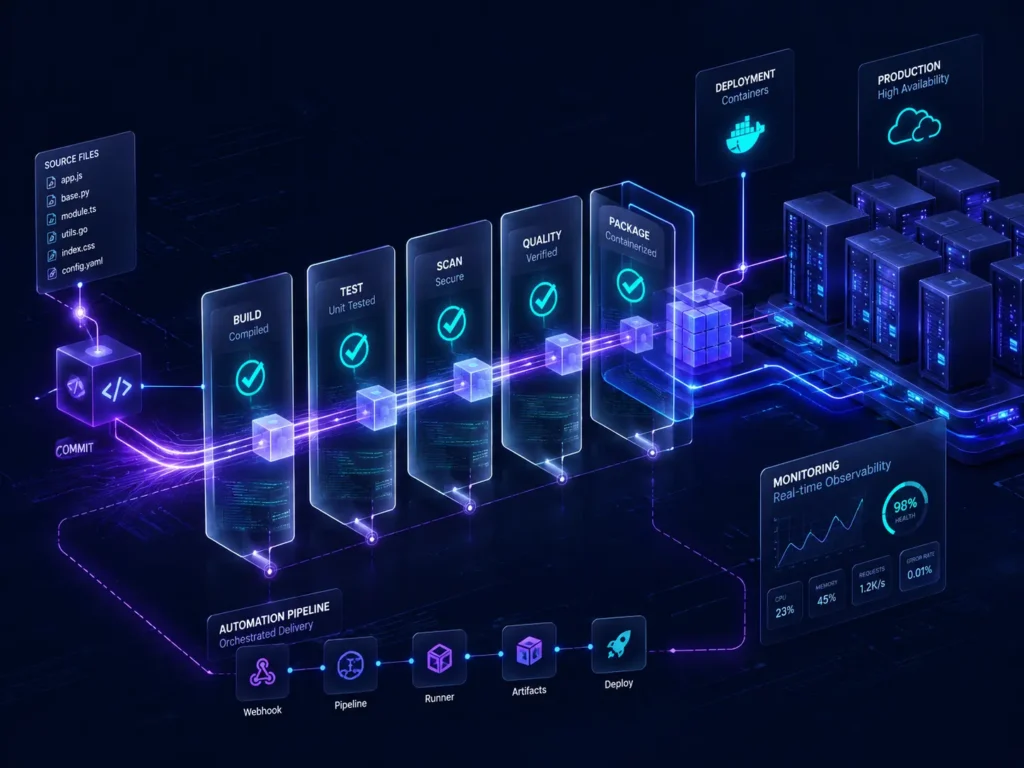
Step 3: Implement Automated CI/CD Pipelines
Manual deployment processes are one of the most reliable sources of production incidents. When deployments require manual steps — copying files, running commands by hand, remembering the correct sequence of operations — human error is inevitable. A single mistake during a deployment can take down a production system.
Continuous Integration and Continuous Deployment pipelines automate the entire process from code commit to production deployment. Every change goes through automated testing before it can be merged. Every deployment follows a standardized, repeatable process. If something goes wrong, the pipeline catches it before it reaches production users.
Tools like GitHub Actions and Docker provide the foundation for modern CI/CD pipelines that are accessible to teams of any size. Setting these up is one of the highest-leverage investments you can make during the MVP to production transition.
Step 4: Optimize Database and Infrastructure
Database performance is often the first bottleneck that manifests as traffic grows. Queries that return results in milliseconds with a few hundred records may take seconds with millions — and those slow queries cascade into slow page loads, API timeouts, and poor user experience.
Audit your most frequently executed queries and ensure they are using indexes appropriately. Review your data model for normalization issues that are causing redundant data storage or complex join operations. Implement caching for data that is read frequently and changes infrequently.
On the infrastructure side, move from shared or basic hosting to managed cloud infrastructure that can scale with your needs. Implement proper monitoring and alerting so you know about performance issues before your users do. Set up automated backups and test your recovery procedures before you need them.
Step 5: Transition to Modular Architecture
If your MVP was built as a monolithic application — a single codebase that handles everything — the MVP to production transition is a good time to start thinking about how to decompose it into more modular components.
This does not mean immediately migrating to microservices. That is often premature and creates complexity before it creates value. The more practical approach is to start separating concerns within your existing codebase — isolating business logic from presentation logic, separating different functional areas into well-defined modules with clear interfaces, and designing your API layer so that different clients can be built independently of the backend.
This modular approach makes the codebase easier to understand, easier to test, and easier to scale — both technically and in terms of team size. Different teams or engineers can work on different modules without constantly stepping on each other.
Common Mistakes During the MVP to Production Transition
Trying to Fix Everything at Once
The most common mistake in technical debt reduction is attempting a comprehensive cleanup all at once. This approach takes engineering resources away from product development for extended periods, creates massive branches that are difficult to merge, and often introduces new bugs while fixing old ones. The better approach is incremental refactoring — targeting the highest-priority issues systematically while keeping the product running and improving.
Optimizing Prematurely for Scale You Do Not Have
Designing for millions of concurrent users when you have thousands leads to unnecessary complexity and wasted engineering time. Address the scaling challenges you actually face, with appropriate headroom for projected growth. Build for the next order of magnitude, not for the theoretical maximum.
Skipping Security Audits
Many teams assume that because their prototype ran without security incidents in a limited beta, the production system is reasonably secure. This assumption is dangerous. A proper security audit with a fresh set of eyes almost always surfaces issues that the development team overlooked — not because of incompetence, but because familiarity with the codebase creates blind spots.
Neglecting Documentation
As the codebase grows and the team expands, undocumented code becomes an increasingly serious bottleneck. New engineers cannot onboard quickly. Existing engineers spend time reverse-engineering code they did not write. Bugs take longer to fix because understanding the context takes longer than fixing the bug. Invest in documentation continuously throughout the MVP to production transition, not as a one-time cleanup at the end.
Refactoring Code That Is About to Be Deleted
Before investing engineering time in refactoring any part of the codebase, confirm with the product team that the feature or functionality will still exist in six months. Refactoring code that is about to be deprecated or replaced wastes time that could go toward higher-priority improvements.
Frequently Asked Questions
Q: How do we know when our MVP is ready for the production transition?
A: Your MVP is ready for production hardening when the core user workflows have been validated with real users, your load testing shows where current bottlenecks are, and your team has a clear list of known technical debt prioritized by risk and impact. You do not need to wait until every metric is perfect — you need enough validation to justify the investment in production-grade infrastructure.
Q: Should we rewrite the codebase entirely instead of refactoring?
A: In most cases, no. A full rewrite is expensive, time-consuming, and risky — you are essentially rebuilding something that already works while the original continues to accumulate debt. Incremental refactoring that addresses the highest-priority issues systematically almost always delivers better results with lower risk. Full rewrites are warranted only when the architecture is so fundamentally broken that incremental improvement is not feasible.
Q: What is the biggest risk during the MVP to production transition?
A: The biggest risk is introducing instability while trying to improve stability. Changes to a production system always carry risk, and the MVP to production transition involves significant changes. Mitigating this requires comprehensive automated testing before you start refactoring, incremental changes rather than large rewrites, and proper rollback procedures for every deployment.
Q: How long does the MVP to production transition typically take?
A: Depending on the size and complexity of the codebase, the amount of technical debt accumulated, and the team’s capacity, a professional production migration typically spans four to twelve weeks of focused work. This assumes an incremental approach — larger rewrites or complex infrastructure migrations may take longer.
Q: How do we balance refactoring with continuing to ship new features?
A: This is the central tension of the MVP to production transition. The practical answer is to allocate a portion of each sprint to technical debt reduction — typically twenty to thirty percent — while maintaining the rest for feature development. This keeps the product moving forward while systematically improving the foundation. Pure refactoring sprints with no feature work tend to create business pressure that leads to abandoning the effort before it is complete.
Q: What monitoring should we implement before going to production?
A: At minimum, you need application performance monitoring to track response times and error rates, infrastructure monitoring to track server health and resource utilization, and alerting that notifies the right people when something goes wrong. Logging that captures enough context to diagnose issues without exposing sensitive data is also essential. Setting these up before you have production traffic lets you establish baselines that make anomalies easier to detect.
Q: How do we handle database migrations without downtime?
A: Zero-downtime database migrations require careful planning. The general approach is to make migrations backward-compatible — adding new columns or tables without removing old ones until the new code has been fully deployed and verified. For more complex schema changes, blue-green deployment strategies or feature flags can help manage the transition without taking the system offline.
The Bottom Line
The MVP to production transition is not glamorous work. It does not produce new features or visible improvements that are easy to demo. But it is the work that determines whether a product that found market fit can actually grow into a sustainable business — or whether the technical foundation collapses under the weight of its own success.
The teams that handle this transition well do not try to fix everything at once. They audit their codebase honestly, prioritize by risk and impact, address the most critical issues incrementally, and build the operational infrastructure — CI/CD, monitoring, documentation — that makes future changes safer and faster.
The teams that handle it poorly delay the work until the debt is too large to address incrementally, then face the choice between a costly rewrite and continued operation on an increasingly fragile foundation. Neither option is good.
Start the MVP to production transition earlier than feels necessary. Address technical debt when it is small and manageable, not when it has grown into a crisis.
Ready to Scale Your MVP to Production?
We help product teams manage the transition from MVP to production — auditing codebases, implementing CI/CD pipelines, optimizing performance, and building the architecture that supports sustained growth.
More Blog

High-Availability Cloud Infrastructure: 5 Proven Steps

Nginx Redis Caching Optimization: 6 Proven Speed Tactics

Content Optimization for AI Search: 5 Proven Steps to Rank



