

Multi-Vendor Marketplace Architecture: 7 Proven Core Pillars

Multi-Vendor Marketplace Architecture: 7 Core Pillars
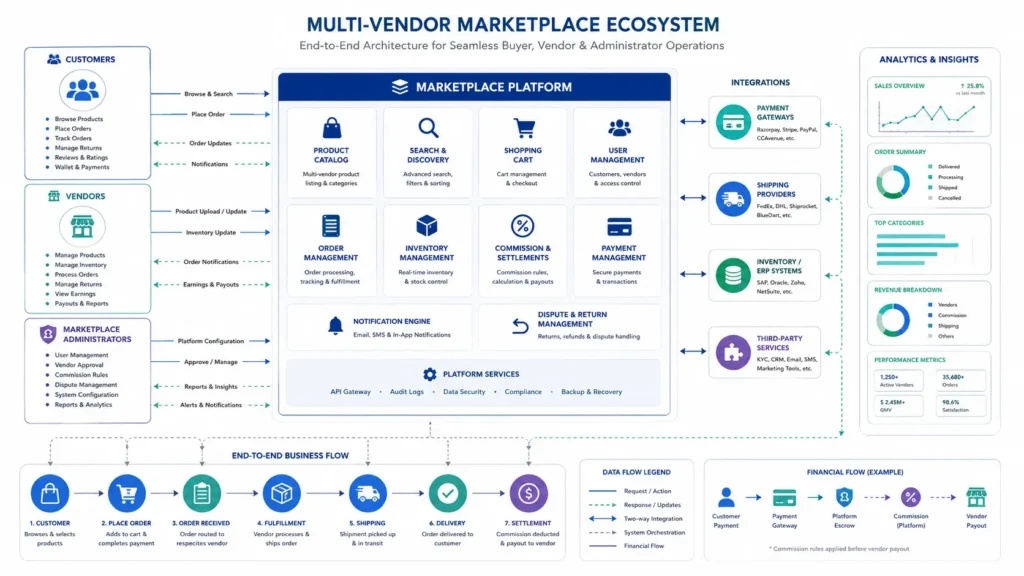
Building a multi-vendor marketplace is not like launching a standard eCommerce store. It is an entirely different category of engineering challenge. You are not just selling products anymore — you are building an ecosystem. Vendors need their own storefronts. Customers need a unified, trustworthy experience. Money needs to move accurately, automatically, and securely between multiple parties every single day.
Most businesses underestimate how much complexity lives underneath a marketplace. The storefront that customers see is just the surface. Underneath it is a distributed application managing commission splits, vendor onboarding, role-based permissions, fraud detection, inventory synchronization, and real-time analytics — all running simultaneously, all dependent on each other.
Get the multi-vendor marketplace architecture right from the start, and your platform scales with every new vendor you onboard. Get it wrong, and you will spend the next two years firefighting — failed payouts, angry vendors, security vulnerabilities, and a codebase held together with temporary fixes.
This guide breaks down the seven core pillars of a resilient, scalable multi-vendor marketplace architecture — the same framework we use at MarkupMarvel when we design and build marketplace infrastructure for our clients — from payment orchestration and vendor dashboards to data security and search performance. Whether you are building from scratch or rearchitecting an existing platform, these are the foundations that actually matter.
SHORT ANSWER
A robust multi-vendor marketplace architecture requires three core components working in harmony: a secure, automated payment split system to handle commissions and vendor payouts; an intuitive, modular vendor dashboard for inventory and order management; and a centralized administrative hub for platform governance and security. For high-growth businesses, this architecture must be built on scalable, API-first foundations to handle high transaction volumes and complex vendor-customer interactions without compromising platform stability.
1. Why Architecture Is the Difference Between Growth and Collapse
Here is a pattern we see more often than we should. A business launches a marketplace on a modified single-vendor platform — WooCommerce with a marketplace plugin, or a Shopify setup with some custom code bolted on. It works fine for the first dozen vendors. Then things start breaking.
Payouts are miscalculated. A vendor accidentally sees another vendor’s customer data. The search function becomes unusable as the product catalog grows. The admin team is manually processing payments that should be automated. The platform that was supposed to create revenue is now consuming it.
This is not bad luck. It is what happens when you build a multi-vendor business on a single-vendor foundation. The architecture was never designed for what you are asking it to do.
A properly engineered multi-vendor marketplace architecture treats every layer of the system as a first-class concern from day one — not something to be retrofitted when things break. That upfront investment in architecture is the reason some marketplaces scale to thousands of vendors while others stall at fifty.
2. Payment Orchestration: The Engine Room of Your Marketplace
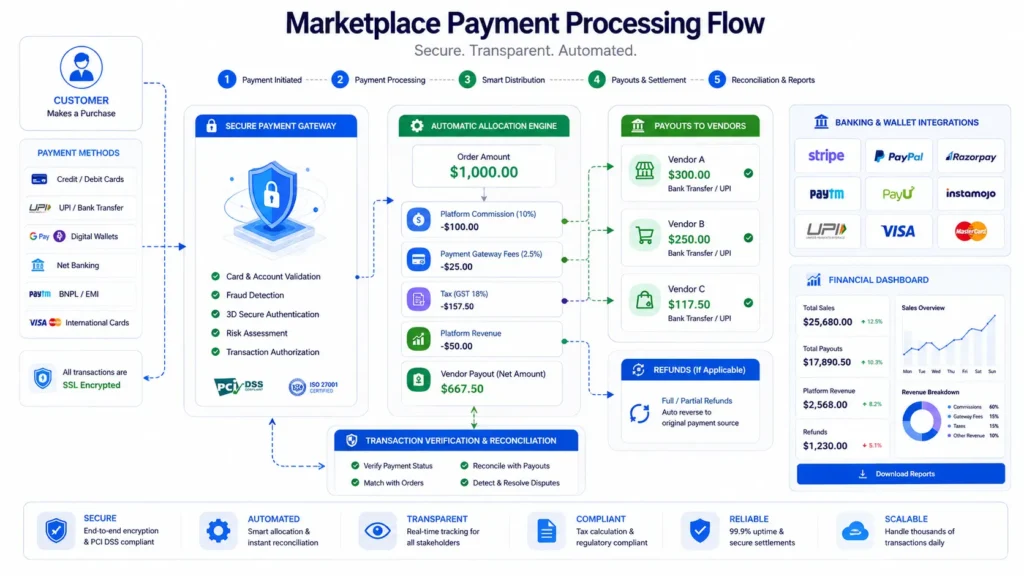
If there is one component of a marketplace that cannot afford to fail, it is payments. Every transaction your platform processes involves multiple parties — the customer who paid, the vendor who sold, and the platform that facilitated. Getting that money to the right place, in the right amount, at the right time, is not a nice-to-have. It is the core function of your business.
THE SPLIT PAYMENT PROBLEM
When a customer pays $100 for a product, your platform needs to instantly calculate that $90 goes to the vendor and $10 stays as your commission — and then actually move those funds to the correct accounts. Multiply that by thousands of transactions per day, across hundreds of vendors with different commission rates, and you start to understand why manual payment processing is not a viable option.
The industry standard for solving this at scale is Stripe Connect. It is purpose-built for marketplace payment flows and handles the complexity of split payments, automated payouts, and tax compliance across multiple currencies and jurisdictions. For a full technical reference on how marketplace payments work,see the official Stripe Connect documentation
AUTOMATED PAYOUT SCHEDULES
Different vendors have different expectations around when they get paid. Some want daily payouts. Others prefer weekly or net-30 settlements. Your architecture needs to support configurable payout schedules at the vendor level — not a one-size-fits-all approach that causes friction with your best sellers.
REFUNDS AND DISPUTE MANAGEMENT
Every marketplace will have refunds and payment disputes. Your architecture needs to handle these gracefully — automatically reversing the correct commission split, updating vendor balances, and maintaining an accurate audit trail for every transaction. This is not something you want to handle manually at any meaningful scale.
3. The Vendor Dashboard: Where Your Platform Wins or Loses Vendors
Your vendors are your supply chain. If they find your platform frustrating to use, they will move to a competitor. If they find it intuitive and powerful, they will invest in growing their presence on your marketplace. The vendor dashboard is where that relationship is made or broken every single day.
WHAT A GREAT VENDOR DASHBOARD ACTUALLY NEEDS
The best vendor dashboards are built around one principle: give vendors complete visibility and control over their own business, without ever exposing them to data that belongs to other vendors or to the platform itself.
That means real-time sales analytics that vendors can actually understand — not raw data dumps, but clear visualizations of revenue, order volume, and customer behavior. It means inventory management that is fast to update and hard to get wrong. It means order tracking that tells vendors exactly where every shipment stands without requiring them to contact your support team.
ONBOARDING THAT DOES NOT LOSE VENDORS BEFORE THEY START
The vendor onboarding experience is one of the most commonly underbuilt parts of a marketplace. A complex, slow, or confusing onboarding flow means vendors abandon the process before they ever list a single product. Every vendor you lose at onboarding is revenue you never earned.
A well-designed onboarding flow guides vendors through identity verification, payment setup, and first product listing in a single, logical sequence — with progress indicators, clear instructions, and the ability to save and resume at any point.
MOBILE-FIRST VENDOR EXPERIENCE
A significant portion of your vendors will manage their stores from mobile devices. A vendor dashboard that only works well on desktop is a vendor dashboard that works poorly for half your supply chain. Building with a mobile-first approach ensures your vendors can manage orders, update inventory, and check their analytics from wherever they are.
4. Security Architecture: Protecting Every Party on Your Platform
When you open your platform to third-party vendors, you introduce a category of risk that does not exist in a single-vendor store. You have multiple parties with different levels of access, different motivations, and different levels of technical sophistication. Your security architecture has to account for all of them.
ROLE-BASED ACCESS CONTROL
Not every user on your platform should see the same data. A vendor should see their own orders, their own customers, and their own analytics — and nothing else. An admin should have platform-wide visibility with appropriate audit logging. A customer should see their own order history and nothing more.
Role-Based Access Control (RBAC) is the architectural pattern that enforces these boundaries. Every API endpoint, every database query, every frontend component needs to be aware of who is making the request and what they are allowed to access. This is not something you add to an existing system as an afterthought — it needs to be built into the foundation.
DATABASE ISOLATION
Vendor data isolation is not just a best practice — it is a legal requirement in most jurisdictions under frameworks like GDPR and CCPA. Your database architecture needs to ensure that Vendor A has no technical pathway to Vendor B’s customer data, even if Vendor A’s account were to be compromised.
FRAUD DETECTION AND CONTENT MODERATION
Marketplaces are attractive targets for fraud — both from bad actors trying to exploit your payment system and from vendors trying to list counterfeit or prohibited products. Automated content moderation pipelines that vet new product listings before they go live, combined with transaction monitoring for unusual payment patterns, are essential components of any production-grade multi-vendor marketplace architecture.
5. Scalable Data Architecture: Built for Growth
A marketplace that works beautifully with 50 vendors and 5,000 products may become unusable with 500 vendors and 500,000 products — if the data architecture was not designed for scale from the beginning.
SEARCH AND FILTERING PERFORMANCE
Generic site search is one of the first things to break as a marketplace catalog grows. When customers are searching across hundreds of thousands of products from hundreds of vendors, they need fast, accurate, faceted search — filtering by price, category, vendor rating, location, and dozens of other attributes simultaneously.
Dedicated search infrastructure like Elasticsearch or Algolia is the right solution at scale. These tools are built specifically for the kind of high-concurrency, multi-faceted search that a marketplace demands, and they integrate cleanly with modern API-first architectures.
DATABASE DESIGN FOR MULTI-TENANCY
Your database schema needs to be designed for multi-tenancy from the start. Every product, every order, every customer interaction needs to be correctly associated with the right vendor, the right customer, and the right transaction — with indexes and query patterns optimized for the access patterns your platform actually uses.
Getting this wrong early means expensive and risky database migrations later, at exactly the moment your platform is growing fastest and can least afford downtime.
6. Common Mistakes That Derail Marketplace Builds
Even well-funded marketplace projects run into the same set of avoidable mistakes. Here are the ones we see most often.
BUILDING ON A SINGLE-VENDOR FOUNDATION
The most expensive mistake is trying to turn a single-vendor platform into a multi-vendor marketplace through plugins and workarounds. The underlying architecture was never designed for what you are asking it to do. The technical debt accumulates faster than the revenue, and eventually the platform has to be rebuilt anyway — but now with the added complexity of migrating live vendor and customer data.
MANUAL PAYOUT MANAGEMENT
If someone on your team is manually processing vendor payouts, you do not have a marketplace architecture — you have a spreadsheet with a storefront in front of it. Manual payout processing does not scale, introduces human error into financial transactions, and creates compliance risk. Automate it from day one.
IGNORING VENDOR UX UNTIL LAUNCH
The vendor dashboard is often treated as an internal tool and deprioritized in favor of the customer-facing experience. This is a strategic mistake. Your vendors are your product. An intuitive, capable vendor dashboard is one of the most powerful retention and acquisition tools your platform has.
UNDERESTIMATING COMPLIANCE REQUIREMENTS
If your marketplace operates across multiple jurisdictions, you are dealing with different tax regimes, different data protection laws, and different financial regulations simultaneously. Building compliance in as an afterthought is significantly more expensive than building it in from the start.
7. How MarkupMarvel Builds Marketplace Infrastructure
At MarkupMarvel, we treat multi-vendor marketplace architecture as a systems engineering challenge — not a theme customization project. Every multi-vendor marketplace architecture we build starts with the same foundational questions: how will money move, how will data be isolated, how will the system behave under load, and how will vendors and customers experience the platform on day one and day one thousand.
We build on modern, API-first foundations — typically the MERN stack for custom builds, with Stripe Connect for payment orchestration and dedicated search infrastructure for catalog performance. Every vendor dashboard we build is mobile-first, role-aware, and designed to minimize the support burden on your team.
Whether you are building a new marketplace from scratch, rearchitecting an existing platform that has hit its scaling ceiling, or migrating from a plugin-based setup to a proper custom architecture, we bring the same commitment to structural integrity and long-term maintainability to every engagement.
FREQUENTLY ASKED QUESTIONS (FAQ)
Q: What is the biggest technical challenge in building a multi-vendor marketplace architecture?
A: The biggest challenge is managing split payments and automated payouts securely at scale. This requires complex API integrations with payment processors like Stripe Connect to ensure commissions are calculated correctly, taxes are compliant, and vendor payouts are processed accurately without manual intervention.
Q: Should I use a SaaS marketplace platform or invest in custom development?
A: SaaS platforms are good for quick validation, but they impose hard limits on your growth. Custom development gives you total control over payout logic, vendor UX, security architecture, and feature roadmap — all of which are essential for building a differentiated marketplace at scale.
Q: How do I ensure my marketplace is secure for both vendors and customers?
A: Security starts with database isolation to ensure vendors cannot access each other’s data, combined with robust Role-Based Access Control for every API endpoint. Add automated content moderation for vendor-uploaded products and transaction monitoring for unusual payment patterns, and you have a solid security foundation.
Q: How do I keep vendors engaged and active on my platform?
A: Give them an intuitive dashboard where they can manage products, view real-time sales analytics, and track payouts without needing to contact your support team. A vendor who can run their store independently is a vendor who stays on your platform.
Q: Can you help migrate an existing marketplace to a better architecture?
A: Yes. We specialize in marketplace migrations — moving existing vendor accounts, product catalogs, order histories, and customer data to a new architecture without losing SEO authority or transactional continuity.
Q: How long does it take to build a multi-vendor marketplace from scratch?
A: A focused MVP with core vendor management, payment orchestration, and customer-facing catalog typically takes twelve to sixteen weeks. A full-featured platform with advanced analytics, multi-currency support, and custom search infrastructure typically takes twenty to thirty weeks depending on complexity.
READY TO BUILD A MARKETPLACE THAT ACTUALLY SCALES?
Building the right multi-vendor marketplace architecture from day one is the difference between a platform that grows and one that gets rebuilt.
The cost of getting the architecture wrong compounds every day you operate on a broken foundation. The right time to build it correctly is before that debt starts accumulating.
More Blog

High-Availability Cloud Infrastructure: 5 Proven Steps

Nginx Redis Caching Optimization: 6 Proven Speed Tactics

Content Optimization for AI Search: 5 Proven Steps to Rank



