
MongoDB Multi-Tenancy Architecture Guide | MarkupMarvel

MongoDB Multi-Tenancy: A Scalable Architecture Guide for SaaS
Key Takeaways: Quick Summary for Technical Leaders
Before diving into the full architecture breakdown, here is a quick reference for engineering leads who need the bottom line fast:
– Isolation Strategy: Choose between Silo, Pool, or Bridge models based on your compliance requirements and scale targets.
– Indexing Discipline: Always prefix compound indexes with tenant_id to prevent cross-tenant performance degradation.
– Middleware Security: Use Mongoose query hooks to automatically inject tenant_id into every database operation.
– Sharding Strategy: Configure Atlas sharding early using { tenant_id: 1, _id: 1 } to future-proof your infrastructure.
Introduction: Why MongoDB Multi-Tenancy Defines Your SaaS Ceiling
MongoDB multi-tenancy is one of the most consequential architectural decisions you will make when building a SaaS platform. Get it right, and your database becomes a quiet, reliable engine that scales with your business. Get it wrong, and you are looking at cross-tenant data leaks, compliance failures, and infrastructure costs that climb faster than your revenue.
What makes this decision so difficult is that it sits at the intersection of engineering, business, and compliance. It is not purely a technical choice. The isolation model you pick today will shape how your platform handles enterprise security audits, how your cloud bills grow, and how much engineering time gets spent on database firefighting versus actual product development.
At MarkupMarvel, our engineering team has built MongoDB multi-tenancy systems for enterprise SaaS platforms, FinTech applications, and high-volume B2B marketplaces. This guide documents the architecture patterns, indexing strategies, and middleware logic that actually work in production — not just in theory.
1. The Business Impact of Your Database Architecture
Most development teams treat the database layer as a purely technical concern. That is a mistake that shows up on the balance sheet within months of launch.
The way you structure your MongoDB multi-tenancy architecture has a direct impact on four areas that matter to the business:
Infrastructure Profitability: A well-optimized schema aligns cloud spend with revenue. When your database design is inefficient, you pay for RAM and CPU that your actual workload does not justify. MongoDB Atlas bills scale with resource consumption, and a poorly designed tenancy model can double your infrastructure costs without adding a single new customer.
Enterprise Viability: Large enterprise clients do not just ask about features — they send security questionnaires. Your data isolation strategy will be reviewed, and if you cannot demonstrate that one tenant’s data is cleanly separated from another’s, the deal does not close. This is not theoretical. It is a standard part of the enterprise procurement process.
Maintenance Velocity: A clean tenancy architecture means schema migrations happen in one operation across all tenants. A messy one means every change requires coordination across dozens of databases or collection structures. Engineering time spent on database maintenance is engineering time not spent building features.
Compliance Readiness: SOC 2, GDPR, and HIPAA all require demonstrable data isolation. Having a documented, well-implemented tenancy model shortens your compliance audit cycle and accelerates enterprise sales timelines in ways that are difficult to quantify but easy to feel.
2. Choosing Your MongoDB Multi-Tenancy Isolation Strategy
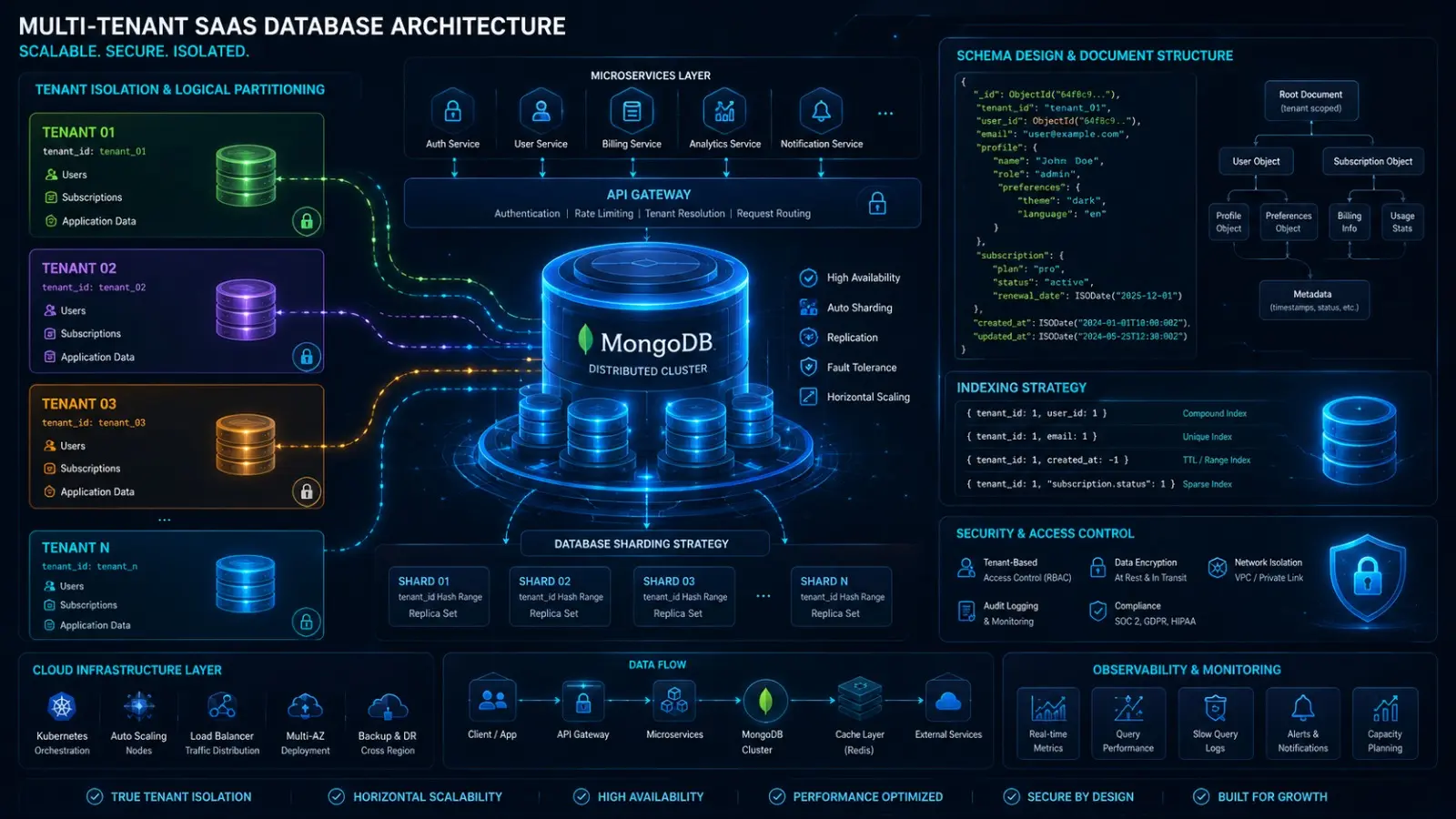
There are three isolation models used in MongoDB multi-tenancy. Each one makes different trade-offs between security, cost, and operational complexity. Understanding those trade-offs is the foundation of making a good architectural decision.
H3: Strategy 1 — The Silo Model (Database per Tenant)
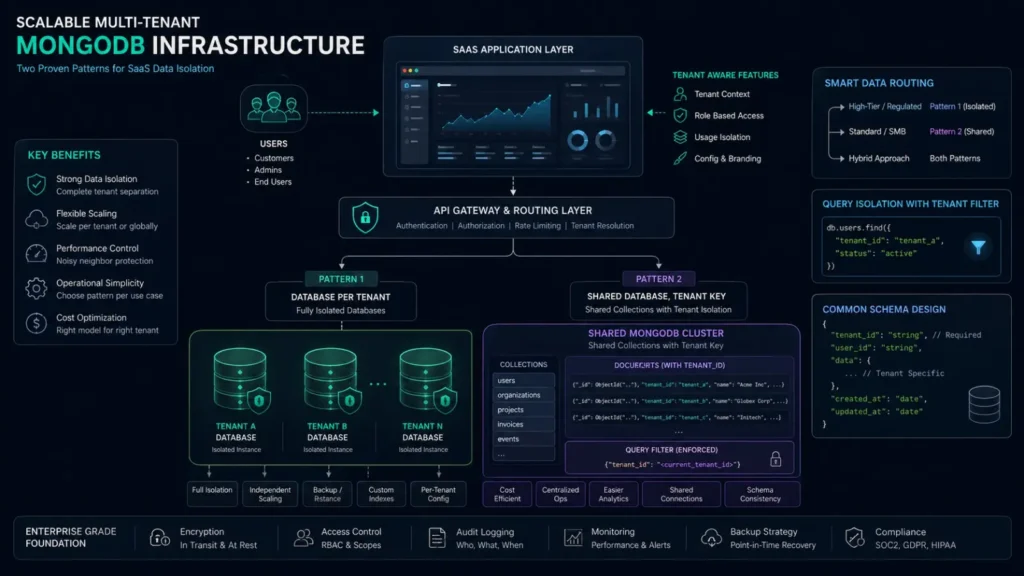
In the Silo model, every customer gets their own dedicated MongoDB database within the cluster. Data isolation is absolute and physically enforced at the database engine level — not by application logic, but by the storage layer itself.
When to use: This model is the right choice for high-ticket enterprise SaaS, healthcare platforms, and FinTech applications where regulatory frameworks mandate physical data separation. If your enterprise clients are asking for a Business Associate Agreement or a custom data residency clause, the Silo model is likely where you need to be.
Pros:
– Absolute Security: Cross-tenant data exposure is virtually impossible by design, not by convention.
– Granular Management: Individual tenant backups, point-in-time restores, and data migrations can be performed without touching any other tenant’s data.
– Compliance Clarity: Each tenant database can be documented and audited independently, which simplifies SOC 2 and HIPAA reporting significantly.
Cons:
– Resource Overhead: MongoDB’s WiredTiger storage engine allocates metadata and memory for every database in the cluster. As your tenant count grows into the thousands, RAM saturation becomes a real operational concern.
– Connection Complexity: Managing separate connection pools for thousands of isolated databases in a Node.js application requires careful architecture. It is solvable, but it adds meaningful engineering complexity to your application layer.
Strategy 2 — The Pool Model (Shared Database, Shared Collections)
In the Pool model, all tenants share the same database and the same collections. Isolation is handled logically through a tenant_id field attached to every document. This is the most widely used pattern in modern B2B SaaS development, and for good reason.
When to use: The Pool model is the right default for most modern SaaS platforms, multi-vendor marketplaces, and high-growth consumer applications. If you are not operating in a heavily regulated industry, this is almost certainly where you should start.
Implementation: Every document in every collection must include a tenant_id field — typically an ObjectId referencing an Organizations or Tenants collection. This field becomes the cornerstone of your entire security and performance strategy.
Pros:
– Cost-Efficient: A single cluster can support tens of thousands of tenants on modest hardware. Infrastructure costs remain predictable and proportional to actual usage rather than tenant count.
– Operational Ease: Schema changes, index updates, and data migrations apply globally in a single operation. No per-tenant coordination required.
– Simpler Connection Management: One connection pool, one database — your application layer stays clean.
Cons:
– Leak Risk: A developer forgetting to include a tenant_id filter in a query can expose data across tenant boundaries. This is the primary risk of the Pool model, and it is why Mongoose middleware is not optional — it is mandatory security infrastructure.
Strategy 3 — The Bridge Model (Collection per Tenant)
Avoid this model. Creating a separate collection for each tenant might seem like a reasonable middle ground between the Silo and Pool approaches, but it creates serious operational problems at scale.
As your tenant count grows, WiredTiger struggles to manage the namespace metadata for thousands of collections. The result is slow server startup times, degraded query performance, and eventually a database that becomes difficult to operate. There is no meaningful isolation benefit over the Pool model that justifies this cost. When you see the Bridge model recommended, treat it as a red flag.
3. Performance Optimization and Indexing for MongoDB Multi-Tenancy
Choosing the right isolation model is only half the battle. Once you are in a Pool model environment, performance at scale comes down entirely to how your indexes are structured. This is an area where even experienced engineering teams make mistakes that only surface under production load.
The Compound Indexing Rule
In a single-tenant database, a simple index on createdAt or status might be perfectly adequate. In a multi-tenant shared collection with millions of documents across thousands of tenants, that same index causes MongoDB to scan across all tenant data before filtering — a full collection scan that destroys query performance and drives CPU usage up sharply.
The rule is straightforward: every index on a shared collection must start with tenant_id.
Example — querying orders by date:
Bad index : { createdAt: -1 }
Good index : { tenant_id: 1, createdAt: -1 }
The compound index tells MongoDB to first isolate the specific tenant’s data partition, then scan only within that partition. Query latency drops dramatically, and CPU overhead scales with tenant data volume rather than total collection size.
This applies universally. Status filters, search fields, sorting fields — if a query touches a shared collection, its index starts with tenant_id. No exceptions.
Sharding for Horizontal Growth
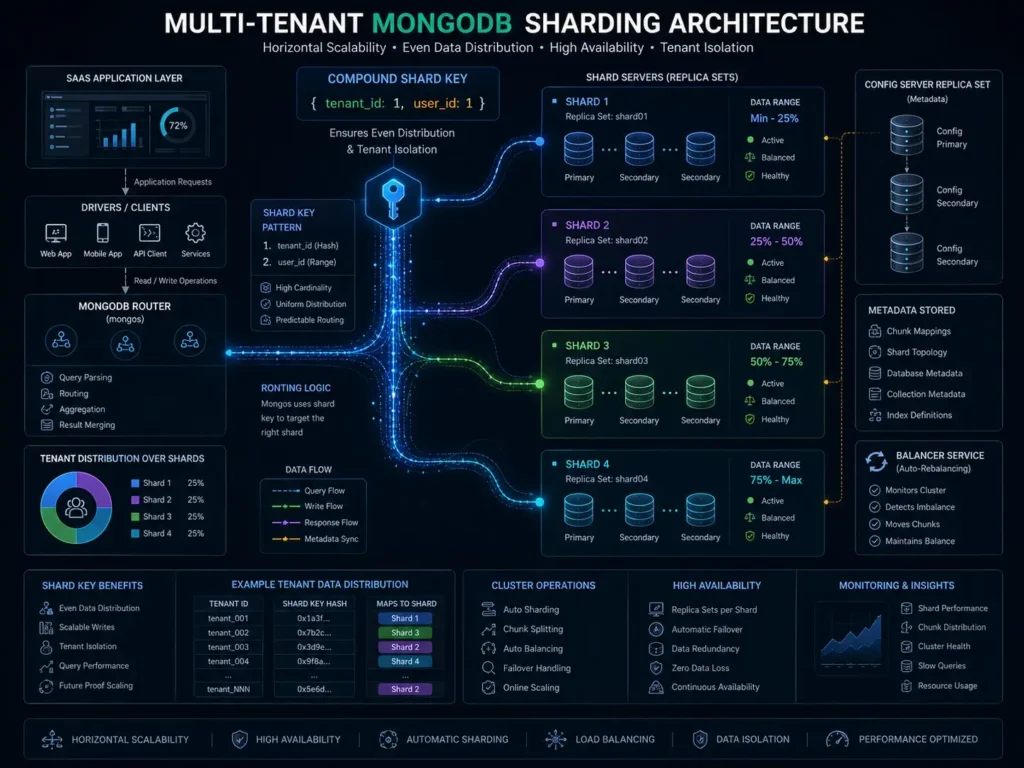
For platforms approaching high-concurrency enterprise load, MongoDB Atlas sharding is how you scale the Pool model horizontally without redesigning your data layer.
Shard Key: { tenant_id: 1, _id: 1 }
This configuration keeps all of a single tenant’s documents co-located on one shard, which means queries for that tenant do not require cross-shard scatter-gather operations. As large enterprise tenants generate more data, MongoDB can split jumbo chunks across additional physical nodes automatically.
Configure sharding before you need it. Retrofitting a sharding strategy onto an unsharded production cluster is one of the most painful database migrations you can perform. Planning it into your initial architecture costs almost nothing and saves significant engineering pain later.
4. MongoDB Multi-Tenancy Isolation Model Comparison
Use this matrix as a quick reference when presenting the architecture decision to technical stakeholders or enterprise clients:
Model | Isolation Level | Infrastructure Cost | Scalability | Best For
Silo (DB per Tenant) | Physical (Absolute) | High | Limited | Enterprise / Regulated Industries
Pool (Shared Collection) | Logical (App-enforced) | Low | High (Sharding) | Modern B2B SaaS / High-Growth
Bridge (Collection/Tenant)| Moderate | Very High | Very Limited | Do NOT use
5. Technical Implementation Checklist
Every MongoDB multi-tenancy implementation should pass through these checkpoints before going to production. Skipping any of them creates technical debt that compounds quickly.
1. Requirement Mapping: Audit your compliance requirements first. If you are handling healthcare, financial, or government data, evaluate the Silo model seriously. For everything else, start with Pool.
2. Indexing Audit: Review every collection and confirm that each index used in a multi-tenant query starts with tenant_id. There are no exceptions to this rule at production scale.
3. Middleware Logic: Build Mongoose plugins that intercept find, findOne, update, updateMany, delete, and deleteMany operations. The plugin should automatically append the current tenant’s tenant_id to every query — removing the risk of human error in the application layer entirely.
4. Sharding Configuration: Set up MongoDB Atlas sharding using { tenant_id: 1, _id: 1 } before your first enterprise tenant goes live. The cost of doing this early is minimal. The cost of retrofitting it later is significant.
5. Offboarding Protocol: Build an automated tenant deletion flow that purges all documents, indexes, and stored tokens associated with a departing tenant. This is not just good engineering — it is required for GDPR right-to-erasure compliance.
6. Common Mistakes to Avoid in MongoDB Multi-Tenancy
These are the errors that show up most often in production systems — usually discovered after something breaks rather than before.
Manual Filtering: Relying on developers to remember to include tenant_id in every query is not a process — it is a liability. A single missed filter is a data leak. Mongoose middleware at the driver level eliminates this risk by making tenant isolation automatic rather than voluntary.
Unbounded Arrays: Embedding large activity logs, audit trails, or message histories directly inside a tenant document will eventually hit MongoDB’s 16MB document size limit. Use separate collections with parent references for any data that grows unboundedly over a tenant’s lifetime.
Startup Time Blindness: If your application or database server is taking several minutes to restart, check your namespace count. Hundreds or thousands of collections cause WiredTiger to load and track metadata for each one at startup — saturating RAM and slowing initialization dramatically.
Missing Compound Indexes: Single-field indexes on shared collections will cause full collection scans as data volume grows. By the time you notice the performance degradation, you are already under load. Index structure is something you get right at the beginning.
No Sharding Plan: Going live without a sharding strategy does not mean you avoid the problem — it means you defer a much harder version of it. Unplanned migrations of unsharded production data under active load are among the most stressful database operations your team can face.
7. Frequently Asked Questions About MongoDB Multi-Tenancy
Q: What is MongoDB multi-tenancy?
A: MongoDB multi-tenancy is an architectural pattern where a single MongoDB cluster serves multiple customers — called tenants — while keeping their data logically or physically separated. Each tenant experiences the platform as if they have their own dedicated database environment, even when sharing underlying infrastructure with thousands of others.
Q: Which MongoDB multi-tenancy model is best for SaaS?
A: For most modern B2B SaaS platforms, the Pool model is the most practical starting point. It is cost-efficient, scales well with Atlas sharding, and straightforward to operate. Regulated industries like healthcare and FinTech should evaluate the Silo model when compliance requirements demand physical data separation rather than logical isolation.
Q: Can I switch MongoDB multi-tenancy models later?
A: Yes, but it is a significant migration. Switching from Pool to Silo requires exporting all documents for each tenant individually, seeding them into new isolated databases, updating connection logic in the application layer, and verifying data integrity across every tenant. It is entirely doable, but choosing the right model from the start avoids this work entirely.
Q: How does Mongoose middleware help MongoDB multi-tenancy?
A: Mongoose middleware acts as an automated security layer at the database driver level. It intercepts every query — find, update, delete — before it executes and appends the current tenant’s tenant_id automatically. This means no developer can accidentally run a query without proper tenant filtering, regardless of whether they remembered to add it manually.
Q: Why does WiredTiger matter in MongoDB multi-tenancy?
A: WiredTiger is MongoDB’s default storage engine. It manages how data is written to disk and cached in memory, and it tracks metadata for every database and collection in the cluster. When the Bridge model creates thousands of collections, WiredTiger must load and manage metadata for all of them — leading to RAM exhaustion, slow startup times, and degraded query performance across the entire cluster.
Q: Can MarkupMarvel help architect our MongoDB multi-tenancy system?
A: Yes. Our senior technical consultants have designed and implemented MongoDB multi-tenancy frameworks for enterprise SaaS products, FinTech platforms, and high-concurrency B2B marketplaces. We cover architecture design, Mongoose middleware implementation, Atlas sharding configuration, and compliance documentation. Reach out to book a free technical strategy call.
8. Conclusion: Build Your MongoDB Multi-Tenancy Foundation Today
The multi-tenancy architecture you choose at the start of your SaaS project will follow you for years. The right decision keeps your infrastructure costs predictable, your enterprise sales cycle short, and your engineering team focused on building product rather than managing database complexity. The wrong decision creates compounding technical debt that gets more expensive to fix the longer it sits.
Most modern B2B SaaS platforms belong in the Pool model with properly structured compound indexes, Mongoose middleware enforcing tenant isolation at the driver level, and Atlas sharding configured before the first enterprise tenant goes live. Regulated industries should evaluate the Silo model carefully — the higher infrastructure cost is often the right investment when compliance requirements demand it.
What both models share is the need for deliberate, documented architecture from the beginning. MongoDB multi-tenancy is not something you retrofit successfully. It is something you design correctly from the first commit.
At MarkupMarvel, we build these systems from the ground up — secure, scalable, and ready for the kind of enterprise scrutiny that comes with real growth. If you are making this architectural decision now, our team is ready to help you get it right.
More Blog

High-Availability Cloud Infrastructure: 5 Proven Steps

Nginx Redis Caching Optimization: 6 Proven Speed Tactics

Content Optimization for AI Search: 5 Proven Steps to Rank



