

Laravel for Enterprise Applications: 5 Best Reasons

Why Laravel for Enterprise Applications is Still a Powerful Backend Framework
Key Takeaways: Quick Summary for Decision Makers
Before we dive deep, here is what every CTO, engineering manager, and product owner needs to know upfront about Laravel for enterprise applications:
The Core Benefit
Laravel has evolved far beyond a simple PHP framework. Today it is a comprehensive, modular engineering ecosystem built to handle high-traffic corporate infrastructure, complex API orchestration, and multi-tenant SaaS platforms at scale.
Performance That Competes at the Highest Level
With Laravel Octane powered by Swoole or RoadRunner, applications stay resident in memory between requests. This eliminates the traditional PHP bootstrap overhead and delivers microsecond response times that genuinely compete with Node.js and Go in real-world benchmarks.
Enterprise-Grade Security Out of the Box
Laravel enforces protection against SQL injection, XSS (Cross-Site Scripting), and CSRF (Cross-Site Request Forgery) attacks natively, without requiring additional configuration. This is bank-level data protection built directly into the framework core.
A Mature Ecosystem Built for Scale
Official first-party packages like Laravel Horizon, Laravel Passport, Laravel Vapor, and Laravel Sanctum handle everything from Redis-backed queue management to OAuth2 authentication — no third-party patchwork required.
Introduction: The Framework Decision That Shapes Your Business
When engineering teams evaluate a backend framework for a high-traffic digital platform, the wrong choice does not just slow down development — it creates compounding technical debt that drains engineering budgets for years. Laravel for enterprise applications has become a recurring decision point for CTOs and senior architects across industries ranging from FinTech to Healthcare to B2B SaaS.
The concern is always the same: is Laravel actually built for enterprise scale, or is it just a rapid prototyping tool that falls apart under real load?
We have worked with enterprise clients who asked us this exact question before migrating their platforms to Laravel — and after migration, the results consistently surprised even the most skeptical engineering teams. Slower deployments became faster. Infrastructure costs dropped. Developer onboarding time shrunk from months to weeks.
The short answer is a confident yes. Laravel for enterprise applications is not just viable — for many organizations, it is the single best backend choice available today. Far beyond a simple web framework, Laravel has matured into a highly modular, enterprise-ready engineering ecosystem. From deep API integrations and asynchronous queue management to built-in compliance tools and serverless cloud deployment via Laravel Vapor, the framework provides everything required to build, optimize, scale, and maintain complex digital platforms over the long term.
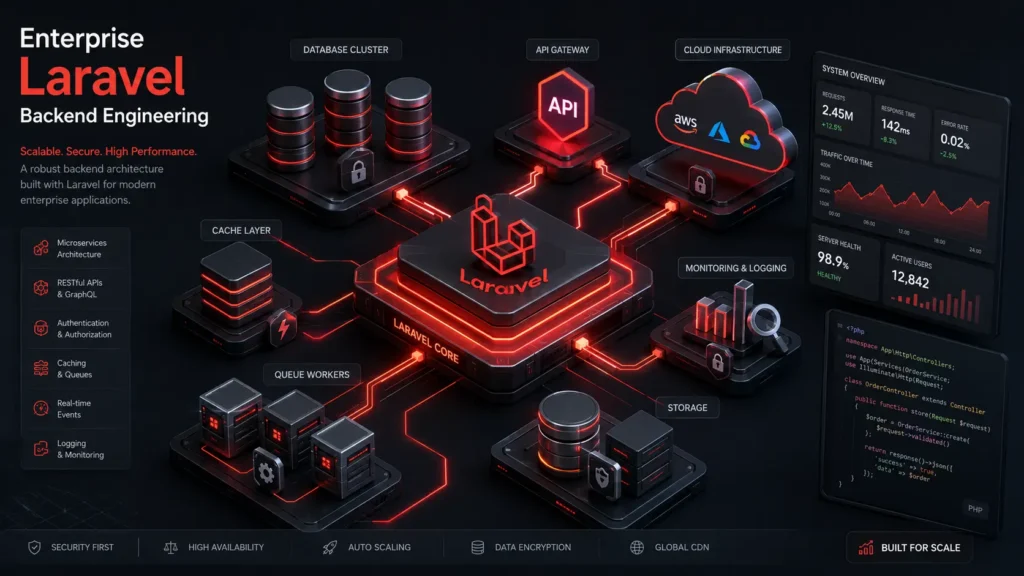
Is Laravel Good for Enterprise Applications? The Direct Answer
Yes — Laravel for enterprise applications is highly effective, and the evidence is not theoretical. Companies operating millions of daily transactions, healthcare platforms managing sensitive patient records, and SaaS businesses serving tens of thousands of concurrent users are running on Laravel right now.
What makes it enterprise-ready is not any single feature. It is the combination of a structured, opinionated architecture that enforces consistency across large engineering teams, a rich ecosystem of battle-tested official packages, and a framework maintainer (Taylor Otwell and the Laravel core team) that has demonstrated a 12-year commitment to backward compatibility and long-term stability.
For enterprise decision makers, that stability is not a minor point — it is the difference between a platform that ages gracefully and one that accumulates crippling technical debt.
Why Framework Architecture Directly Impacts Your Business Bottom Line
Choosing the right backend framework is never purely a technical decision. It is a strategic business decision with direct financial consequences.
Developer Velocity and Time-to-Market
Laravel’s expressive, clean syntax dramatically reduces the amount of boilerplate code developers need to write. What takes a Java Spring developer 300 lines to accomplish, a Laravel developer often achieves in 30. This is not just a developer quality-of-life improvement — it translates directly to faster feature delivery, shorter sprint cycles, and faster time-to-market for your product roadmap.
Scalability for High-Traffic Demands
Laravel integrates natively with Redis for caching and session management, and with AWS infrastructure for horizontal scaling. When your user base grows from 10,000 to 10 million, your Laravel application scales with your business rather than against it.
Security and Risk Reduction
Security vulnerabilities in enterprise platforms are not just technical problems — they are legal liabilities, regulatory violations, and brand-destroying events. Laravel’s built-in protection layer significantly reduces your attack surface from day one, without requiring your security team to configure complex middleware from scratch.
Long-Term Talent Availability
Laravel is consistently ranked among the most popular PHP frameworks globally, with a massive pool of trained developers available across every major hiring market. This eliminates the vendor lock-in risk that plagues teams dependent on niche, poorly-documented frameworks.
Core Technical Strengths of Laravel for Enterprise Applications
Advanced Database Management with Eloquent ORM
Data complexity is the defining challenge of enterprise software. Managing polymorphic relationships, deep data mutations, multi-tenant architectures, and complex reporting queries can turn a database layer into an unmaintainable nightmare in poorly-structured frameworks.
Laravel’s Eloquent ORM is arguably the most developer-friendly and powerful ORM in the PHP ecosystem. It enables developers to interact with multiple database connections simultaneously, write complex queries with clean and readable syntax, and manage database migrations, seeders, and rollbacks with surgical precision. For large engineering teams, this means that 15 developers can collaborate on the same database architecture without stepping on each other’s work or introducing destructive schema conflicts.
API-First Architecture with Sanctum and Passport
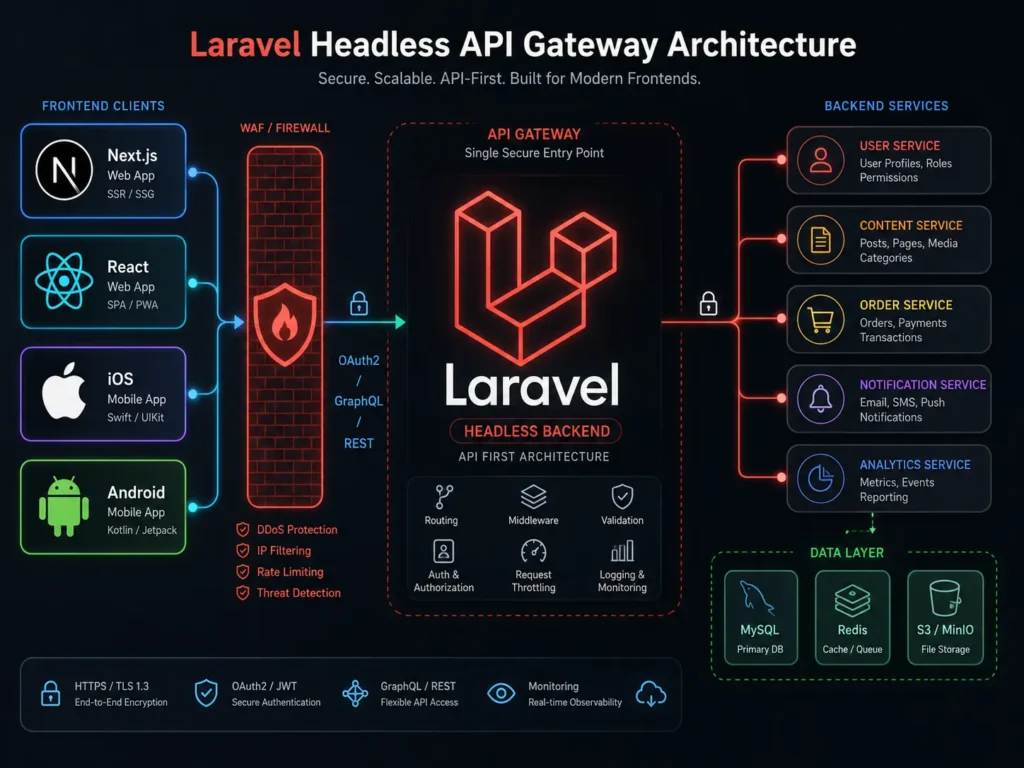
Modern enterprise platforms are not monolithic web applications. They are distributed ecosystems of mobile apps, web frontends, third-party integrations, and internal microservices — all communicating through APIs. Laravel was designed with this reality in mind.
Laravel Sanctum provides lightweight, token-based API authentication ideal for SPA (Single Page Application) frontends and mobile clients. Laravel Passport delivers a full OAuth2 server implementation for scenarios requiring delegated authorization across enterprise partner integrations. Together they give your platform a complete, production-grade authentication layer that would take months to build from scratch in other stacks.
Background Processing with Laravel Horizon
In enterprise applications, not everything should happen synchronously. Sending emails, generating PDF reports, processing uploaded files, syncing data with external CRMs, and running analytics jobs should never block the user-facing request cycle.
Laravel Horizon is a beautiful, Redis-powered queue management dashboard that gives your engineering team real-time visibility into background job throughput, failure rates, and queue depths. With Horizon, your platform can handle spikes in background processing demand gracefully, retry failed jobs automatically, and alert your DevOps team before a queue backup becomes a user-facing problem.
Laravel Octane: The Performance Game-Changer for Enterprise Workloads
One of the most common objections to Laravel for enterprise applications is performance. The assumption is that PHP — and by extension Laravel — cannot match the raw throughput of Node.js, Go, or Java under heavy concurrent load. Laravel Octane eliminates this objection entirely.
By integrating with high-performance application servers like Swoole and RoadRunner, Laravel Octane keeps your application bootstrapped and resident in memory between incoming requests. In a traditional PHP setup, every single request triggers a full application bootstrap cycle — loading service providers, resolving dependencies, and parsing configuration files from scratch. Octane eliminates this overhead entirely.
Real-world benchmarks show Laravel Octane handling tens of thousands of requests per second on modest hardware — performance figures that put it in direct competition with Node.js for the vast majority of enterprise workload profiles. For SaaS platforms, FinTech APIs, and high-concurrency B2B applications, this level of performance is more than sufficient.
Enterprise Cloud Deployment with Laravel Vapor and Forge
Laravel Vapor — Serverless at Enterprise Scale
Laravel Vapor is a serverless deployment platform built on AWS Lambda, purpose-built for Laravel applications. It removes the complexity of server provisioning entirely. Your application automatically scales to handle traffic spikes — whether that is 100 concurrent users or 100,000 — and scales back to zero during idle periods, eliminating unnecessary infrastructure spend.
For enterprise finance teams, this is particularly compelling: you pay only for actual compute consumption, not for reserved server capacity that sits idle 80% of the time. For enterprise operations teams, Vapor removes the toil of server patching, capacity planning, and manual scaling events.
Laravel Forge — Simplified Infrastructure Management
For teams that prefer traditional server infrastructure over serverless, Laravel Forge provides a powerful server provisioning and deployment automation platform. Forge manages your servers on AWS, DigitalOcean, Linode, or any SSH-accessible machine — handling Nginx configuration, SSL certificates, database provisioning, and deployment pipelines through a clean web interface. Your DevOps team manages complex cloud infrastructure without writing raw server configuration from scratch.
Real-Time Capabilities with Laravel Echo and Reverb
Modern enterprise applications increasingly require real-time functionality — live dashboards, instant notifications, collaborative editing, and real-time analytics. Laravel Echo and the newer Laravel Reverb WebSocket server make implementing these features straightforward.
Whether you are building a real-time customer support chat system, a live operations monitoring dashboard, or an instant notification layer for a mobile app, Laravel’s real-time toolkit integrates cleanly with your existing application architecture. This removes the need to bolt on a separate real-time service stack alongside your primary backend.
Seamless Integration with AI and Modern Data Workflows
As enterprise platforms increasingly incorporate AI-driven features — from predictive analytics to LLM-powered interfaces — the backend framework’s ability to orchestrate complex, asynchronous data workflows becomes critical.
Laravel for enterprise applications serves as an ideal AI orchestration layer. Heavy AI workloads, such as sending prompts to large language model APIs, running predictive modeling jobs, or processing large datasets for machine learning pipelines, can be offloaded seamlessly to Laravel’s queue system. This keeps the user-facing application interface fast and responsive while complex processing happens in the background.
Additionally, Laravel’s clean service container and dependency injection architecture make it straightforward to integrate AI service clients — whether OpenAI, Anthropic, AWS SageMaker, or custom model endpoints — as first-class application services. Your engineering team can build AI-powered features without restructuring the application architecture around them.
Mitigating Compliance Risks with Laravel for Enterprise Applications
For organizations operating in FinTech, Healthcare, E-commerce, or any regulated industry, compliance is not a feature request — it is a non-negotiable operational requirement. Laravel for enterprise applications provides the granular control required to meet GDPR, HIPAA, and PCI-DSS standards without building compliance infrastructure from scratch.
Data Sovereignty and Regional Data Residency
Laravel’s flexible filesystem abstraction and database driver system make it straightforward to configure your application to store user data in specific geographic regions. For GDPR-compliant platforms serving European users, this is a critical capability that many competing frameworks make unnecessarily complicated.
Tamper-Proof Audit Logging
Through Laravel’s custom middleware and event system, your team can implement comprehensive, tamper-proof audit trails that log every sensitive administrative action, data access event, and configuration change. These audit logs provide the documentation backbone for security audits, regulatory reviews, and incident investigations.
Encrypted Data Storage
Laravel’s native encryption services, built on AES-256-CBC encryption, ensure that sensitive data stored in your database remains unreadable even in the event of unauthorized database access. Patient records, financial data, and personal information can be encrypted and decrypted transparently at the application layer.
By implementing these enterprise-grade compliance capabilities, your organization can move through rigorous regulatory certification processes significantly faster than competitors relying on unmanaged or custom-built backend solutions.
Enterprise Backend Selection Matrix
Use this matrix when evaluating Laravel for enterprise applications against specific architectural requirements:
Architectural Requirement | How Laravel Solves It | Best Suited For
High-Concurrency API | Laravel Octane with Swoole or RoadRunner | SaaS platforms, FinTech APIs
Heavy Background Processing | Laravel Horizon with Redis queue management | Analytics engines, Data sync pipelines
Multi-Tenant Architecture | Native multiple database connection support | B2B SaaS platforms
Complex Authorization Logic | Eloquent ORM with Policies and Gates | Healthcare platforms, ERPs
Serverless Cloud Deployment | Laravel Vapor on AWS Lambda | High-growth startups, Cost-sensitive enterprises
Real-Time Features | Laravel Echo and Reverb WebSocket server | Operations dashboards, Collaboration tools
OAuth2 API Authentication | Laravel Passport full OAuth2 server | Enterprise partner integrations
Lightweight API Authentication | Laravel Sanctum token-based auth | Mobile apps, SPA frontends
Common Mistakes to Avoid When Scaling Laravel for Enterprise Applications
Even the most powerful framework delivers poor results when misused. These are the most critical architectural mistakes we see enterprise teams make with Laravel — and how to avoid them.
Ignoring Observability Until It Is Too Late
The most perfectly architected Laravel application can still fail under unexpected load if the team has no visibility into what is happening at runtime. Enterprise Laravel deployments require robust observability from day one. Laravel Pulse provides real-time application performance monitoring built directly into the framework. Sentry captures and aggregates exceptions with full stack traces. New Relic or Datadog provide infrastructure-level APM for high-stakes production environments. Without these tools, your team is flying blind when performance incidents occur.
The N+1 Query Problem
This is the single most common performance killer in Laravel applications at scale. When loading a list of 500 users and their associated companies, a naive implementation executes 501 database queries — one for the user list, and one for each user’s company. Always use Laravel’s eager loading (the with() method) to load relationships in a single optimized query. At enterprise data volumes, this difference is between a 50ms response and a 5-second timeout.
Overloading Controllers
Laravel controllers should be thin orchestration layers — not business logic dumping grounds. Enterprise Laravel applications should adopt the Action Class or Service Class design pattern, keeping individual business operations encapsulated in dedicated, testable classes. Bloated controllers become unmaintainable at team scale.
Running Heavy Tasks Synchronously
Any operation that takes more than 200 milliseconds — sending emails, generating documents, calling external APIs, processing uploads — must be pushed to a Laravel Queue. Running these operations synchronously in the request cycle degrades user experience and creates timeout vulnerabilities under load.
Skipping Automated Testing
Enterprise Laravel applications should maintain comprehensive test coverage using PHPUnit and Pest. Feature tests should cover critical user journeys. Unit tests should cover business logic classes. Without automated testing, every deployment carries unnecessary risk, and refactoring becomes dangerous.
Frequently Asked Questions About Laravel for Enterprise Applications
Is Laravel scalable enough for enterprise-level traffic?
Yes, Laravel for enterprise applications is fully capable of handling enterprise-scale traffic when properly architected. With Laravel Octane running on Swoole, combined with Redis caching, horizontal scaling via load balancers, and serverless deployment through Laravel Vapor on AWS, Laravel applications regularly handle millions of daily requests. The framework itself is not the bottleneck — database queries, inefficient caching strategies, and poor queue management are the real scaling challenges, and Laravel provides excellent native tools to address all three.
How does Laravel compare to Node.js for enterprise backend development?
Both are capable enterprise backend technologies, but they serve different team profiles and project requirements. Node.js excels in raw I/O-bound concurrency and is a strong choice for teams with deep JavaScript expertise building real-time streaming applications. Laravel offers a more structured, opinionated architecture that enforces consistency across large engineering teams — a significant advantage when your backend codebase is maintained by 10 or 20 developers simultaneously. Laravel also offers dramatically faster development velocity for CRUD-heavy enterprise applications, built-in ORM and authentication, and a more mature ecosystem of official enterprise-focused packages. For most enterprise SaaS and B2B platforms, Laravel delivers better long-term maintainability.
How does Laravel compare to Java Spring for enterprise applications?
Java Spring is a powerful enterprise framework with deep roots in large corporate environments. However, it comes with significant tradeoffs: steep learning curves, verbose configuration, slower development cycles, and substantially higher developer hiring costs. Laravel for enterprise applications delivers comparable architectural rigidity and enterprise-grade capabilities with significantly faster time-to-market, lower engineering overhead, and a much broader global talent pool. For enterprises not operating under Java-specific compliance or legacy integration constraints, Laravel is frequently the smarter economic choice.
Is Laravel secure enough for financial and healthcare data?
Yes. Laravel for enterprise applications is fully capable of supporting HIPAA, GDPR, and PCI-DSS compliance requirements. The framework provides native AES-256-CBC encryption, CSRF protection, SQL injection prevention through parameterized queries, XSS output escaping, and granular access control through its Policies and Gates authorization system. Organizations in FinTech and Healthcare regularly build and certify production platforms on Laravel. The framework provides the tools — your team’s implementation determines the compliance outcome.
Can Laravel handle multi-tenant SaaS architectures?
Absolutely. Multi-tenancy is one of Laravel’s documented strengths for enterprise applications. Laravel supports multiple database connection configurations natively, allowing your application to route each tenant to an isolated database schema with a single configuration change. Packages like Tenancy for Laravel extend this further with automated tenant identification, subdomain routing, and data isolation. For B2B SaaS platforms where data isolation between customer accounts is a legal and contractual requirement, Laravel provides a robust, well-documented solution.
How does Laravel handle major version upgrades without breaking enterprise applications?
Laravel maintains a clear versioning schedule with Long-Term Support (LTS) releases and a strong commitment to documented upgrade paths. The Laravel Shift service automates the migration of Laravel applications between major versions, handling the mechanical parts of the upgrade — configuration file changes, renamed methods, updated dependencies — through an automated diff-based process. This means enterprise teams can stay current with security patches and framework improvements without dedicating entire sprint cycles to manual migration work.
What is the total cost of ownership for Laravel versus other enterprise frameworks?
Total cost of ownership for Laravel for enterprise applications is consistently lower than comparable Java or .NET alternatives across three dimensions. First, developer hiring costs are lower because the PHP and Laravel talent pool is substantially larger globally. Second, development velocity is higher, meaning fewer engineering hours per feature delivered. Third, infrastructure costs are lower, particularly with Laravel Vapor’s serverless model eliminating reserved server capacity waste. For mid-market to enterprise organizations without legacy Java infrastructure dependencies, Laravel typically delivers a measurably better return on engineering investment over a 3 to 5 year horizon.
Conclusion: Building Your Enterprise Foundation with Laravel
At MarkupMarvel, we have worked with enterprise engineering teams across FinTech, Healthcare, E-commerce, and B2B SaaS to design, build, and scale Laravel backends that power real business outcomes. The consistent lesson from every engagement is this: your backend framework choice is a multiplier on everything your engineering team builds.
Laravel for enterprise applications is not a compromise between developer comfort and enterprise capability. It is a framework that has earned its place in serious enterprise infrastructure through more than a decade of continuous improvement, a thriving ecosystem of official tools, and a track record of production deployments at genuine scale.
By choosing Laravel for enterprise applications, you are not just selecting a programming framework. You are selecting an engineering culture — one defined by clean architecture, comprehensive tooling, and a development philosophy that keeps your platform maintainable, secure, and extensible as your business evolves.
Empowering Your Engineering Team for the Long Term
Beyond the technical capabilities, Laravel for enterprise applications creates organizational resilience. Consistent architecture, comprehensive documentation, and a global talent pool mean your platform is never dependent on a single developer’s institutional knowledge. New engineers onboard faster. Senior developers spend their time building features rather than deciphering legacy code. Your platform grows with your business — not against it.
The question is not whether Laravel can handle enterprise requirements. The evidence is clear that it can. The question is whether your organization is ready to invest in the right foundation.
More Blog

High-Availability Cloud Infrastructure: 5 Proven Steps

Nginx Redis Caching Optimization: 6 Proven Speed Tactics

Content Optimization for AI Search: 5 Proven Steps to Rank



