

Headless Shopify with Next.js: 6 Signs Your Brand Is Ready

Headless Shopify with Next.js: 6 Signs Your Brand Is Ready
For high-volume eCommerce brands, the standard monolithic Shopify experience eventually hits a ceiling. When your marketing team demands sub-second page loads, pixel-perfect creative freedom, and the ability to unify content across multiple channels, the default Shopify frontend becomes a bottleneck rather than an asset. This is where Headless Shopify with Next.js enters the strategic conversation. Brands that have successfully adopted Headless Shopify with Next.js consistently report faster load times, higher conversion rates, and greater marketing flexibility.
Moving to a headless architecture is not a decision to be made lightly. It is a major transition from an all-in-one platform to an API-first ecosystem. In this article, we evaluate the business case for decoupling your store, the technical trade-offs involved, and how to determine if your brand is ready.
SHORT ANSWER
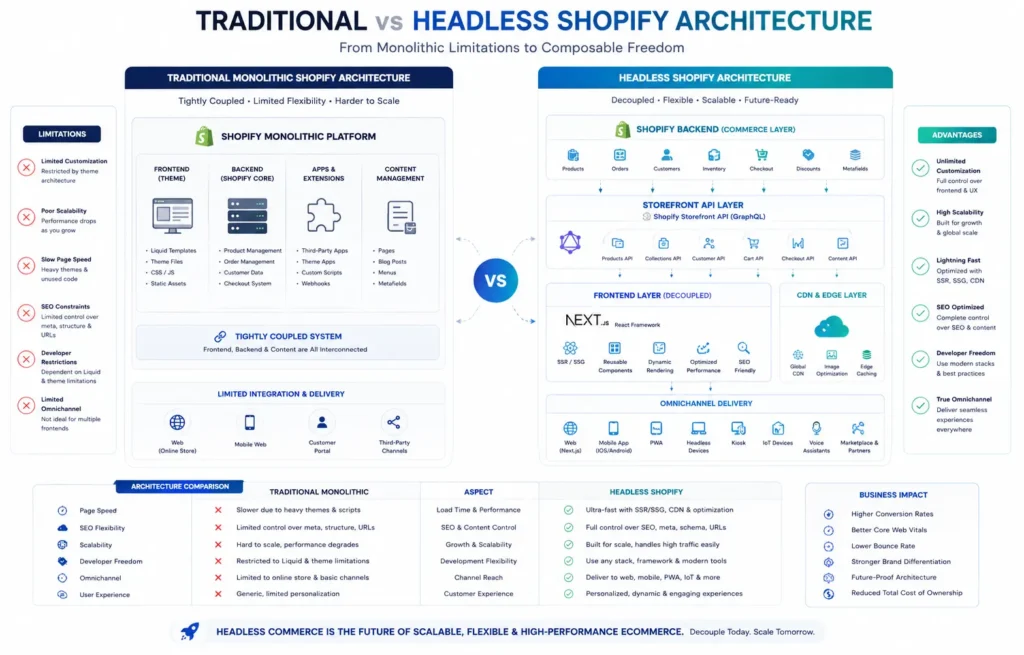
Headless Shopify with Next.js is a decoupled architecture where Shopify acts solely as the backend commerce engine, while Next.js handles the frontend user interface. You should choose this path when your brand requires extreme site performance, omnichannel content delivery, or highly custom UI/UX that standard theme editors cannot support. It is best for high-revenue stores ready to invest in a proprietary, high-speed, and secure digital infrastructure.
[IMAGE 1]
File Name : headless-shopify-nextjs-storefront-api-architecture.webp
Alt Text : Headless Shopify with Next.js architecture diagram showing Storefront API connecting Shopify backend to Next.js frontend.
Title Text : Headless Shopify and Next.js Architecture Overview
1. Why This Matters for Your Business
Decoupling your storefront is an investment in your brand’s future scalability. Here is why it matters:
CONVERSION IMPACT
Every 100ms of latency reduction directly correlates to higher conversion rates. Next.js offers superior server-side rendering and static generation capabilities that standard Liquid themes simply cannot match.
TOTAL DESIGN FREEDOM
You are no longer restricted by theme architecture. Your developers can implement any UI design, animation, or custom checkout flow your team can imagine.
SEO ADVANTAGE
You can learn more about how page speed affects rankings in the official Core Web Vitals documentation
RISK MITIGATION
By separating your frontend from your backend, you isolate your commerce engine from UI-related errors — ensuring your store stays operational even during major design updates.
2. How It Works: The Core Concept
At its core, a headless setup breaks the monolith of a traditional Shopify store into two distinct parts:
THE HEAD (FRONTEND)
This is the Next.js application. It is what your customers see and interact with — a high-performance web app built using React. For a full technical reference, see the official Next.js documentation
THE BODY (BACKEND)
This is Shopify. It continues to handle the heavy lifting — inventory management, payments, order processing, and customer data via the Shopify Storefront API. Full API reference is available at the official Shopify developer documentation
This separation means your frontend is not reliant on Shopify’s servers to render a page. Instead, it pulls data on-demand, delivering an app-like experience for the end user.
3. The Strategic Breakdown: 4 Key Shifts
THE PERFORMANCE BENCHMARK
Traditional themes load a library of CSS and JavaScript for every possible feature — whether you use it or not. Next.js allows for code splitting, where the browser only loads the exact JavaScript required for the specific page being viewed. This is the most effective way to achieve perfect Core Web Vitals scores — and one of the core reasons brands choose Headless Shopify with Next.js over standard Liquid themes.
OMNICHANNEL CONTENT DELIVERY
A headless architecture lets you push the same product data to multiple channels — your website, a mobile app, or even an in-store kiosk — using the same backend data source. This unified brand experience is impossible to achieve with a standard web-only theme.
COMPLEXITY VS. CAPABILITY
Headless is not a magic button. It increases the complexity of your technical stack. You are now managing two systems instead of one. For growing brands, this is a positive trade-off. For smaller stores, the maintenance overhead may outweigh the performance gains.
INTEGRATING AI AND CUSTOM WORKFLOWS
Because you control the frontend code, you can easily integrate AI-powered search, personalized product recommendations, and custom automation directly into the UI. You are building a custom software product rather than just configuring a store.
4. Standard vs. Headless: Side-by-Side Comparison
Feature | Standard Shopify (Liquid) | Headless Shopify (Next.js)
———————–|————————–|—————————
Development Time | Fast | Significant
UI Flexibility | Theme-restricted | Unlimited
Page Load Speed | Average | Superior (Sub-second)
Maintenance | Low | Higher (Requires tech team)
Best For | SMBs, Startups | Scaling Brands, High-Volume
—
5. Common Mistakes to Avoid
GOING HEADLESS TOO SOON
Headless Shopify with Next.js is a significant investment. If your store is not generating the revenue to justify the added development cost, you are incurring unnecessary technical debt.
IGNORING APP COMPATIBILITY
Some Shopify apps rely on Liquid code to inject functionality. In a headless setup, you must manually integrate these via API — a significant hidden cost many brands overlook.
WEAK API STRATEGY
Failure to properly cache Storefront API calls can result in rate-limiting issues. Always implement a robust caching strategy from day one.
NEGLECTING SEO SETUP
When building a custom frontend, you must manually manage canonical tags, metadata, and structured data. Never let your SEO performance drop during the transition.
LACK OF STAGING LOGIC
Headless requires a sophisticated deployment pipeline. Testing in production is not an option for an enterprise-level site.
6. How MarkupMarvel Can Help
Transitioning to a headless architecture is a significant engineering undertaking that requires a partner who understands both the commerce engine and the modern frontend stack. At MarkupMarvel, we do not just deploy code — we architect sustainable growth.
We bridge the gap between Shopify’s powerful backend and the high-performance requirements of your frontend. Whether you are taking your first steps into Headless Shopify with Next.js or optimizing an existing headless setup, our team is here to guide every step — from API integration to technical SEO.
FREQUENTLY ASKED QUESTIONS (FAQ)
Q: Is Headless Shopify with Next.js always faster than a standard theme?
A: Not inherently. While Next.js is highly performant, it depends entirely on how the architecture is built. Poorly written custom code can actually be slower than a well-optimized standard theme. It requires professional engineering to deliver the performance gains headless promises.
Q: How do I know if my store is ready for headless?
A: If your store has complex performance bottlenecks that standard Liquid cannot fix, or if your creative team is constantly limited by the theme editor, you are likely ready to explore headless. Stores generating significant monthly revenue with high traffic volumes see the clearest ROI.
Q: Does going headless break my existing Shopify apps?
A: Yes, potentially. Apps that rely on Liquid theme app extensions will not work out of the box in a headless environment. You must plan for manual API integrations for all essential apps — this is one of the most commonly underestimated costs of going headless.
Q: Can MarkupMarvel help with the migration from a standard theme to headless?
A: Absolutely. We specialize in managing the technical transition from monolithic Shopify to headless, ensuring minimal downtime and preserving your SEO rankings through careful URL management and redirect strategies.
Q: How does hosting change with a headless setup?
A: Shopify hosts your backend, but you must host your Next.js frontend separately — typically on Vercel or AWS. MarkupMarvel manages this infrastructure setup, ensuring your frontend is always performant and secure.
Q: What is the biggest hidden cost of going headless?
A: App compatibility. Many merchants budget for development but underestimate the cost of re-integrating essential Shopify apps via API. A proper audit of your app stack before committing to headless is essential.
READY TO BUILD A STORE THAT SCALES WITHOUT LIMITS?
If you are planning to scale your eCommerce store with a headless architecture, we can help you design, build, and optimize the right solution for your brand.
More Blog

High-Availability Cloud Infrastructure: 5 Proven Steps

Nginx Redis Caching Optimization: 6 Proven Speed Tactics

Content Optimization for AI Search: 5 Proven Steps to Rank



