

GEO vs SEO vs AEO: 4 Key Differences for AI Search Success

GEO vs SEO vs AEO: How Businesses Should Prepare for AI Search
Organic search is going through its biggest structural shift since Google first introduced PageRank. AI Overviews, Perplexity, and ChatGPT’s search features are quietly changing what a “search result” even means. Instead of a page of blue links, users are increasingly getting a single synthesized answer — sometimes with no need to click through to any website at all.
That shift raises an uncomfortable question for any business that depends on organic traffic: what happens when search engines stop sending links and start sending answers instead? Understanding the practical differences between GEO vs SEO vs AEO is no longer a niche technical debate. It is becoming a baseline requirement for protecting the traffic and revenue your website currently generates.
Businesses that ignore this shift risk a slow, quiet decline in traffic as more queries get answered directly on the search results page. Businesses that adapt early are positioning themselves to be the source AI engines actually cite — which carries its own kind of authority that a normal search ranking never did. This guide breaks down what each of these three frameworks actually means, how they differ technically, and what your business needs to do to stay visible across all three.
GEO vs SEO vs AEO — The Short Answer
SEO, or Search Engine Optimization, is the practice of optimizing a website to rank highly in traditional search results using keywords, backlinks, and technical performance. It is fundamentally a “click-through” strategy — the goal is getting the user from the search results page onto your website.
AEO, or Answer Engine Optimization, structures content so it can be pulled directly into featured snippets and voice assistant responses. Instead of sending the user to a page, the answer engine extracts a single, definitive answer block straight from your content.
GEO, or Generative Engine Optimization, adapts your digital presence for AI-driven search tools like Perplexity and Google’s AI Overviews. Rather than optimizing for a click or a snippet, GEO is about being recognized as a credible, citable source that an AI model chooses to reference when constructing its answer.
These three are not competing strategies. They are increasingly layers of the same overall approach to staying visible in a search landscape that is rapidly diversifying.
Why the Shift from SEO to AEO and GEO Matters for Your Business
Traffic and Revenue Impact
As AI engines answer more queries directly on the results page, the volume of purely informational traffic to websites is going to decline. Businesses need to adapt their content strategy to capture the transactional, high-intent users who still click through — and to be the source AI cites for the users who don’t.
The Changing Value of Content
Content built purely around keyword volume and density checks is becoming less valuable. Investing in genuinely expert, entity-based content protects your visibility from algorithm volatility and positions you for the queries that matter, not just the ones that are easy to rank for.
Technical Architecture Requirements
AI crawlers and answer engines depend heavily on clean code, fast page rendering, and properly structured data. A legacy website that is slow to load or buries its content behind heavy client-side JavaScript will simply not get parsed, indexed, or cited by modern AI systems — regardless of how good the content actually is.
Brand Authority and Trust
Being directly cited by an AI engine functions as a strong trust signal to the person reading the answer. Optimizing for GEO increases your odds of earning that citation, which builds a kind of brand authority that a standard search ranking position never quite delivered on its own.
Reducing Dependence on a Single Channel
Relying exclusively on traditional SEO creates a single point of failure for your entire organic acquisition strategy. A combined approach across SEO, AEO, and GEO builds a more resilient pipeline that is not entirely at the mercy of one algorithm update or one platform’s policy change.
Defining the Three Frameworks: SEO, AEO, and GEO
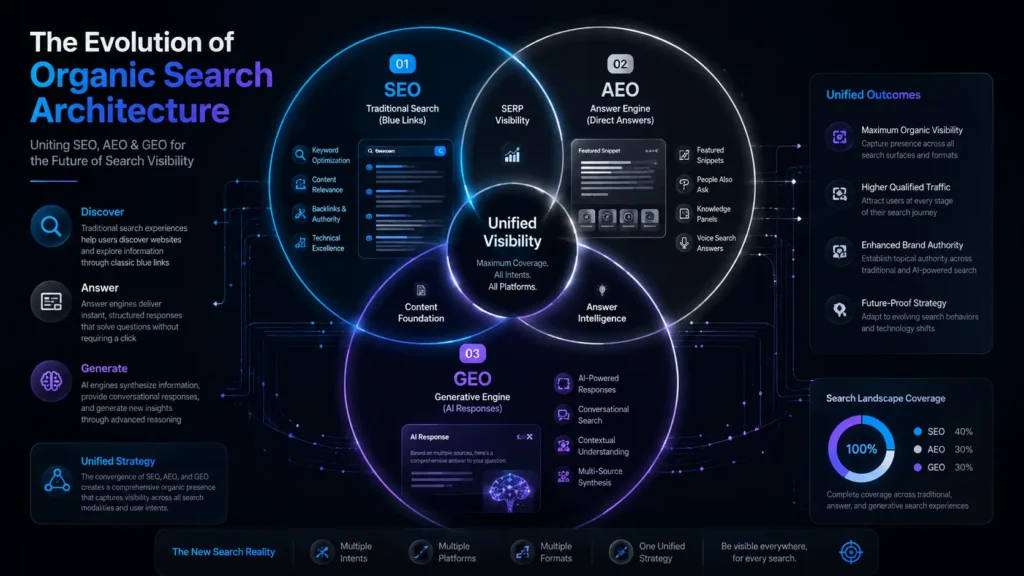
Search Engine Optimization (SEO)
SEO is the long-established practice of optimizing a website to rank well in traditional results pages on Google or Bing. It is built around keywords, backlink authority, and technical crawlability. When someone types a query, the search engine retrieves and ranks the most relevant pages it can find. This is fundamentally a blue-link strategy — success means the user clicks through to your site to find their answer there.
Answer Engine Optimization (AEO)
AEO is a more specialized discipline built for the era of featured snippets and voice assistants like Alexa, Siri, and Google Assistant. Rather than presenting a list of links, answer engines pull a single definitive answer directly from a trusted source and present it on the spot. This requires content structured around clear question-and-answer blocks, clean heading hierarchy, and precise list formatting, all backed by solid structured data.
Generative Engine Optimization (GEO)
GEO is the newer, more technically demanding frontier. Generative search tools — Perplexity, OpenAI’s search features, and Google’s AI Overviews — do not just match links. They pull information from multiple sources in real time and synthesize it into a single conversational response. Optimizing for GEO means transforming your brand from “a website that exists” into a verified, recognizable entity that these systems trust enough to cite by name.
The Bigger Shift: From Keyword Strings to Semantic Entities
Traditional digital marketing was built around strings — exact keyword phrases and character sequences repeated through a page’s content. AEO and GEO operate on a different logic entirely, built around entities: well-defined concepts, people, brands, and the relationships between them.
Generative engines use natural language processing to map context across an entire topic rather than scanning for repeated phrases. This means the old question — “did we use the focus keyword enough times?” — is no longer the right one to be asking. The better question is whether your content actually demonstrates the depth, dependencies, and practical nuance of the topic you are covering.
This is a genuine shift in how content needs to be built, not just a new set of technical boxes to check. A page that thoroughly explains a topic with real expertise will naturally satisfy entity-based search far better than a page engineered around keyword density ever could.
The Technical Infrastructure AI Crawlers Actually Need
Modern AI scraping systems operate under real resource constraints. If your website relies on slow client-side rendering, sluggish database queries, or convoluted page structures, many of these crawlers will simply skip indexing your content rather than wait around for it to load.
Server-Side Rendering
Rendering your application on the server — whether through a high-performance React setup or a headless CMS architecture — means your raw content is immediately readable by crawlers without requiring them to execute JavaScript first. This single change can be the difference between being indexed and being skipped entirely.
Core Web Vitals
Fast, stable page rendering remains a baseline requirement, not just for traditional search crawl budgets but for giving AI systems a clean, quick window into your content before they move on to the next source.
Clean Semantic HTML Structure
Using proper semantic tags — article, nav, section — helps crawlers understand the actual structure and intent of your page rather than having to guess which parts are content and which parts are navigation clutter or layout scaffolding.
Structuring Content for Answerability and AI Citations
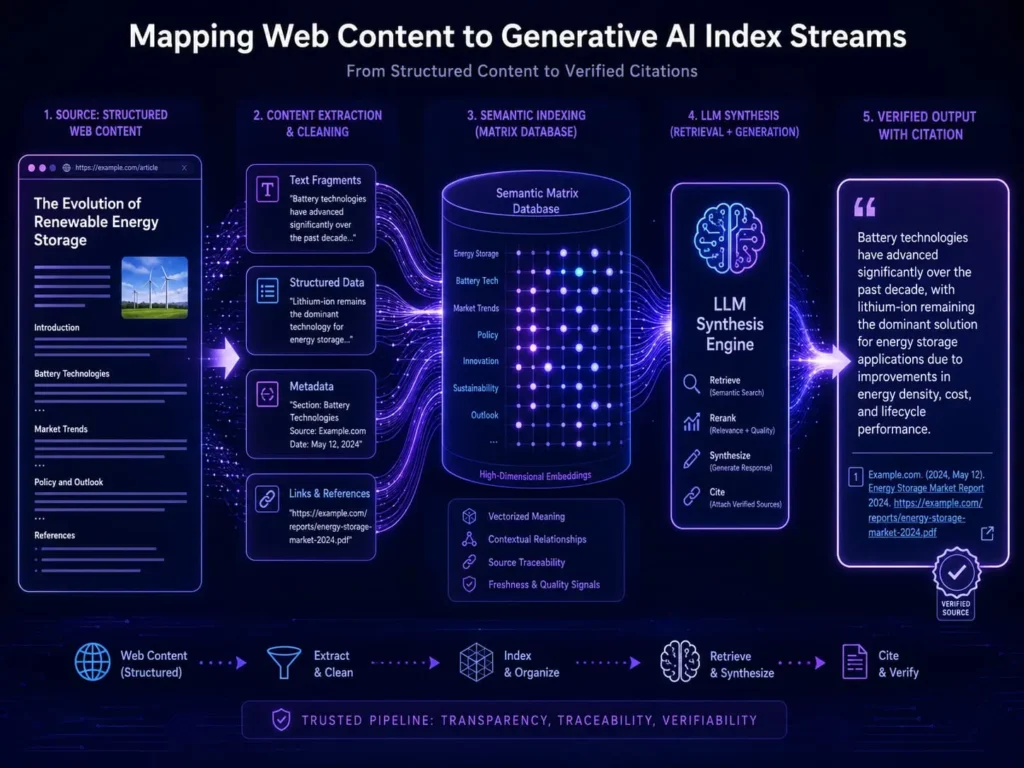
Earning featured snippet placement and AI citations requires a deliberate structural choice in how you present information — essentially an inverted pyramid, leading with the answer rather than building up to it.
A content structure that works well across SEO, AEO, and GEO follows roughly this order: start with a short, direct, factual answer right at the top of the page, follow it immediately with supporting data, statistics, or comparisons, and then expand into the deeper context, edge cases, and practitioner-level detail that a casual reader might not need but a thorough one will appreciate.
This structure satisfies a voice assistant looking for a fast, clean snippet, while also giving large language models the depth they need to treat your page as a credible, citable original source rather than a thin rehash of something already published elsewhere.
SEO vs. AEO vs. GEO — A Direct Comparison
Primary Objective
SEO aims to drive click-through traffic to your website through ranked links. AEO aims to deliver the single best, most concise factual answer to a specific question. GEO aims to earn a verified citation inside an AI-generated response.
Where Each One Shows Up
SEO results appear on Google and Bing search pages. AEO results appear in voice assistant answers and featured snippet blocks. GEO results appear inside Perplexity, ChatGPT search, and AI Overviews.
What Each One Optimizes For
SEO optimizes for keyword relevance, backlink volume, and content length. AEO optimizes for direct question-and-answer formatting, schema markup, and brevity. GEO optimizes for entity clarity, original insight, and demonstrated expertise.
The Technical Foundation Each One Needs
SEO depends on crawl access and solid index management. AEO depends on comprehensive JSON-LD and clean semantic HTML. GEO depends on server-side rendering and well-connected entity metadata across your site and the wider web.
How the Content Itself Should Read
SEO content tends to be broad, informational, and written to cover a topic comprehensively. AEO content is concise, structured, and direct. GEO content reads as authoritative and practitioner-led, drawing on original research or hands-on expertise rather than summarizing what is already published elsewhere.
Common Mistakes Businesses Make With GEO, SEO, and AEO
– Declaring traditional SEO dead: Abandoning solid page structure, metadata, and link management to chase the newest AI trend will quietly collapse the traffic base you already have. GEO is built on top of strong SEO fundamentals, not in place of them.
– Publishing generic, unedited AI-generated content: Using raw AI output as your GEO strategy is contradictory. Generative engines are specifically looking for unique, human-expert insight when deciding what to cite, and generic text gets filtered out as noise rather than treated as a source.
– Skipping structured data: Leaving search engines and AI systems to guess at the context of your content introduces unnecessary ambiguity. Detailed JSON-LD schema markup is no longer optional for businesses serious about AI visibility.
– Locking content behind heavy client-side JavaScript: If your important content only renders after a complex script runs in the browser, resource-constrained AI crawlers may never see it at all. Pre-rendering or server-side rendering solves this directly.
– Only targeting short, generic keywords: Generative search queries tend to be conversational and long-tail by nature. Optimizing exclusively for short head terms locks you out of the more specific, intent-rich queries that AI engines are increasingly built to handle.
– Ignoring digital PR and external mentions: AI systems build trust in a brand partly by cross-referencing how that brand is discussed elsewhere on the web. If your business has little to no presence outside your own website, AI systems have fewer reasons to treat you as an authoritative source worth citing.
How MarkupMarvel Helps Businesses Win Across SEO, AEO, and GEO
At MarkupMarvel, we treat SEO, AEO, and GEO as layers of one connected strategy rather than three separate disciplines competing for budget. Preparing a website for the next phase of search requires the same things across all three: clean technical infrastructure, properly structured data, and content that demonstrates real expertise rather than just repeating keywords.
Our technical SEO and content teams handle this end to end — from building the structured data architecture that AEO and GEO depend on, to addressing the rendering and performance issues that quietly keep AI crawlers from indexing a site properly in the first place. For background on how we approach the technical side of structured data specifically, see our guide on advanced schema markup, which covers the JSON-LD implementation details that both AEO and GEO rely on
For a broader technical reference on how Google’s systems evaluate page experience and content quality — which feeds directly into how AI Overviews select sources — Google’s own Search Central documentation is worth reviewing
Frequently Asked Questions About GEO vs SEO vs AEO
Q: What is the main structural difference between SEO and GEO?
A: Traditional SEO aims to rank links in search results to drive click-through traffic. GEO aims to structure your content and brand as a verified, trustworthy entity so that AI systems are willing to cite and reference your insights directly inside their generated answers.
Q: Does AEO replace the need for traditional SEO work?
A: No. AEO works as a specialized layer on top of solid SEO fundamentals. SEO handles your overall indexation and domain authority, while AEO formats specific pieces of content so they can be easily extracted and used by voice assistants and featured snippets.
Q: How can a business actually earn citations in AI Overviews?
A: Prioritize original data, proprietary research, expert case studies, and clearly structured markup. Combine that with a fast, clean technical foundation that allows AI crawlers to extract your facts without friction.
Q: Are keywords irrelevant now for GEO?
A: Keywords still matter for establishing what topic your content covers. The difference is that GEO rewards rich semantic variety and genuine topical depth over exact-match phrase repetition.
Q: Do we need to completely rebuild our website to compete for GEO visibility?
A: Not always, though a technical audit is a smart first step. If your current platform is slow, suffers from rendering issues, or buries content in heavy JavaScript, a move toward a faster, more crawler-friendly architecture may be worth considering.
Q: How long does it take to see results from AEO and GEO work?
A: Technical fixes like clean structured data and faster server response times can improve crawl behavior within a few weeks. Building the kind of entity authority that leads to consistent AI citations is a longer process, typically unfolding over three to six months.
Final Thoughts
SEO, AEO, and GEO are not three competing strategies fighting for the same budget. They are three layers of the same underlying goal — being visible, trusted, and useful wherever people are actually searching, whether that is a traditional results page, a voice assistant, or an AI-generated summary.
The businesses that will struggle in the next few years are not the ones who choose the “wrong” framework. They are the ones who assume nothing has changed and keep doing exactly what worked five years ago. Adapting now, while the rules are still being written, is a meaningfully better position than trying to catch up after the shift is already complete.
More Blog

High-Availability Cloud Infrastructure: 5 Proven Steps

Nginx Redis Caching Optimization: 6 Proven Speed Tactics

Content Optimization for AI Search: 5 Proven Steps to Rank



