

IPFS and Arweave: Powerful Decentralized Storage Guide

IPFS and Arweave Explained: Decentralized Storage for Modern Web Apps
Decentralized storage for web apps is moving from a niche Web3 concept into a practical infrastructure decision that development teams are making for real production applications. Understanding what it actually means — and which protocol fits which use case — is what separates teams that implement it well from those that spend months troubleshooting problems they did not anticipate.
The core idea is straightforward. Traditional web applications store files on centralized servers — your own hardware, AWS S3, Google Cloud Storage, or a similar provider. Those servers are reliable for most purposes, but they introduce dependencies that decentralized storage eliminates: a single point of failure, vendor lock-in, the possibility of data being modified or removed by the hosting provider, and geographic latency for users far from your data center.
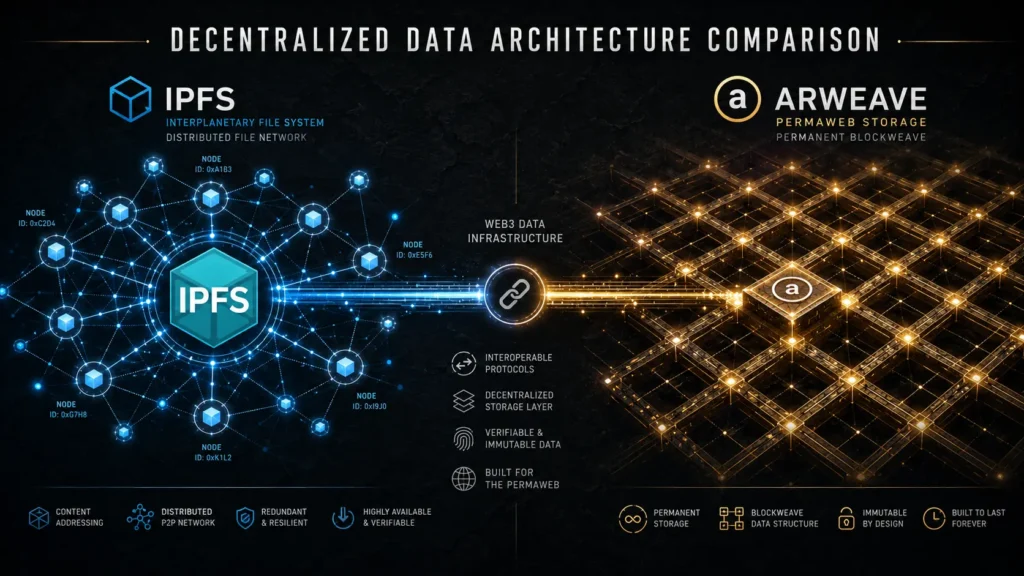
IPFS and Arweave solve these problems in different ways, for different kinds of data, with different trade-offs. IPFS is built for fast, distributed content delivery. Arweave is built for permanent, unalterable storage. Knowing which to reach for — and when to use both — is the practical question this guide answers.
Short Answer
Decentralized storage for web apps refers to peer-to-peer systems that store data across a distributed network rather than on centralized servers. IPFS is a content-addressable protocol optimized for fast, decentralized file sharing and edge delivery. Arweave offers permanent, tamper-proof storage through its blockweave architecture, backed by a one-time payment endowment model. Use IPFS for dynamic content delivery and large-scale media distribution. Use Arweave for data that must remain permanently accessible and unalterable — legal records, audit logs, NFT metadata, and archival content.
Why Decentralized Storage for Web Apps Matters Now
The case for decentralized storage is not primarily ideological. It is practical, and it applies to a wider range of applications than most development teams assume.
Centralized storage introduces dependencies that only become visible when something goes wrong. A provider outage takes your assets offline. A provider policy change affects what you can store and how. A geographic concentration of servers creates latency for users in other regions. Data that can be modified by a third party — even with good intentions — cannot be treated as genuinely immutable.
For applications where these concerns are significant — DeFi protocols where smart contract metadata must be permanently accessible, NFT projects where asset permanence is part of the value proposition, legal and compliance applications where tamper-proof records are a requirement, or globally distributed applications where CDN performance matters — decentralized storage addresses real problems that centralized alternatives cannot fully solve.
Even for applications that do not have strict immutability requirements, the combination of IPFS-based content delivery and traditional cloud storage can improve performance and reduce costs in ways that are worth evaluating.
The practical question is not whether decentralized storage is philosophically preferable to centralized storage. It is whether the specific properties of IPFS or Arweave solve specific problems your application has.
For teams also building smart contract infrastructure alongside their storage layer, see our guide on smart contract security: /smart-contract-security-common-risks
How Decentralized Storage Actually Works
Content Addressing vs. Location Addressing
The fundamental difference between decentralized and centralized storage is how files are identified and retrieved.
In traditional storage, a file is identified by its location — a URL that points to a specific server at a specific path. If that server is unavailable, or if the file at that path changes, anyone requesting the original URL gets a different result or no result at all. The URL tells you where the file should be, not what the file is.
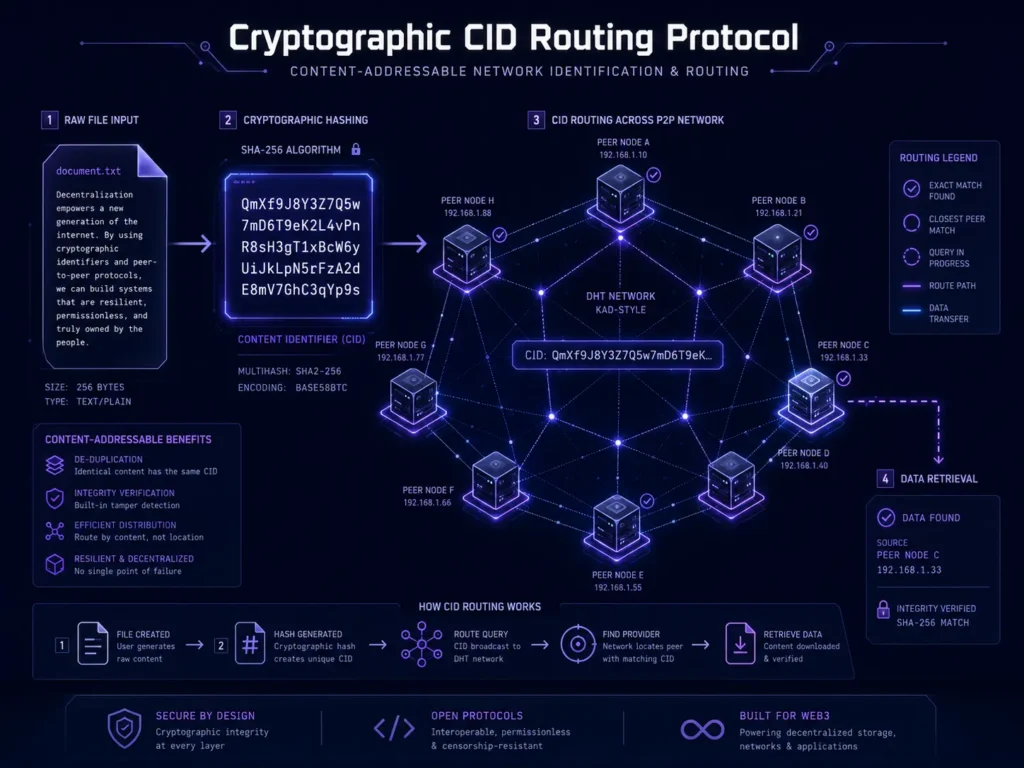
Decentralized storage replaces location-based addressing with content-based addressing. Instead of a URL pointing to a server location, each file is identified by a cryptographic hash of its content — called a Content Identifier or CID in IPFS terminology. Any node in the network that holds a file matching that hash can serve it. If the file content changes by even a single character, the hash changes, producing a completely different identifier.
This has a practical implication that matters for many applications: content-addressed files are verifiably immutable. You cannot retrieve a file by its CID and get different content than you expected. The hash is a mathematical proof of the content’s identity.
IPFS: Distributed Content Delivery
IPFS is a peer-to-peer file system designed for fast, distributed content delivery. When a file is added to IPFS, it is split into chunks, each identified by its own CID, with a root CID identifying the complete file. Any node in the network can request and cache chunks, serving them to nearby peers.
The analogy to a CDN is useful but incomplete. A CDN stores copies of your files on servers in multiple geographic locations. IPFS distributes files across any node that has requested or pinned them — which can include your own infrastructure, dedicated pinning services, and any other participant in the network who has accessed the content.
The important caveat is persistence. IPFS does not guarantee that any particular node will continue storing a file indefinitely. Nodes periodically run garbage collection that removes files that have not been recently requested. To ensure a file remains available, it must be pinned — either on a node you control or through a dedicated pinning service.
Arweave: Permanent Storage
Arweave operates on a fundamentally different premise. Where IPFS is optimized for fast retrieval and requires active management to maintain persistence, Arweave is designed for permanent, unalterable storage with no ongoing maintenance requirement.
The economic model is what makes this possible. When you upload data to Arweave, you pay a one-time fee that funds a storage endowment. That endowment is designed to cover storage costs for over two hundred years as the cost of storage continues to fall over time. Once data is uploaded, it is permanently accessible through the Permaweb — Arweave’s permanent, decentralized web layer.
The trade-off is immutability. Data stored on Arweave cannot be modified or deleted. To update a file, you upload a new version and update your application to reference the new transaction ID. The original version remains permanently accessible.
—————————————————————-
IPFS vs. Arweave: Full Technical Comparison
Feature | IPFS | Arweave
————————-|———————————–|—————————
Primary Goal | Fast distributed content delivery | Permanent immutable storage
Persistence | Temporary — requires pinning | Permanent — guaranteed by endowment
Cost Model | Free to self-host or pinning fee | One-time upfront payment
Retrieval Speed | Very fast — optimized for edge | Moderate — optimized for permanence
Data Mutability | Content is immutable by hash | Fully immutable — no updates
Best For | Media, DApp frontends, dynamic data| Legal records, NFTs, audit logs
Blockchain Required | No | Yes — Arweave’s own chain
Self-Hosting Option | Yes | Via mining participation
4 Practical Strategies for Implementing Decentralized Storage
1. Choose the Right Protocol for Each Data Type
Not all data has the same requirements, and most production applications benefit from using IPFS and Arweave for different parts of their storage needs.
Use IPFS for assets that need to be delivered quickly and that may change over time — frontend build artifacts, media files, user-generated content. Use Arweave for data that must remain permanently accessible and verifiably unaltered — smart contract metadata, NFT assets, compliance records, audit logs.
Many Web3 applications use both: IPFS for current, frequently accessed content and Arweave for permanent archival and record-keeping.
2. Set Up Reliable Pinning for IPFS Content
The most common mistake with IPFS is uploading files without a pinning strategy and assuming they will remain accessible. Without pinning, files that are not regularly requested will eventually be garbage collected by nodes.
For production applications, use a dedicated pinning service. Pinata are two widely used options that provide reliable IPFS pinning with APIs that integrate cleanly into standard development workflows. Self-hosted pinning on infrastructure you control is also an option for teams with the operational capacity to manage it.
3. Encrypt Sensitive Data Before Upload
Decentralized storage networks are public by design. Any data uploaded without encryption is permanently and publicly accessible to anyone. This is appropriate for many use cases — public NFT assets, open-source application builds, publicly verifiable records. It is not appropriate for personal data, private business records, or any content subject to data privacy regulations.
The correct approach is to encrypt data at the application layer before uploading it to the network. Decryption keys stay within your secure backend infrastructure. The encrypted data on the network is useless without those keys.
4. Handle Propagation Latency in Your Application
Unlike reads from a local database or a well-cached CDN, IPFS content retrieval involves peer discovery and data propagation that can introduce latency — particularly for newly uploaded content that has not yet been widely cached across the network.
Build your application to handle this gracefully. Use gateway caching layers to buffer requests. Design UI states that account for asynchronous content loading. Implement fallback gateways so that if your primary IPFS gateway is slow, requests route to an alternative automatically.
For Arweave, retrieval through the Arweave gateway is generally reliable but should also be treated as an asynchronous operation with appropriate loading states in your frontend.
Common Decentralized Storage Mistakes
Assuming IPFS Provides Automatic Persistence
Uploading to IPFS without a pinning strategy is the most common mistake teams make with decentralized storage. Files that are not pinned will eventually be removed by garbage collection. Every production IPFS implementation needs a clear pinning strategy before it goes live.
Uploading Unencrypted Sensitive Data
Public decentralized networks store data permanently and publicly. Personal data, private business information, or any content subject to GDPR or similar regulations must be encrypted before upload. This is not optional — it is a fundamental requirement for any compliant use of public decentralized storage.
Ignoring Propagation Latency
Expecting IPFS to respond as fast as a local database or a heavily cached CDN leads to poor user experiences. Design for asynchronous retrieval, implement appropriate loading states, and use gateway caching to minimize perceived latency.
Over-Engineering Simple Use Cases
Decentralized storage adds complexity. For simple marketing sites, standard blogs, or low-traffic applications where traditional cloud storage performs well and the specific properties of decentralized storage are not needed, the added complexity is not justified. Choose decentralized storage when its specific properties solve a real problem, not as a default architecture for every project.
Not Planning for Arweave’s Immutability
Arweave’s permanence is its primary feature — and it is also a constraint that requires planning. Any data uploaded to Arweave cannot be modified or deleted. Make sure your application architecture accounts for versioning through new uploads rather than modifications, and that no sensitive or regulated data is uploaded without encryption.
Frequently Asked Questions
Q: Do I need a blockchain to use decentralized storage?
A: Not necessarily. IPFS operates as a peer-to-peer file system with no blockchain dependency. Arweave uses its own blockchain-like consensus mechanism to enforce permanence, but using Arweave does not require you to deploy or interact with any other blockchain.
Q: Is decentralized storage more expensive than AWS S3?
A: It depends on your use case. For frequently changing files, traditional cloud storage is generally cheaper. For archival data that must be stored permanently, Arweave’s one-time payment model can be significantly more cost-effective than paying recurring monthly storage fees for decades. IPFS with a pinning service has ongoing costs similar to traditional cloud storage.
Q: Can we modify data once it is uploaded to Arweave?
A: No. Arweave is fully immutable — uploaded data cannot be modified or deleted. To update content, you upload the new version as a separate transaction and update your application to reference the new transaction ID. The original version remains permanently accessible.
Q: How do we protect sensitive user data on a public decentralized network?
A: Encrypt all sensitive data at the application layer before uploading it to the network. Keep decryption keys within your secure backend infrastructure. The encrypted data on the network is inaccessible without the keys, which never leave your controlled environment.
Q: Which protocol should we use for NFT metadata?
A: Both are used in production NFT projects. IPFS with reliable pinning is the most common choice for NFT metadata because of its speed and widespread tooling support. Arweave is increasingly used when guaranteed permanence is a specific requirement — ensuring that NFT metadata remains accessible even if the project team no longer actively maintains pinning infrastructure.
Q: What is the Permaweb?
A: The Permaweb is Arweave’s permanent, decentralized web layer — a collection of web applications, documents, and data stored permanently on the Arweave network. Applications deployed to the Permaweb remain accessible indefinitely without any ongoing infrastructure maintenance by the original deployer.
Q: How do we integrate IPFS into a standard web application?
A: The most practical approach for most teams is to use a pinning service with an API rather than running your own IPFS node. Pinata and Web3.Storage both provide REST APIs that work like standard file upload services, returning CIDs that you store in your database and use to construct gateway URLs for content retrieval.
The Bottom Line
Decentralized storage for web apps is not a replacement for all centralized storage — it is a tool with specific properties that solve specific problems better than centralized alternatives.
IPFS solves the problem of distributing content efficiently across a global peer-to-peer network, with content-addressable retrieval that makes files verifiably immutable. It requires active pinning management, but for applications that need fast, distributed content delivery with cryptographic verification, it is a strong choice.
Arweave solves the problem of permanent storage — data that must remain accessible and unalterable indefinitely, without ongoing infrastructure management by the party that uploaded it. The one-time payment model and the permanence guarantee make it uniquely suited for archival data, compliance records, and NFT assets where permanence is part of the value.
Most production Web3 applications use both, applying each where its properties are the right fit. The teams that implement decentralized storage successfully are the ones who understand those properties precisely and design their architecture accordingly — not the ones who adopt it wholesale as a replacement for every cloud storage use case.
Ready to Build on Decentralized Infrastructure?
We design and build Web3 applications with the storage architecture, pinning infrastructure, and integration patterns that make decentralized storage work reliably in production.
More Blog

High-Availability Cloud Infrastructure: 5 Proven Steps

Nginx Redis Caching Optimization: 6 Proven Speed Tactics

Content Optimization for AI Search: 5 Proven Steps to Rank



