

How to Build an MVP: 5 Powerful Steps to Validate Fast

How to Build an MVP That Validates the Market Without Overbuilding
When founders decide to build an MVP, the most common mistake is not moving too fast — it is building too much. The instinct to add features, polish the interface, and cover every edge case before launch is understandable. It is also one of the most reliable ways to waste months of development time and tens of thousands of dollars validating assumptions that a simpler product could have tested in weeks.
The purpose of an MVP is not to ship a simplified version of your final vision. It is to answer a specific question as cheaply and quickly as possible: does this solution create enough value for real users to justify continued investment? Every feature you add that does not directly contribute to answering that question is a cost with no validation benefit.
This guide walks through how to build an MVP the right way — defining the right scope, choosing the right architecture, prioritizing the right features, and setting up the feedback mechanisms that turn early user behavior into clear product direction.
Short Answer
To build an MVP successfully, start by isolating your product’s core value proposition — the single problem you solve better than anyone else. Remove every feature that does not directly support that core function. Use existing APIs and proven frameworks instead of building from scratch. Launch quickly to a small group of real users, measure their behavior, and iterate based on what you learn. Your goal is market learning, not product perfection.
Why Most Founders Build an MVP the Wrong Way
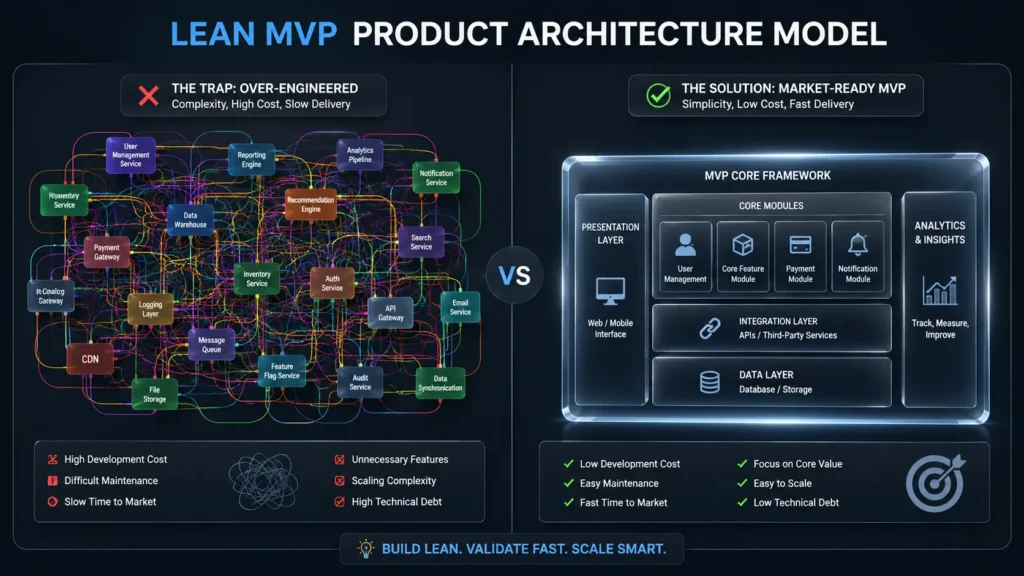
The phrase “minimum viable product” is widely used and widely misunderstood. Most teams interpret “minimum” as a scope reduction exercise — take the full product vision and cut features until it fits in the available time and budget. This approach produces a smaller version of something nobody has validated yet.
The correct interpretation of “minimum viable” is about learning efficiency. An MVP is the smallest thing you can build that will give you reliable information about whether your core assumption is correct. Everything else is noise that makes the signal harder to read.
When teams build an MVP by cutting features from a larger plan, they typically still end up with weeks of unnecessary development because the underlying architecture is designed for the full product rather than the validation experiment. The result is a launch that happens later than it needed to, costs more than it needed to, and still does not produce clear answers because the product is too complex to isolate which specific element is driving user behavior.
The better approach is to start from the question you need to answer, work backward to the simplest possible thing that would answer it, and build only that.
Understanding this distinction is what separates founders who use their MVP budget efficiently from those who spend it building something the market never asked for.
How to Build an MVP: The 5-Step Lean Framework
Step 1: Define Your Core Value Proposition
Before you write a single line of code, you need to answer one question with precision: what is the specific problem your product solves, and for whom?
Not a general problem space. Not a category of issues. One specific problem that a specific type of user faces regularly, where the gap between what currently exists and what you are building is large enough that users would change their behavior to use your product.
If you are building a marketplace, your core value is connecting buyers and sellers efficiently. Not the analytics dashboard, not the messaging system, not the review platform. The matching function. Everything else is a feature you add after you have validated that the matching function works well enough that users come back.
Write the core value proposition in one sentence. If you cannot do this, you are not ready to build yet. The clarity of that sentence determines the clarity of your MVP scope.
Step 2: Prioritize Features Using the MoSCoW Method
Once you have a clear core value proposition, apply the MoSCoW method to everything you are considering building. This framework sorts features into four categories.
Must-haves are the features without which your product cannot function at all. These are the only things you build in your MVP. For a marketplace, this might be user registration, listing creation, and a basic transaction flow.
Should-haves are important features that improve the experience but are not required for the core function to work. These go on the post-launch roadmap, not in the MVP.
Could-haves are features that would be nice to include if time and budget allowed. These also go on the post-launch roadmap.
Won’t-haves are features that are explicitly out of scope for this build cycle. Documenting these matters — it prevents scope creep when someone on the team argues for adding something mid-build.
Most teams are surprised by how short the Must-have list actually is when they apply this filter honestly. That short list is your MVP scope.
Step 3: Choose the Right Tech Stack for Speed
When you build an MVP, your technology choices should optimize for development speed and iteration flexibility, not for the architecture you will eventually need at scale.
This means using established frameworks with large ecosystems and good documentation. React or Next.js for frontend. Node.js or Laravel for backend. PostgreSQL or MongoDB for data storage depending on your data model. These choices are boring on purpose — boring technology with a large community means faster development, easier debugging, and more available talent when you need to hire.
It also means using existing APIs instead of building custom functionality. Need payment processing? Use Stripe. Need authentication? Use Auth0 or Supabase. Need email? Use SendGrid. Need calendar scheduling? Use an existing calendar API. The hours you save by not building these systems yourself are hours you can spend on the parts of your product that are actually unique.
The instinct to build everything custom is natural but almost always wrong at the MVP stage. You are not building infrastructure — you are running an experiment.
Step 4: Design for Iteration, Not Perfection
When you build an MVP, your code architecture needs to support change. User feedback will reveal that some of your assumptions were wrong. The features you thought were critical turn out to be ignored. The features you considered secondary turn out to be what users actually want.
Design your components to be modular and independently modifiable. Keep business logic separate from presentation layer. Write clear documentation as you go. Use version control consistently. These practices do not slow you down — they are what make it possible to change direction quickly when the market gives you new information.
The MVP that cannot be easily modified is not actually a lean product. It is a rigid prototype that will require significant rework before it can evolve into a real product.
Step 5: Build Your Feedback Loop Before Launch
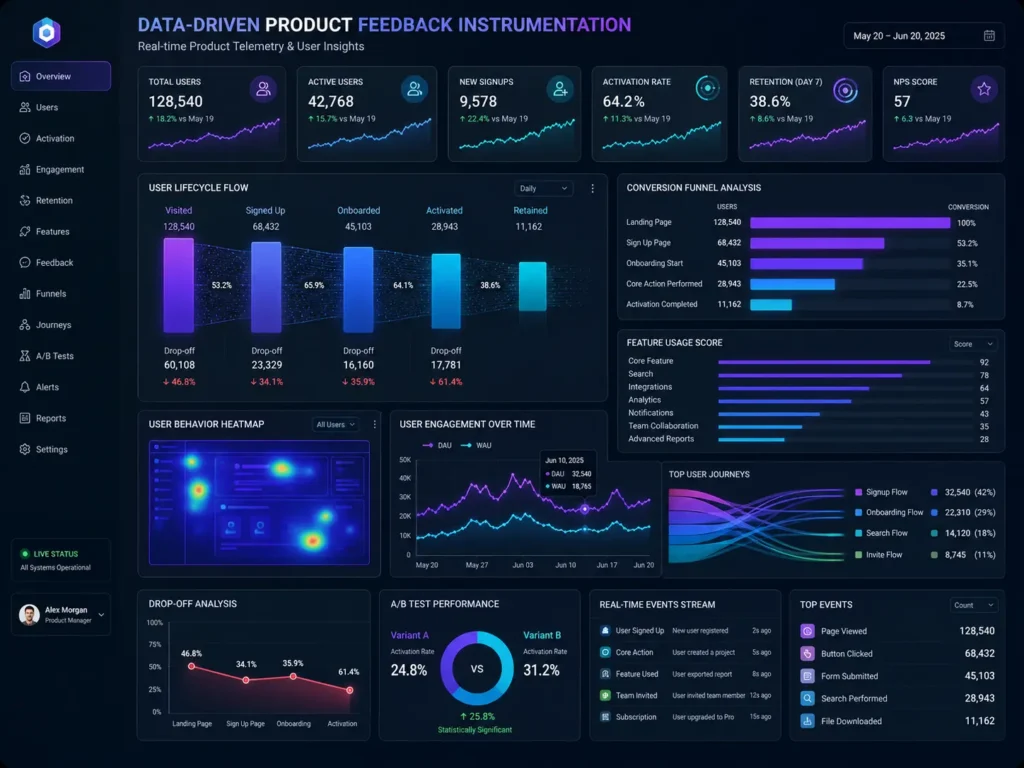
An MVP without measurement is a product launch, not a market validation experiment. Before you launch to your first users, set up the systems that will tell you what those users are actually doing.
At minimum, you need event tracking that records which features users interact with, where they drop off, and how often they return. You need a way to collect qualitative feedback — surveys, user interviews, or support conversations. And you need a framework for deciding in advance what success looks like: what user behavior would confirm your core assumption, and what behavior would suggest you need to change direction.
Learn more about the concept of MVP from industry experts at
ProductPlan MVP Guide.
Set these up before you invite your first users. The data from the first few weeks of real usage is often the most valuable you will ever collect about your product — do not waste it by not being ready to capture it.
Common Mistakes When You Build an MVP
Building for an Imagined User
The most expensive mistake is building features based on assumptions about what users will want rather than evidence of what they actually need. Every feature that is not grounded in real user research or validated demand is a bet — and most bets at the MVP stage are wrong. Talk to potential users before you build, not after.
Accumulating Technical Debt Too Early
Moving fast does not mean writing messy code. Undocumented, unstructured code that works in the short term creates compounding problems when you need to modify or extend it — which you will, as soon as your first users give you feedback. Write clean, readable code from the start. The time investment is small and the payoff is significant.
Launching to Too Many Users Too Soon
Releasing an unrefined MVP to a large public audience before you have validated the core experience leads to early churn that is hard to recover from. Start with a small, controlled group of beta users who are willing to give detailed feedback. Use what you learn to refine the experience before expanding.
Skipping Mobile Optimization
A surprising number of B2B MVPs launch without properly testing the mobile experience, because the development team primarily uses desktop. If your users include anyone who might access your product on a phone — which is most products — this is a critical gap that affects your validation data.
Not Defining Success Metrics in Advance
If you do not decide before launch what user behavior would constitute validation of your core assumption, you will find yourself interpreting ambiguous data optimistically after launch. Define your success metrics upfront: what retention rate, what activation rate, what usage frequency would tell you that you have found product-market fit for this core feature.
For teams also building AI-powered features into their MVP stack, see our guide on RAG system development: /rag-system-development-business-knowledge
Frequently Asked Questions
Q: How long should it take to build an MVP?
A: A well-scoped MVP with a clear core value proposition should take eight to twelve weeks to build and launch. If your timeline is stretching beyond that, your scope is almost certainly too large. Revisit your Must-have list and cut anything that is not strictly necessary for the core user workflow to function.
Q: Should we outsource MVP development?
A: Partnering with an experienced development team can significantly accelerate your timeline and give you access to senior engineers across multiple frameworks without the overhead of hiring. The key is working with a team that understands lean product development and will push back on scope creep rather than just building whatever you ask for.
Q: Can an MVP scale into a full enterprise product?
A: Yes, if it is built with modular architecture and clean code practices from the start. An MVP built on a well-structured foundation can be extended and scaled without requiring a full rewrite. An MVP built on spaghetti code to meet a deadline typically cannot.
Q: What should we do if early users reject our MVP?
A: Early rejection is valuable information, not failure. The goal of an MVP is to learn, and learning that your initial assumptions were wrong quickly and cheaply is exactly what the process is designed to produce. Use the feedback to identify which specific assumption failed and what the data suggests about a better direction.
Q: Is a no-code tool appropriate for building an MVP?
A: No-code tools work well for validating very early concepts and for internal tools. For a B2B SaaS product where you eventually need custom functionality, data ownership, and security controls, building on a proper code foundation from the start avoids a full rebuild later. The overhead of starting with code is lower than the overhead of migrating away from a no-code platform when you hit its limits.
Q: How many users do we need to validate an MVP?
A: There is no universal number, but more users does not automatically mean better validation. Fifty highly engaged users who give detailed feedback are more valuable than five hundred passive users who churn silently. Focus on quality of feedback over quantity of signups in the early validation phase.
Q: What is the biggest sign that our MVP scope is too large?
A: If your team cannot clearly explain to a potential user what the product does in one sentence, or if it takes more than thirty seconds to reach the core value in the user flow, your scope is too large. Simplicity in the user experience is a direct reflection of clarity in the product scope.
The Bottom Line
The decision to build an MVP is the right one. The way most teams execute it is not.
An MVP is not a smaller version of the product you eventually want to build. It is an experiment designed to answer a specific question about market demand as cheaply and quickly as possible. Every feature that does not contribute to answering that question is a cost — in time, in money, and in the clarity of the signal you get back from your first users.
The teams that build an MVP successfully are the ones who resist the pressure to add more, who define success metrics before launch rather than after, and who treat user feedback as the primary input to every product decision rather than a post-launch activity.
Launch faster than feels comfortable. Measure more carefully than feels necessary. Change direction more quickly than feels safe. That is what the MVP process is actually for.
Ready to Build Your MVP?
We help startups and product teams scope, architect, and build MVPs that validate real market assumptions — without the overbuilding that wastes time and budget before you have a single paying user.
More Blog

High-Availability Cloud Infrastructure: 5 Proven Steps

Nginx Redis Caching Optimization: 6 Proven Speed Tactics

Content Optimization for AI Search: 5 Proven Steps to Rank



