
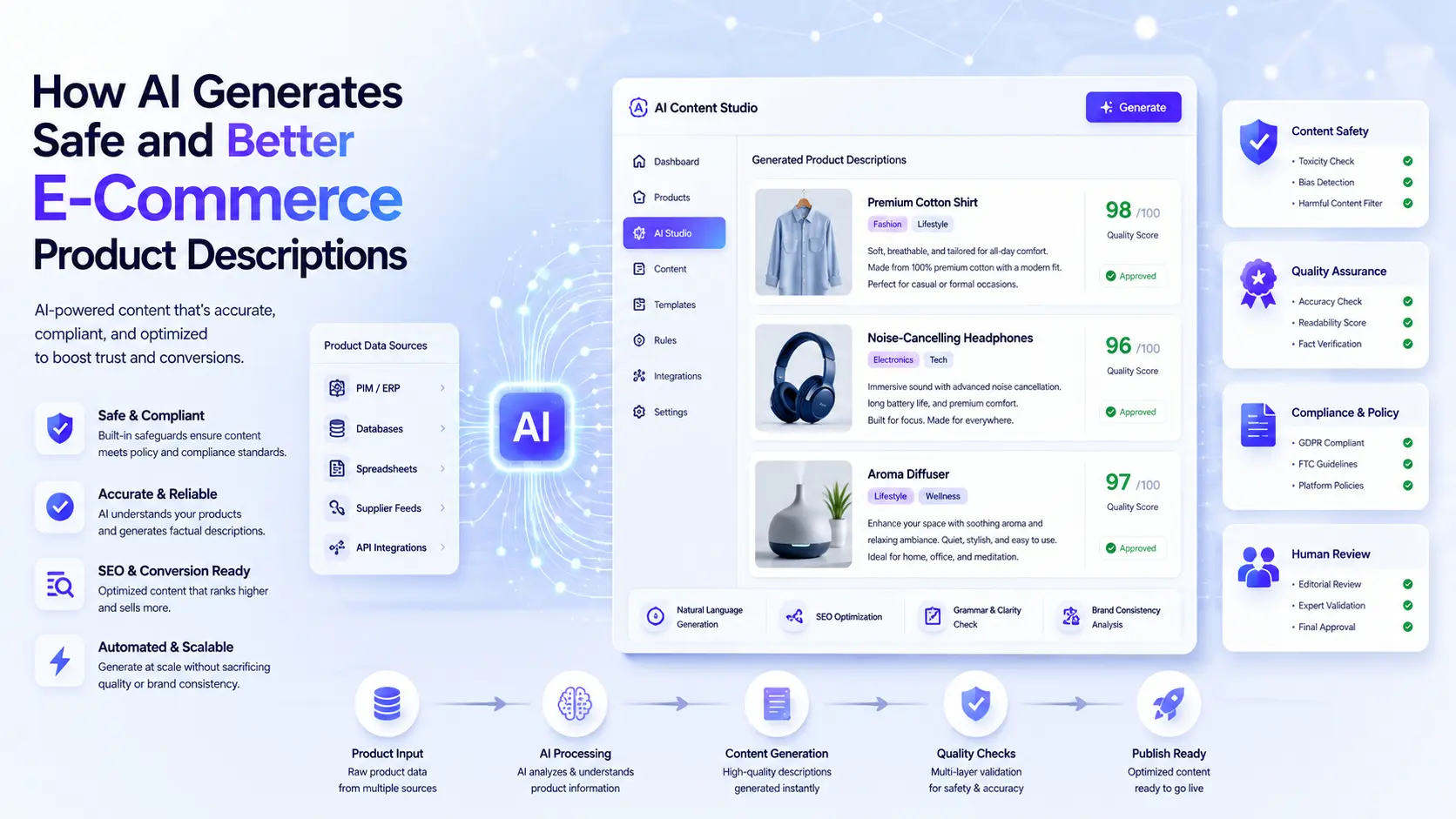
AI Product Description Generation: 10x Better Copy Safely

How AI Product Description Generation Creates 10x Better E-Commerce Copy Safely
AI product description generation is reshaping how e-commerce brands scale their content operations — but only when it is done correctly. Picture this: your team just onboarded 800 new SKUs from a fresh supplier partnership. The launch deadline is in two weeks. Your copywriter — your one, overworked copywriter — looks at the spreadsheet, then looks at you, and says nothing. They do not have to. You both already know what that silence means.
This is the quiet crisis that thousands of growing e-commerce brands face every single quarter. Product descriptions are not just “nice to have” filler text. They are your silent sales team. They answer questions at 2 AM when no live agent is available. They convince a hesitant buyer to click “Add to Cart.” They tell Google exactly why your page deserves to rank. And yet, for most brands, writing them is an afterthought — rushed, inconsistent, and painfully slow.
Done poorly, AI product description generation floods your store with hollow, robotic copy that neither converts nor ranks. Done correctly, it becomes the backbone of a content operation that scales with your business without sacrificing the human voice your customers actually respond to.
This guide breaks down exactly how to use AI the smart way — as a drafting engine you control, not an autopilot you blindly trust.
Short Answer
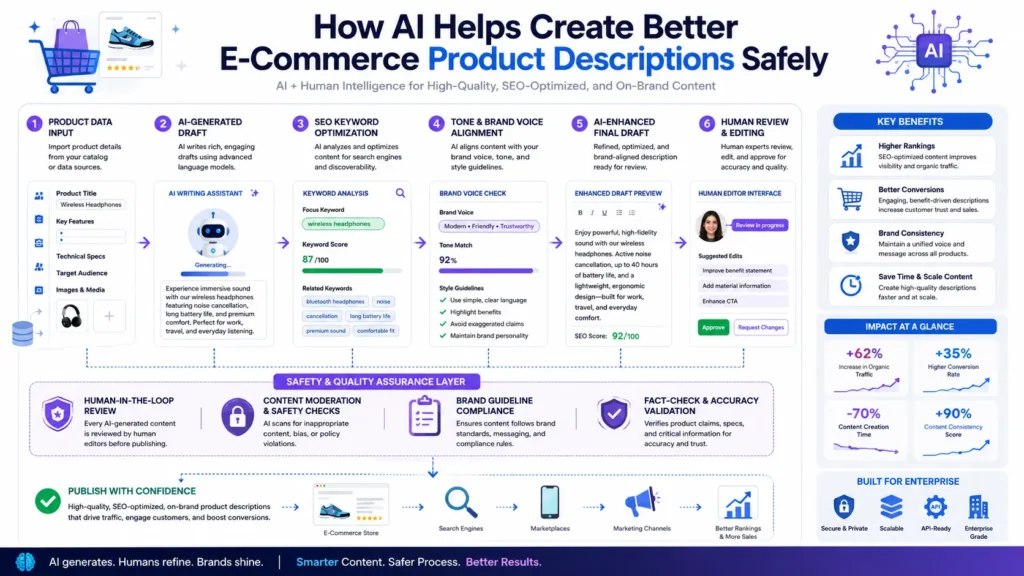
AI product description generation allows e-commerce brands to scale content creation by transforming raw product attributes into benefit-driven, SEO-optimized copy. To use it safely, businesses must avoid bulk-publishing raw AI output. Instead, use AI as a drafting engine — feeding it specific brand guidelines, customer personas, and unique product data. Always maintain a human-in-the-loop review process to ensure factual accuracy, brand alignment, and the inclusion of human-centric details that differentiate your products in a competitive market.
Why Product Descriptions Are a Bigger Problem Than Most Brands Admit
Let’s be honest about the scale of the problem before we talk about solutions.
For a store with 200 products, writing descriptions is manageable — tedious, but manageable. For a store with 2,000 products, it becomes a serious resource drain. For a store with 20,000 products or more, it is simply impossible to do well without some form of automation or augmented workflow.
But the problem goes deeper than just volume. Even when brands do invest the time, the quality is often uneven. The first 50 product pages written by a motivated copywriter are sharp, on-brand, and conversion-focused. By product page 300, the writing gets shorter. The energy drops. The same phrases start repeating. “Premium quality.” “Perfect for everyday use.” “You’ll love this.” These phrases mean nothing to customers and even less to search engines.
And then there is the SEO dimension. In 2026 and beyond, product pages are not just competing for human attention — they are competing for AI attention. Large language models that power Google’s AI Overviews, Bing’s Copilot, and other generative search engines pull structured, well-organized content to synthesize answers. If your product descriptions are thin, vague, or poorly structured, they will not show up in those summaries. You are essentially invisible to a growing portion of the search landscape.
This is the full weight of the problem. AI product description generation, when implemented strategically, addresses all three dimensions: speed, consistency, and search visibility.
If your catalog also runs across Google Shopping, Meta, and TikTok, the quality of your product data matters even more — see our guide on e-commerce product feed optimization: /ecommerce-product-feed-optimization
The Core Principle: AI as a Drafting Engine, Not a Decision-Maker
Before diving into tactics, it is important to establish a mental model that will shape everything else in this guide.
AI is not your copywriter. AI is your assembly line.
Think about how a car manufacturer operates. The engineers design the car. The assembly line builds it. The quality control team inspects it. No one confuses the assembly line for the engineer. The same logic applies here. You — your brand, your expertise, your customer knowledge — are the engineer. AI is the assembly line that takes your carefully designed inputs and produces structured output at scale. The quality control team is your human review process.
When you start from this mental model, everything changes. You stop asking AI to “write a product description” and start asking it to “take these specific attributes, this customer persona, and this brand voice, and assemble a structured draft that I will then review and refine.”
That shift in approach is the difference between generic AI output and genuinely useful, on-brand content.
Step One: Build Your Data Foundation First
The quality of AI product description generation is almost entirely determined by the quality of the data you feed it. Garbage in, garbage out — this principle has never been more true than in AI content workflows.
Before you write a single prompt, you need to organize your product data into clean, structured inputs. This typically means pulling from your Product Information Management (PIM) system or your supplier data sheets and standardizing the following fields:
Your product name and category should be clear and specific. Instead of “Blue Jacket,” you want “Men’s Lightweight Packable Rain Jacket — Navy Blue.” Your material and construction details need to be accurate and complete — fabric composition percentages, hardware materials, construction techniques. Key features should be listed as discrete, factual bullet points, not marketing language. Dimensions and weight matter enormously for categories like furniture, electronics, and apparel. Usage occasions help AI understand context — “designed for weekend hiking, commuting, and travel” tells the model something fundamentally different from “versatile everyday use.”
When AI has structured, specific data to work with, it produces dramatically better output. Instead of vague generalities, it generates concrete, benefit-driven statements that resonate with buyers who are actively comparing products.
Step Two: Define Your Brand Voice With Precision
One of the most common complaints about AI-generated content is that it sounds generic. And it is true — if you do not explicitly tell the AI what your brand sounds like, it will default to the most average, generic tone it has learned from its training data.
The solution is to build a brand voice document that you include in every content generation prompt. This does not need to be a 50-page brand bible. It can be as simple as a clear set of instructions:
State your tone clearly. Are you authoritative and expert-led? Warm and conversational? Bold and direct? Give the AI three to five adjectives that describe how your brand speaks. Then back those up with examples — pull two or three of your best-performing product descriptions and include them as “write in this style” references.
Equally important are the negative constraints. Tell the AI explicitly what to avoid. Common culprits include overused phrases like “game-changer,” “revolutionary,” “seamless experience,” and “takes it to the next level.” These phrases are so saturated in AI-generated content that they have become warning signs for both human readers and search algorithms.
You should also define your sentence structure preferences. Some brands favor short, punchy sentences. Others prefer a more flowing, editorial style. Some mix both. Be specific, and the AI will follow your lead consistently across thousands of product pages.
Step Three: Inject Real Customer Intelligence
Here is where most brands leave significant value on the table.
The most persuasive product copy is not written by copywriters — it is written by customers. The exact language your customers use to describe their problems, their needs, and their decision criteria is more powerful than anything a professional writer can invent.
You already have this data. It is sitting in your product reviews, your customer support tickets, your return reason forms, and your post-purchase surveys. The question is whether you are using it.
Before generating descriptions for a product category, spend 20 minutes reading through the reviews and support conversations for that category. Look for patterns. What do customers consistently love? What questions do they ask before buying? What concerns hold them back? What specific language do they use?
Then inject that intelligence directly into your AI prompts. If customers keep asking “will this fit in a carry-on bag?” for your travel bags, your prompt should include “address the carry-on compatibility question directly.” If customers frequently mention being pleasantly surprised by the quality, your prompt should include “emphasize build quality and material durability.”
This turns your AI-generated descriptions from generic summaries of product specs into targeted responses to real customer concerns. That is what drives conversions.
The Human-in-the-Loop Process: Non-Negotiable
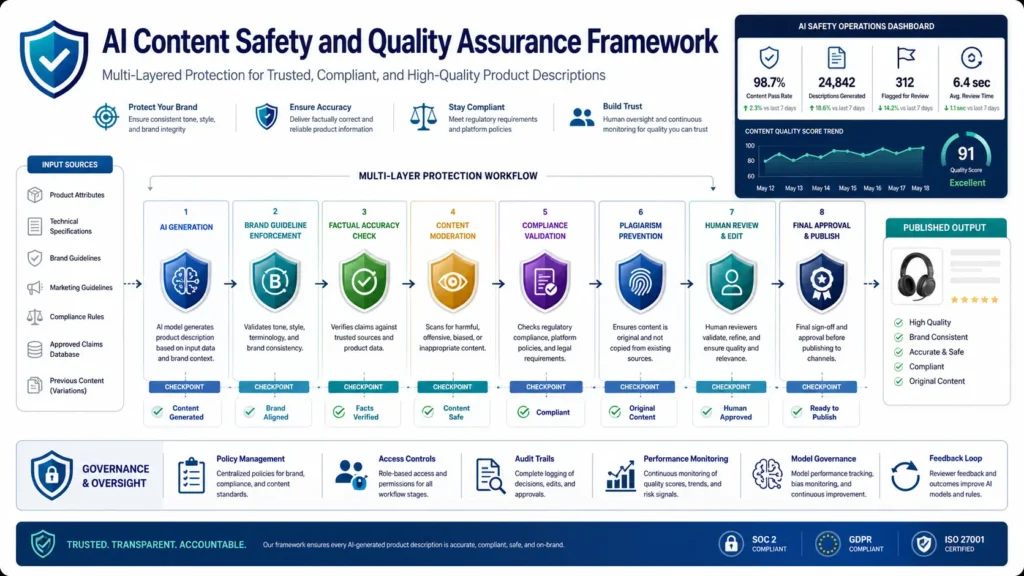
Let’s talk about the one rule that cannot be compromised: never publish raw AI output directly to your store.
This is not a suggestion. This is the single most important safeguard in any AI product description generation workflow, and skipping it is how brands end up with product pages that list incorrect specifications, make claims the product cannot back up, or sound completely disconnected from the rest of the site.
AI hallucination is a real and ongoing challenge. Even the most advanced models will occasionally generate plausible-sounding but factually incorrect content. They might state that a jacket is water-resistant when it is only water-repellent. They might describe a product dimension incorrectly. They might invent a feature that does not exist. For a single product, this is a minor error. At scale, it is a customer trust disaster.
The human-in-the-loop process does not have to be slow or expensive. For most e-commerce brands, a tiered review system works well. High-value products — bestsellers, hero SKUs, new launches — receive full human review and editing. Mid-tier products receive a quick fact-check pass, ensuring technical specifications are accurate and no hallucinated claims made it through. Bulk commodity products can be reviewed in batches using a checklist, with a human spot-checking a sample rather than reading every word.
This approach gives you the speed benefits of AI generation while maintaining the quality control that protects your brand reputation and your customer relationships.
Google’s own guidance on AI-generated content confirms that quality and helpfulness — not authorship — determine how content is evaluated. You can read their position in their official Google Search and AI content documentation.
Technical SEO and Generative Engine Optimization
Writing great product descriptions is only half the battle. Structuring them correctly for modern search engines — both traditional and AI-powered — is what turns good content into traffic and revenue.
For traditional SEO, the principles remain consistent. Each product page should target a specific, intentional keyword. That keyword should appear naturally in the product title, the opening paragraph, at least one subheading, and the image alt text. The description should be comprehensive enough to cover the topic fully — thin content with fewer than 150 words rarely ranks well for competitive product categories.
But there is a newer dimension that forward-thinking brands are paying attention to: Generative Engine Optimization, or GEO. As AI-powered search tools become more prevalent, the way content is structured matters more than ever. These systems are looking for content that answers specific questions clearly and directly.
Structuring your product descriptions in modular blocks helps enormously. A block that directly answers “what is this product made of” followed by a block that answers “who is this product designed for” followed by a block that answers “what problem does this solve” gives AI systems clear, extractable answers to common buyer queries. This increases the likelihood that your product information gets cited in AI Overviews, comparison summaries, and generative shopping experiences.
Schema markup is the technical complement to this approach. Product schema, review schema, and offer schema provide search engines with machine-readable data about your products. You can learn more about implementing product schema correctly in Google’s structured data documentation for products.
Manual Writing vs AI-Augmented Workflow: What Actually Changes
For brands that have relied on traditional copywriting, the transition to an AI product description generation workflow raises a natural question: what exactly changes, and what stays the same?
The strategic thinking does not change. Understanding your customer, knowing your competitive positioning, and defining your brand voice remain entirely human responsibilities. These are the inputs that determine the quality of everything the AI produces.
What changes is the production layer. Instead of a copywriter sitting down to write each description from scratch, they are now reviewing, editing, and approving AI-generated drafts. Their time shifts from production to quality control and strategy. A copywriter who previously produced 15 product descriptions per day can review and refine 80 to 100 AI-generated drafts per day — with higher consistency, because the AI never gets tired or bored.
The data management side also becomes more important. Someone needs to own the product data inputs, maintain the brand voice documentation, and continuously refine the prompts based on what is working and what is not. This is a skill set that your existing team can develop, and it is significantly more valuable work than writing the same type of description for the 200th time.
For agencies and in-house teams alike, the brands that figure out this new division of labor earliest will have a significant competitive advantage in catalog quality, launch speed, and SEO performance.
—————————————————————-
Common Mistakes That Undermine AI Product Description Generation Quality
Understanding what can go wrong is just as valuable as knowing the right approach. These are the mistakes that consistently show up when brands adopt AI content generation without a proper strategy.
Mass Publishing Without Review
Pushing raw AI output live at scale might save time in the short term, but a single batch of hallucinated product specs can generate customer complaints, returns, and trust damage that takes months to repair.
Generic Prompting
Generic prompting produces generic results every single time. If you ask an AI to “write a product description for this running shoe,” you will get something forgettable. If you ask it to “write a 200-word product description for this men’s trail running shoe, targeting experienced trail runners who prioritize grip and ankle support, in a confident and direct tone, avoiding clichés, emphasizing the Vibram outsole and ankle stabilization technology,” you will get something genuinely useful.
Ignoring Brand Voice Consistency
Ignoring brand voice consistency across a large catalog creates a fragmented experience that erodes brand equity. Customers who browse multiple pages on your store should feel like they are interacting with one coherent voice, not a committee of AI instances each doing their own thing.
Over-Optimizing for Keywords
Over-optimization for keywords at the expense of readability is a common trap. Modern search algorithms are sophisticated enough to recognize and penalize keyword stuffing. Write for humans first, and let the keywords appear naturally within that context.
Neglecting Structured Data
Using AI to write great paragraphs while ignoring product schema, review schema, and offer schema means search engines are working with incomplete information about your catalog. Structured data is not optional for competitive e-commerce SEO in 2026.
—————————————————————-
Frequently Asked Questions
Q: Is AI-generated content bad for SEO?
A: AI content is not inherently bad for SEO. Google’s stated position is that it evaluates content based on quality, helpfulness, and relevance — not based on whether a human or a machine wrote it. AI product description generation that is human-reviewed, factually accurate, and genuinely useful to the reader can rank just as well as human-written content. Content that exists purely to fill pages without providing real value — whether AI-generated or not — is what search engines penalize.
Q: How do I prevent AI hallucinations in product specifications?
A: The most effective safeguard is to use your product database as the single source of truth for all technical specifications. Use AI only for the narrative structure and benefit-focused language. Inject specifications, dimensions, materials, and other factual data directly from your PIM or ERP system via structured inputs or API. Never ask AI to figure out technical details — provide them explicitly. Then have a human reviewer do a fact-check pass before any page goes live.
Q: What is the human-in-the-loop process in practice?
A: In practice, it means that AI generates the first draft and a human reviews it before publication. The depth of that review can vary based on the product’s importance. For your top-selling products, a full editorial review makes sense. For a large batch of similar commodity products, a structured checklist review — checking for factual accuracy, brand voice alignment, and keyword presence — is sufficient. The point is that no AI-generated content reaches your customers without a human having seen and approved it.
Q: Can AI product description generation help with Generative Engine Optimization?
A: Yes, significantly. When your descriptions are structured in clear, modular question-and-answer blocks, they become much easier for AI-powered search tools to extract and cite. Think about the specific questions a buyer might ask — “what is this made of,” “how does it fit,” “what is it designed for” — and structure your descriptions to answer those questions explicitly. This approach improves your visibility in both traditional search results and the AI-generated summaries that are becoming increasingly prominent.
Q: How is AI-augmented copywriting different from traditional copywriting?
A: Traditional copywriting is a craft process — each piece is written from scratch with full creative investment. AI product description generation uses your best-performing content as a template and applies that style at scale. The creative intelligence still comes from humans; what AI contributes is speed and consistency. Your copywriters spend less time producing first drafts and more time refining, optimizing, and strategizing. For high-volume e-commerce catalogs, this is a fundamental shift in how content teams operate.
Q: Do small e-commerce stores benefit from AI product description generation?
A: Yes. Even small catalogs benefit from the consistency and speed that AI brings. A small store owner wearing multiple hats can use AI to produce well-structured, SEO-optimized descriptions faster than writing from scratch — freeing up time for other high-value tasks like customer service and marketing strategy.
The Bottom Line
AI product description generation is not a shortcut. It is a capability that, when built correctly, transforms your content operation from a bottleneck into a competitive advantage.
The brands that will benefit most from this approach are the ones that invest in the foundation: clean product data, a clear brand voice, real customer intelligence, and a disciplined human review process. These are not optional additions — they are what separate AI-generated content that actually performs from AI-generated content that just takes up server space.
If you are serious about scaling your e-commerce catalog without sacrificing quality or search performance, the time to build this infrastructure is now — before your competitors do.
—————————————————————-
Ready to Scale Your Product Catalog With AI?
We build AI-powered content workflows for e-commerce brands — combining clean data architecture, brand voice documentation, and human review systems that produce descriptions that convert and rank.
More Blog

High-Availability Cloud Infrastructure: 5 Proven Steps

Nginx Redis Caching Optimization: 6 Proven Speed Tactics

Content Optimization for AI Search: 5 Proven Steps to Rank



