
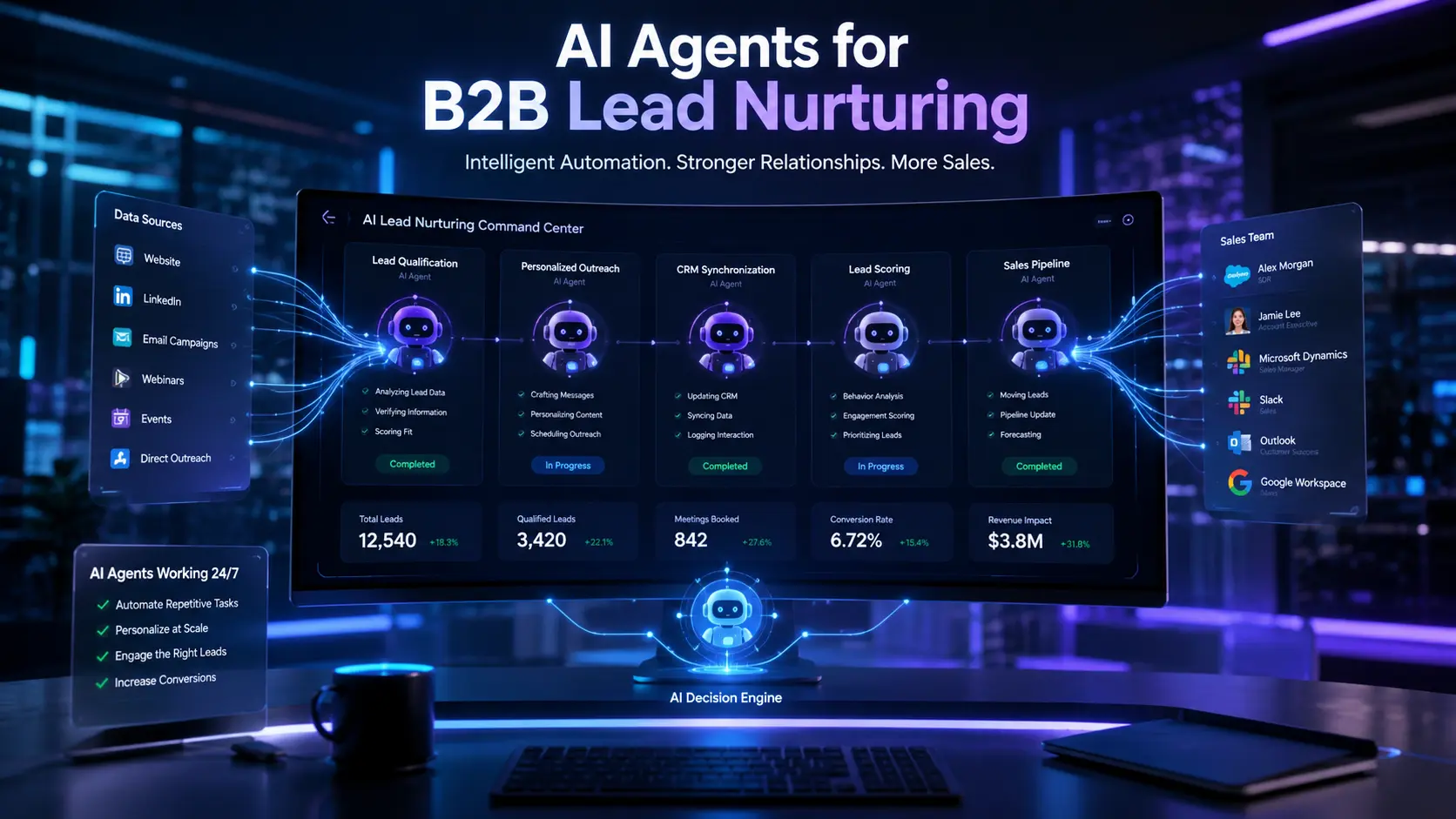
AI Agents for B2B Lead Nurturing: 7 Proven Workflows

AI Agents for B2B Lead Nurturing: 7 Proven Workflows That Actually Convert
There is a gap that exists in almost every B2B sales funnel — the space between a prospect showing initial interest and a sales rep finally getting them on a call. That gap is where deals die. It is where interested prospects go cold because nobody followed up at the right moment, with the right message, at the right level of personalization to keep them moving forward.
Most businesses try to fill that gap with email sequences. A prospect fills out a form, they get added to a drip campaign, and a series of pre-written emails goes out on a timer. It works well enough when you have fifty leads a month. When you have five hundred, the limitations become obvious. The messages feel generic. The timing is arbitrary. The follow-up has no relationship to what the prospect actually did or cared about after the first touchpoint.
AI agents for B2B lead nurturing solve this problem in a fundamentally different way. Instead of sending the same sequence to everyone, an AI agent monitors what each prospect does — which pages they visit, which emails they open, which content they engage with — and responds to that behavior in real time with outreach that is actually relevant to where they are in their decision process.
This is not science fiction, and it is not just for enterprise companies with dedicated AI teams. The tools exist today. The workflows are practical. And the difference between a business that has implemented them and one that has not is increasingly visible in conversion rates, sales cycle length, and the quality of leads that actually reach a closing conversation.
This guide walks through seven proven AI agent workflows for B2B lead nurturing — what they do, why they work, and how to implement them without losing the human judgment that B2B relationships depend on.
Short Answer
AI agents for B2B lead nurturing are autonomous software systems that monitor prospect behavior, analyze intent signals, and execute personalized follow-up actions across your sales funnel — without requiring manual intervention for each individual contact. They integrate with your CRM and marketing stack to deliver relevant content at the right moment, qualify leads before they reach your sales team, and maintain consistent engagement across a prospect database that no human team could manage at the same level of personalization and speed.
1. Why Static Email Sequences Are No Longer Enough
If you have been running B2B email sequences for any length of time, you already know the feeling. Open rates plateau. Click-through rates decline. The same message that converted well eighteen months ago is now getting ignored. And when you look at your sales pipeline, you can see leads that showed genuine interest early on that somehow went cold before ever reaching a conversation.
The problem is not that email does not work. Email is still one of the highest-converting channels in B2B. The problem is that static sequences treat every prospect the same — the same timing, the same content, the same cadence — regardless of what that individual prospect is actually doing.
A prospect who downloaded a technical white paper and then spent twenty minutes on your pricing page is not in the same position as a prospect who opened one email three weeks ago and has not engaged since. They should not be receiving the same follow-up message on the same schedule. But in a static sequence, they do — because the sequence has no way of knowing the difference.
AI agents for B2B lead nurturing change that. They monitor behavior, interpret intent, and respond to what is actually happening with each individual prospect — not what a sequence template assumes is probably happening at a given point in time.
The businesses that have made this shift are seeing shorter sales cycles, higher conversion rates from MQL to SQL, and sales teams that spend more of their time on genuinely qualified conversations rather than chasing leads that were never going to close.
2. Understanding How AI Lead Nurturing Agents Actually Work
Before getting into specific workflows, it helps to understand what an AI agent for lead nurturing actually consists of — because “AI agent” is a term that gets used to describe everything from a simple chatbot to a genuinely sophisticated autonomous system.
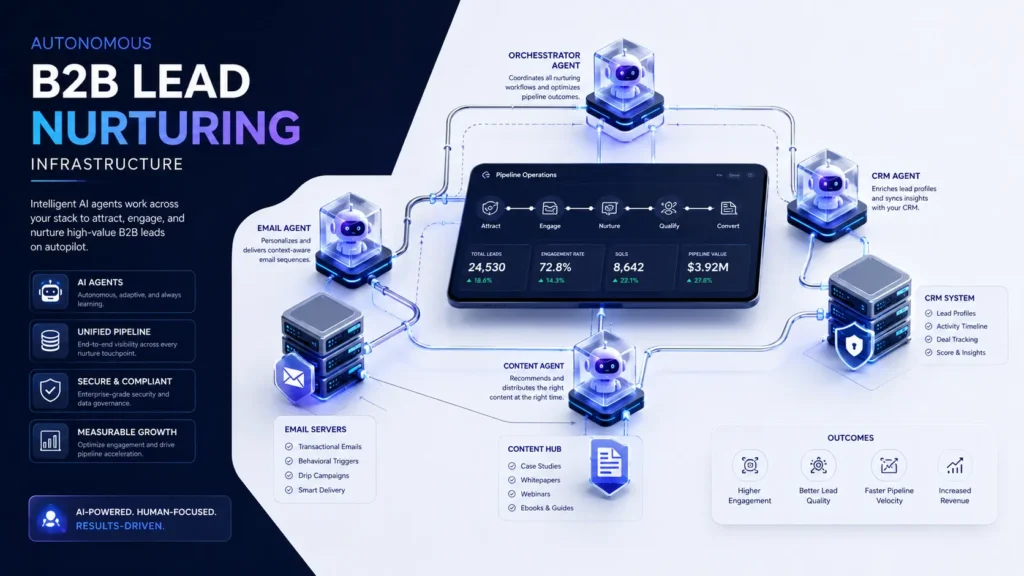
A well-built AI agent for B2B lead nurturing operates across three layers that work together.
The Perception Layer
This is how the agent understands what is happening with a given prospect. It pulls data from your CRM, your marketing automation platform, your website analytics, and your email engagement metrics to build a real-time picture of where each prospect is and what they are paying attention to.
A prospect visiting your enterprise pricing page is a different signal than one clicking a link in a cold outreach email. The perception layer distinguishes between those signals and feeds that context into the next layer.
The Reasoning Layer
This is where an LLM — typically GPT-4o, Claude, or a similar model — processes the behavioral signals and determines the right next action. It does not just pattern-match against a decision tree. It actually reasons about the prospect’s situation, compares it to your sales playbook, and decides what outreach, content, or action would be most likely to move that specific prospect forward.
This is what makes AI agents genuinely different from rule-based automation. A rule says “if they visit the pricing page, send email three.” A reasoning layer says “this prospect has visited the pricing page twice, read the case study for an enterprise client in their industry, and their company just posted a job for a Head of Operations — they are likely in an active evaluation. Send them the ROI calculator and the implementation timeline document.”
The Action Layer
This is where the decision gets executed. The action layer writes to your CRM, triggers an email, schedules a task for a sales rep, sends a LinkedIn connection request, or fires a webhook to another system in your stack. It handles the mechanical execution of whatever the reasoning layer decided, and logs the outcome back into the perception layer so the next decision has more context to work with.
For businesses also running complex API integrations across their tech stack, see our guide on Calendar API integration for enterprise booking systems: /calendar-api-integration-enterprise-booking
3. Seven Proven AI Agent Workflows for B2B Lead Nurturing
Workflow 1 — Intent-Based Content Personalization
Instead of sending the same newsletter to your entire list, deploy an agent that tracks which service pages, case studies, or blog posts each prospect has engaged with and uses that information to personalize follow-up content.
A prospect who spent time on your technical architecture services page receives a follow-up that addresses scalability and performance concerns. A prospect who engaged with your e-commerce work receives content relevant to conversion rate optimization and platform performance. The content is relevant because it responds to demonstrated interest, not assumed interest.
This single change — moving from broadcast content to behavior-responsive content — consistently improves email engagement metrics and accelerates the time to a first sales conversation.
Workflow 2 — Autonomous Lead Qualification
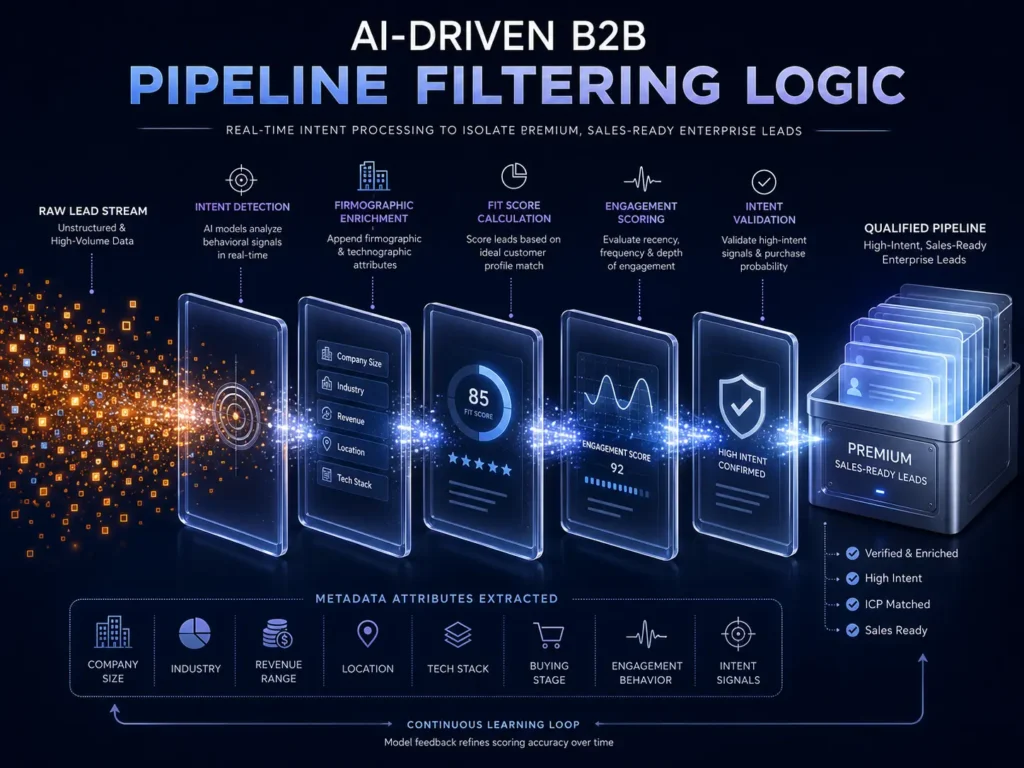
One of the highest-leverage applications of AI agents for B2B lead nurturing is filtering your inbound leads before they reach your sales team. An agent can handle the initial qualification conversation — asking about budget range, project scope, timeline, and technical requirements — and route only leads that meet your qualification criteria to a human rep.
This is not about replacing the sales conversation. It is about ensuring that the conversations your sales team has are with prospects who are actually ready to buy, rather than prospects who are still in early research. For sales teams stretched thin across a large pipeline, the difference in conversion rates and energy expenditure is significant.
Workflow 3 — Dynamic Re-Engagement for Cold Prospects
When a prospect goes cold — no opens, no clicks, no response to direct outreach for four to six weeks — a generic “just checking in” email rarely works. It reads as what it is: a template that could have been sent to anyone.
An AI agent can handle cold re-engagement differently. It can pull recent news about the prospect’s company, identify a relevant development — a new product launch, a leadership change, a market move — and craft a message that connects your offering to something that is actually happening in their world right now. That specificity is what distinguishes re-engagement that works from re-engagement that gets ignored.
Workflow 4 — Meeting Preparation Briefings
This workflow does not directly nurture prospects — it nurtures your sales team’s ability to have better conversations. Before every scheduled sales call, an AI agent automatically compiles a briefing that includes the prospect’s recent website behavior, their engagement history with your content, publicly available information about their company, and suggested talking points based on their demonstrated interests.
A sales rep who walks into a discovery call knowing that the prospect spent forty minutes on your enterprise case studies and recently hired three engineers is a different kind of conversationalist than one who is meeting a name on a calendar. That preparation has a measurable impact on call quality and conversion rates. For a deeper dive into AI workflow automation, see our guide on Make.com vs n8n: /make-vs-n8n-business-automation
Workflow 5 — Multi-Channel Follow-Up Sequencing
AI agents for B2B lead nurturing are not limited to email. A well-architected agent can coordinate follow-up across email, LinkedIn, and direct messaging — sequencing touchpoints across channels based on where the prospect is most responsive, and adjusting the channel mix based on engagement data.
A prospect who consistently ignores email but responds to LinkedIn messages should receive more LinkedIn outreach. An agent that monitors channel engagement and adapts accordingly will outperform a sequence locked to a single channel regardless of where the prospect actually pays attention.
Workflow 6 — Lead Scoring and Pipeline Prioritization
Not all leads deserve equal attention, but knowing which ones deserve more is difficult when your pipeline has hundreds of contacts at various stages. An AI agent can maintain a continuous lead score for every prospect in your pipeline — updating in real time as behavior changes — and surface the highest-intent prospects to your sales team each day.
This is particularly valuable for sales teams managing large pipelines where manual prioritization is impractical. The agent handles the prioritization logic so the rep can focus on the top-priority contacts rather than deciding which contacts to focus on.
Workflow 7 — Automated Post-Meeting Follow-Up
After a discovery call, the quality and speed of the follow-up often determines whether the deal advances or stalls. An AI agent can take a meeting transcript or summary, extract the key discussion points and commitments, and draft a personalized follow-up email that references specific things discussed in the call — along with the relevant resources, case studies, or next steps that were mentioned.
This follow-up goes out faster than a human could write it and is more specific than a template could produce. The prospect receives a message that demonstrates they were genuinely listened to, which is one of the most powerful trust signals in a B2B sales relationship.
4. Static Sequences vs. AI Agents: The Real Difference
Comparison Table
Feature | Static Email Sequences | AI Agent Nurturing
————————-|——————————-|———————————-
Personalization | Name and company only | Full behavioral context
Workflow Flexibility | Fixed linear paths | Adaptive non-linear responses
Decision Logic | If-then rules | LLM reasoning and intent analysis
Channel Coverage | Single channel (email) | Multi-channel coordination
CRM Integration | Basic field updates | Deep bidirectional data sync
Lead Qualification | Manual or form-based | Autonomous conversation-driven
Re-engagement | Generic templates | Company-specific personalized outreach
Sales Team Impact | Delivers volume | Delivers qualified, briefed conversations
The table above is not an argument that AI agents replace email sequences. For many businesses, the right architecture uses both — static sequences for early-stage broad engagement and AI agents for mid-funnel behavior-responsive nurturing and late-stage qualification. The question is not which to use exclusively, but where each approach adds the most leverage.
5. Common Mistakes That Undermine AI Nurturing Systems
Over-Automating the Human Element
The most common mistake teams make when implementing AI agents for B2B lead nurturing is removing human judgment from moments that require it. A prospect asking about a specific implementation challenge, negotiating on a complex multi-year contract, or expressing frustration with a previous vendor experience needs a human response — not an AI-generated one that misreads the emotional context.
Build clear handoff triggers into your agent architecture. When a conversation reaches a threshold of complexity, sensitivity, or strategic importance, the agent should escalate to a human rep rather than continuing autonomously. This is not a limitation of the technology — it is good system design.
Starting with Dirty CRM Data
An AI agent is only as good as the data it has access to. If your CRM contains duplicate records, mismatched fields, outdated contact information, and incomplete engagement history, your agents will make decisions based on a distorted picture of each prospect’s situation. The output will reflect the quality of the input.
Before deploying AI agents at scale, invest time in CRM hygiene. Deduplicate records, standardize field formats, and ensure your tracking integrations are capturing behavioral data accurately. The agents will compound the quality of good data — and the problems of bad data.
Ignoring Privacy and Compliance Requirements
AI agents that monitor prospect behavior and personalize outreach based on that data must operate within the privacy framework appropriate to your market. GDPR in Europe, CCPA in California, and similar regulations in other jurisdictions have specific requirements around consent, data processing transparency, and the right to opt out.
Build compliance into your agent architecture from the beginning, not as an afterthought. This means clear consent mechanisms at data collection points, documented data processing logic, and the ability to purge a prospect’s data from your system on request.
Scaling Before Validating
The temptation when first deploying AI nurturing agents is to roll them out across your entire prospect database immediately. Resist that temptation. Start with a single workflow — intent-based content personalization or autonomous lead qualification — validate that it is working as intended, measure the impact on conversion rates, and then expand.
Each new agent workflow introduces complexity and potential failure points. Validating each one in isolation before layering them together gives you clear signal on what is working and makes troubleshooting significantly easier when something goes wrong.
Frequently Asked Questions
Q: What are AI agents for B2B lead nurturing?
A: AI agents for B2B lead nurturing are autonomous software systems that monitor prospect behavior, analyze intent signals, and execute personalized follow-up actions across your sales funnel without requiring manual intervention for each contact. They integrate with your CRM and marketing stack to deliver relevant outreach at the right moment, qualify leads before they reach your sales team, and maintain consistent engagement at a scale no human team could manage manually.
Q: Is AI lead nurturing suitable for high-ticket B2B sales?
A: Yes — and it is often most valuable in high-ticket cycles precisely because the stakes of each conversation are higher. AI agents help by ensuring your sales team walks into every conversation fully briefed, by maintaining engagement during long evaluation periods, and by surfacing the right content at moments of high intent. The agent handles the consistency and the volume; the human closes the deal.
Q: How do I prevent AI agents from sounding robotic?
A: The quality of AI nurturing output depends on the quality of the prompting and the richness of the context the agent has access to. Agents trained on your actual case studies, your client success stories, and your brand voice guidelines produce significantly more natural output than agents working from generic instructions. Invest time in prompt design and test outputs against your actual brand standards before deploying at scale.
Q: Will AI agents replace my sales team?
A: No. AI agents for B2B lead nurturing function as a force multiplier for your sales team — handling the research, follow-up, qualification, and engagement consistency that currently consumes a significant portion of your reps’ time. The result is a sales team that spends more of its time on high-value conversations rather than administrative pipeline management.
Q: What technical infrastructure do I need to get started?
A: A CRM platform with clean, consistent data is the foundation. From there, the specific infrastructure depends on your workflow requirements — some implementations use low-code automation platforms like n8n or Make.com, while others require custom API integrations and dedicated hosting. The right starting point is usually the simplest workflow that solves your most immediate pipeline problem, validated before expanding.
Q: How long does it take to see results from AI lead nurturing?
A: Initial deployment of a single workflow can happen within a few weeks. Meaningful conversion impact typically becomes visible within thirty to sixty days, once the agent has processed enough prospect interactions to have a measurable effect on pipeline velocity. More complex multi-workflow implementations take longer to validate but compound over time as each layer adds to the system’s overall effectiveness.
Q: How do I handle GDPR and data privacy with AI lead nurturing?
A: Build compliance into your architecture from day one. This means ensuring clear consent mechanisms at every data collection point, documenting how prospect data is processed and stored, giving prospects a clear opt-out path, and being able to purge a contact’s data from your system on request. If you operate across multiple jurisdictions, work with a legal advisor to map the specific requirements for each market before deploying behavioral tracking at scale.
The Bottom Line
AI agents for B2B lead nurturing are not a future technology. They are a present-day competitive advantage that a growing number of businesses are already using to shorten sales cycles, improve conversion rates, and free their sales teams to focus on the conversations that actually require human judgment.
The barrier to getting started is lower than most businesses assume. You do not need a dedicated AI team or a year-long implementation project. You need a clear problem — a specific point in your funnel where leads are going cold, where qualification is taking too long, or where follow-up consistency is suffering — and a focused first workflow designed to address it.
Start there. Validate the result. Then expand.
The businesses that wait for a perfect moment to start building AI-augmented sales systems will find themselves catching up to competitors who started with imperfect first workflows six months ago.
Ready to Build Your AI Lead Nurturing System?
We design and build AI agent workflows for B2B sales teams — from intent-based personalization to autonomous qualification and multi-channel sequencing.
More Blog

High-Availability Cloud Infrastructure: 5 Proven Steps

Nginx Redis Caching Optimization: 6 Proven Speed Tactics

Content Optimization for AI Search: 5 Proven Steps to Rank



