

Advanced Schema Markup: 7 Proven Tactics to Boost Visibility

Advanced Schema Markup for Search Visibility & AEO Guide
For years, ranking in search engines came down to keywords, backlinks, and clean on-page content. That formula still matters, but it stopped being enough the moment search engines started thinking in entities instead of strings of text. If you have noticed competitors showing up with star ratings, pricing, or FAQ dropdowns directly in the search results while your listing sits there as a plain blue link, the difference usually comes down to one thing: advanced schema markup.
Search engines, AI Overviews, and tools like Perplexity and ChatGPT no longer just scan your page for matching words. They are trying to understand who you are, what you sell, and how trustworthy you are as a source. If your website forces these systems to guess, you lose rich snippets, you lose AI citations, and you lose the high-intent traffic that goes to a competitor with cleaner technical architecture.
This guide walks through what advanced schema markup actually is, why it has become a non-negotiable part of technical SEO, and exactly how to implement it so search engines and AI engines treat your website as a primary source of truth in your industry.
What Is Advanced Schema Markup?
Advanced schema markup is a structured, machine-readable vocabulary — almost always written in JSON-LD — that you add to your website’s code so search engines and AI systems can understand your content without guessing.
Most websites have some form of basic schema, usually added automatically by an SEO plugin. That basic layer tells a search engine “this is an article” or “this is a business.” Advanced schema markup goes much further. It connects entities together — your organization, your authors, your products, your reviews — into a single, cohesive structure often referred to as a local Knowledge Graph.
Instead of search engines seeing isolated, disconnected facts about your business, advanced schema markup explicitly tells them how everything relates. This article was published on this page, which belongs to this organization, written by this person, who holds these credentials. That level of clarity is what separates a website that ranks for a few keywords from one that dominates an entire topic.
Why Advanced Schema Markup Matters for Business Outcomes
Technical SEO decisions rarely get attention from business leaders unless they can be tied to revenue. Advanced schema markup is one of the rare technical investments where the business case is direct and measurable.
Higher Click-Through Rates
A standard search result is a blue link and two lines of text. A rich result can include star ratings, pricing, stock availability, or an image carousel — and it visually dominates the page. Securing a product or review rich snippet through proper structured data can meaningfully increase organic click-through rate, simply because your listing looks more credible and informative before a user even clicks.
Generative Engine Optimization (GEO)
AI-driven search tools synthesize answers from multiple sources rather than sending users to a single page. Structured data acts as a direct, clean data feed for these systems. When your content is properly tagged with advanced schema markup, AI engines can parse facts about your business accurately, which dramatically improves your odds of being cited directly inside an AI-generated answer.
Stronger eCommerce Conversion Intent
For online stores, Merchant Listing schema pushes your live inventory, pricing, and shipping information directly into Google’s shopping results. When a shopper sees accurate, real-time data on the search results page before clicking, they arrive at your site already closer to a purchase decision.
Verified E-E-A-T Signals
Google places increasing weight on experience, expertise, authoritativeness, and trustworthiness. Advanced schema markup lets you programmatically prove these signals — linking your Organization schema to your founders’ Person schema, and connecting both to verified social profiles and other authoritative external sources.
A Web Architecture That Scales
As your website grows, a clean, connected semantic structure reduces technical debt. A properly built Knowledge Graph means new pages and new content inherit the same structured relationships automatically, rather than requiring manual schema work every time you publish.
Basic Schema vs. Advanced Schema: Understanding the Real Difference
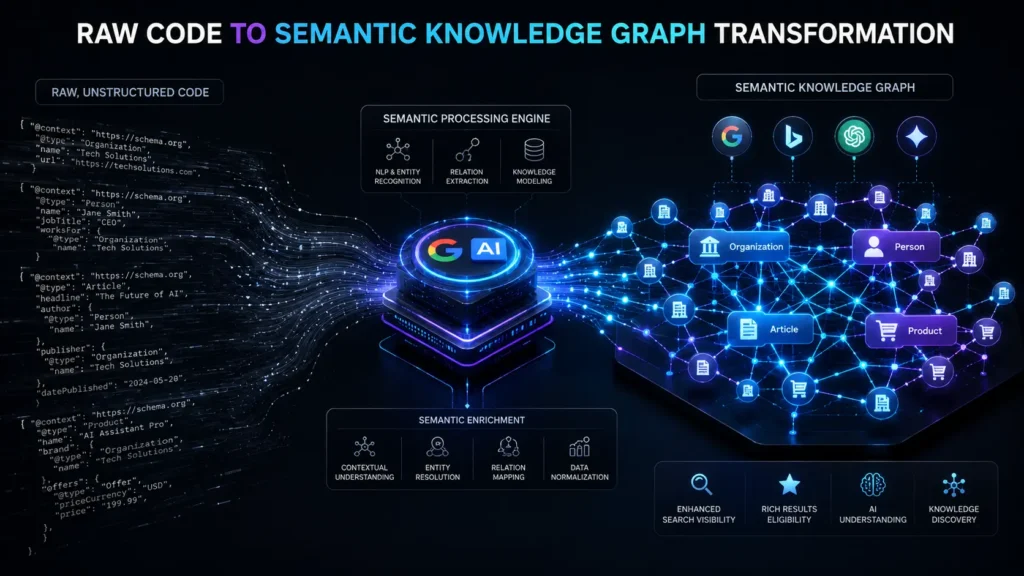
Schema markup itself is not new. It is a shared vocabulary maintained by Schema.org, a project originally backed by Google, Microsoft, Yahoo, and Yandex specifically so search engines could agree on a common language for describing web content.
The problem most websites run into is that their schema implementation is flat. A typical SEO plugin adds a generic Organization tag to the homepage and an Article tag to each blog post, and that is where it stops. Search engines see two disconnected pieces of data sitting on the same domain, with no explicit relationship between them.
Advanced schema markup fixes this by building genuine connections between entities rather than isolated tags. Instead of declaring an Organization and an Article as two separate things that happen to coexist, advanced implementations explicitly link them — this Article belongs to this Organization, was written by this Person, and references this Product. That connected structure is what search engines and AI systems can actually reason about, rather than just index.
The Shift to Entity-Based Search
To understand why advanced schema markup has become so important, it helps to understand how search itself has changed.
Search engines used to match the literal characters someone typed into a search box against the characters on a webpage. Today, search engines use natural language processing to recognize entities — distinct, well-defined things like people, places, organizations, and products — and they map those entities against an enormous internal Knowledge Graph.
When you implement advanced structured data, you are explicitly telling that Knowledge Graph how your website’s entities fit into the bigger picture. A B2B SaaS company should not just tell Google it sells software. Its schema should map the SoftwareApplication entity to an AggregateRating, explicitly declare operating system requirements, and link the brand to external profiles like Crunchbase through the sameAs property.
This is the technical difference between a website that ranks for scattered keywords and one that owns an entire topic in the eyes of search engines.
The Most Important Schema Types for B2B and eCommerce
Different business models need different structured data priorities. These are the schema types that consistently drive the most visibility.
Product and Merchant Listing Schema
Standard product schema is the baseline for any Shopify or WooCommerce store. Advanced implementations go further with Merchant Listing properties like hasMerchantReturnPolicy, shippingDetails, and OfferItemCondition. Done correctly, this can get your products surfaced in Google’s native shopping carousels, bypassing standard text-based results entirely.
FAQPage Schema
Wrapping your most common buyer questions in FAQPage schema is one of the fastest ways to claim more space on the search results page. Search engines can extract these question-and-answer pairs and display them directly beneath your listing, which pushes competitors further down the page and gives potential buyers an immediate answer before they even click through.
SoftwareApplication Schema
For SaaS companies, this schema type directly influences buyer trust. It allows pricing, category, and user ratings to appear in search results. When someone searches “best CRM software” and sees star ratings and pricing sitting right in the organic listing, that visual trust signal often decides the click before the user reads a single word of your page copy.
Organization and LocalBusiness Schema
Every business benefits from solid Organization schema, and service-based businesses should specialize further into LocalBusiness subtypes like ProfessionalService or FinancialService. Advanced setups include geo-coordinates, precise opening hours, and nested department information so search engines understand the full scope of both your physical and digital presence.
How Advanced Schema Markup Powers Generative Engine Optimization
As Answer Engine Optimization and Generative Engine Optimization become standard parts of an SEO strategy, structured data is doing double duty as the communication layer between your website and AI systems.
When a generative AI tool processes a user’s question, it relies on retrieval-augmented generation — pulling facts from the web in real time to construct an answer. Large language models are powerful, but they are also prone to getting facts wrong when the data they pull from is messy or ambiguous.
Clean JSON-LD removes that ambiguity. If someone asks an AI assistant about pricing for your software, a well-structured SoftwareApplication schema lets that AI quickly locate the exact PriceSpecification node and cite your website with confidence rather than guessing or skipping you entirely. Websites with properly implemented advanced schema markup have a meaningfully higher chance of being cited as a source in generative AI responses, according to ongoing analysis from the technical SEO community covered by Search Engine Land.
This is no longer an optional consideration. As more search behavior shifts toward AI-generated answers, websites that have not invested in clean structured data will simply become invisible to the systems doing the answering.
Why JSON-LD Is the Technical Standard
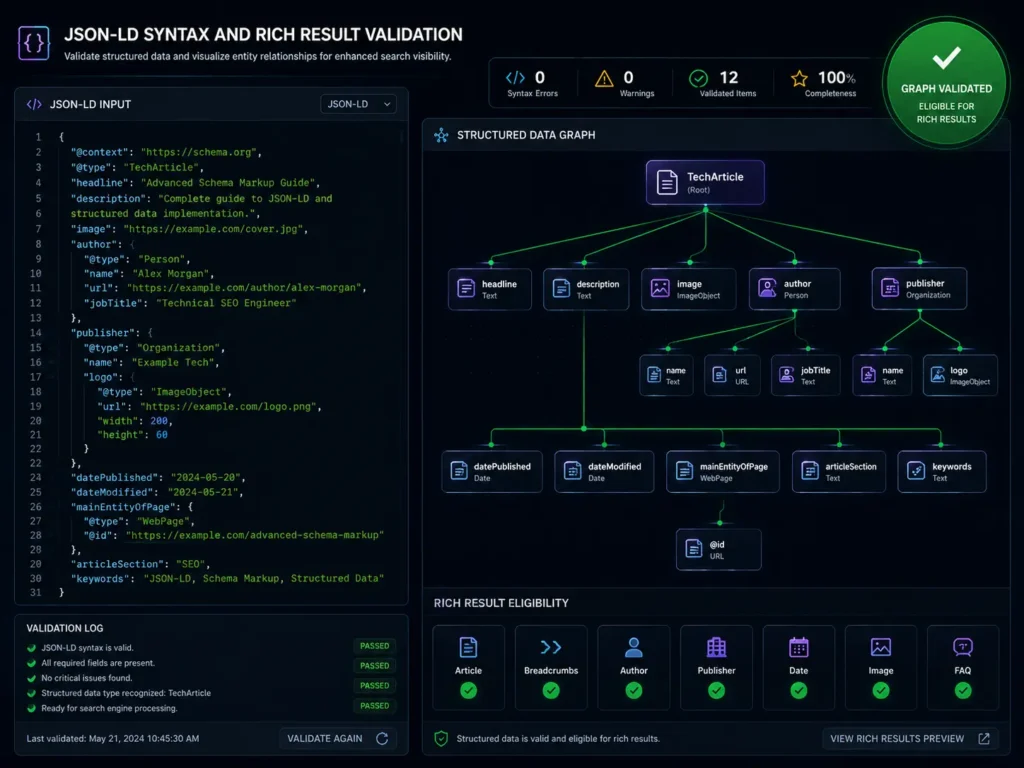
When deploying schema on any modern platform — custom WordPress, headless React, or Shopify — the format you choose has real technical consequences.
Older approaches like Microdata and RDFa work by wrapping HTML tags directly inside your visible page content. This is fragile by design. If a marketer edits a heading or a developer changes a CSS class, the embedded schema can silently break, invalidating your structured data without anyone noticing until rankings drop.
JSON-LD is the format Google explicitly recommends, and for good reason. It is a self-contained block of code placed in the page’s head or body, fully decoupled from the visual HTML. Development teams can generate and inject JSON-LD programmatically through a database or API without ever touching the page’s design or layout.
The real power of advanced schema markup comes from @id node referencing. In a basic setup, a blog post might declare both an Organization and an Article as two separate, disconnected items. With @id referencing, you define your Organization once — typically on the homepage — give it a permanent unique identifier, and then every other page on your site simply points to that same @id rather than repeating the details. This eliminates data fragmentation, reduces code bloat, and builds a genuinely interconnected Knowledge Graph rather than a pile of isolated tags.
The official Schema.org documentation maintains the complete reference vocabulary for every entity type and property available, and it is worth bookmarking as your implementation reference.
A Practical Implementation and Auditing Checklist for Advanced Schema Markup
Before deploying or revamping structured data on your site, work through these steps in order to make sure the implementation actually holds up technically and strategically.
– Entity Mapping: Define the core entities on your site — products, authors, services, locations — before writing a single line of code.
– Format Standardization: Commit to JSON-LD as the universal format across your entire stack, with no mixed Microdata implementations left over from old plugins.
– Knowledge Graph Connections: Use @id node referencing throughout so related schemas point back to the same canonical entities instead of duplicating data.
– E-E-A-T Signal Injection: Populate sameAs properties on both Organization and Person entities, linking to verified social profiles and authoritative external sources.
– Dynamic Data Ingestion: Generate schema programmatically from your CMS or database rather than hardcoding values that will inevitably go stale.
– Syntax Validation: Test every staging implementation with a schema validator before it goes live, since a single misplaced comma can invalidate the entire block.
– Rich Result Confirmation: Run live and staged URLs through Google’s Rich Results Test to confirm eligibility before assuming the work is done.
– Ongoing Health Monitoring: Check the Enhancements tab in Google Search Console regularly, since schema errors often appear weeks after deployment as your content changes.
Common Mistakes That Undermine Advanced Schema Markup
Even experienced technical teams make costly errors when implementing structured data at scale.
– Schema and content mismatch: If your JSON-LD states a product price of fifty dollars but the visible page shows seventy-five, search engines treat this as manipulative and strip your rich result eligibility entirely.
– Broken JSON-LD syntax: JSON is unforgiving. A single missing comma, an extra bracket, or an unescaped quote invalidates the entire script, and search engines simply ignore the broken block.
– Page-specific schema applied site-wide: A common legacy WordPress mistake is injecting FAQPage or Product schema globally across every page rather than isolating it to the specific URL where that content actually lives, which confuses crawlers about what each page truly represents.
– Ignoring the sameAs property: Failing to link your schema to authoritative external profiles leaves valuable E-E-A-T signal on the table for no good reason.
– Stale data in eCommerce: Hardcoded schema is a disaster for high-volume stores. If a product sells out but the schema still says InStock, you frustrate users and risk a Google penalty. Inventory data needs to be injected dynamically, not hand-typed.
– Schema spam: Adding irrelevant schema types purely to try to manipulate visibility — like tagging a SaaS blog post with Recipe schema — results in algorithmic or manual penalties rather than the rich results you were hoping for.
How MarkupMarvel Implements Advanced Schema Markup
Implementing advanced schema markup properly requires more than installing a basic SEO plugin and calling it done. It demands a real understanding of semantic web architecture, JSON-LD scripting, and how to keep structured data accurate as your content and inventory change daily.
At MarkupMarvel, we sit at the intersection of search strategy and technical execution. Whether you are migrating a legacy site, scaling a multi-vendor marketplace, or building a custom headless web architecture, our team designs a Knowledge Graph specific to your business model and programmatically injects advanced JSON-LD into your WordPress, Shopify, or custom MERN stack application.
We do not treat this as a one-time setup. Schema validation, rich result monitoring, and ongoing data accuracy checks are part of how we maintain structured data over time — because a Knowledge Graph that was accurate at launch and goes stale six months later stops helping you the moment it breaks.
For a closer look at how this fits into broader technical infrastructure work, see our guide on zero-downtime website migration, which covers how structured data and SEO equity should be preserved during any platform move.
Frequently Asked Questions About Advanced Schema Markup
Q: What is the difference between basic and advanced schema markup?
A: Basic schema is usually flat and isolated — a generic article tag added by a default plugin with no connections to anything else on the site. Advanced schema markup uses custom JSON-LD to nest entities and explicitly define relationships through @id node referencing, creating a cohesive local Knowledge Graph rather than disconnected tags.
Q: Does schema markup guarantee rich snippets in search results?
A: No. Advanced structured data makes your site eligible for rich snippets, but search engines ultimately decide whether to display them based on user intent, query complexity, and the overall trust signals associated with your website.
Q: Can I just use a standard SEO plugin for advanced schema?
A: Standard plugins handle basic foundational schema reasonably well. For dynamic eCommerce data, complex B2B entity mapping, or headless web architectures, you typically need custom JSON-LD injection configured by someone who understands technical SEO to achieve a fully connected Knowledge Graph.
Q: How do AI search engines actually use structured data?
A: AI engines and large language models use structured data to parse facts, context, and relationships without guessing based on unstructured text. Clean schema improves the accuracy of AI retrieval, which increases your chances of being cited as a trusted source in generative engine optimization.
Q: Is JSON-LD always better than Microdata?
A: Yes. Google explicitly recommends JSON-LD because it is easier to maintain, fully decoupled from your site’s HTML presentation layer, and allows developers to inject dynamic data programmatically without ever breaking the visual design of the page.
Q: How long does it take to see results after implementing advanced schema markup?
A: Once structured data is deployed correctly, search engines need to crawl and re-index the updated pages. Rich snippets typically start appearing within a few days to a couple of weeks, assuming there are no syntax errors blocking validation.
Final Thoughts
If your website’s underlying code is not communicating clearly with search engines and AI systems, you are leaving high-intent revenue on the table every single day. Search has moved past simple keyword matching, and the businesses winning visibility right now are the ones that stopped making search engines guess.
Advanced schema markup is not a minor technical checkbox. It is the foundational data layer that determines whether your business shows up as a credible, structured entity or gets passed over for a competitor whose website speaks the language search engines and AI systems actually understand.
More Blog

High-Availability Cloud Infrastructure: 5 Proven Steps

Nginx Redis Caching Optimization: 6 Proven Speed Tactics

Content Optimization for AI Search: 5 Proven Steps to Rank



